

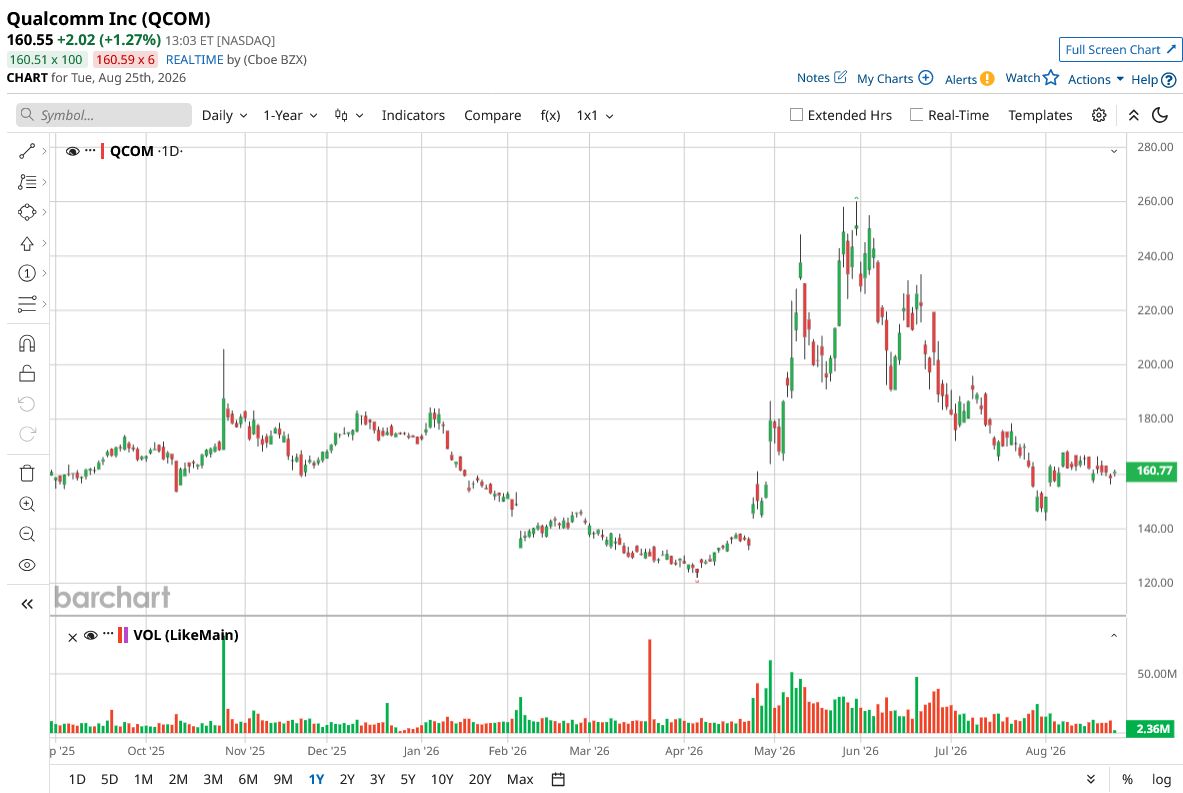
Qualcomm (QCOM) stock has faced considerable selling pressure, falling about 38% from its year-to-date (YTD) high. However, the significant decline has made Qualcomm’s risk-reward more attractive. At the same time, analyst sentiment toward QCOM has improved over the past couple of months.
Notably, the weakness in Qualcomm's CDMA Technologies (QCT) business has weighed on its performance and share price. Qualcomm generated $9.9 billion in the third quarter of fiscal 2026, a 4% year-over-year (YoY) decline, while QCT revenue fell 5% to $8.5 billion. The most significant weakness came from the handset unit, where revenue dropped 20%.
More Top Stocks Daily: Go behind Wall Street’s hottest headlines with Barchart’s Active Investor newsletter.
The broader Android smartphone market remains challenging. Increased investment in AI infrastructure and high-bandwidth memory has redirected some memory supply toward data centers, raising component costs for smartphone manufacturers. Weak consumer demand has added to the pressure, prompting several Android manufacturers, particularly in China, to cut production.
Qualcomm’s profitability also suffered. Although Qualcomm has taken steps to control expenses, these cost pressures, combined with weaker handset demand, have weighed on margins. Adjusted earnings per share consequently fell to $2.21, approximately 20% below the year-ago level.
Another important headwind is Apple (AAPL). Because of supply constraints and the expected transition in Qualcomm’s role within Apple’s product lineup, the company expects Apple-related revenue to decline more rapidly starting in Q4 of fiscal 2026. This creates an additional near-term drag on its financials.
 www.barchart.com
 Qualcomm Set for a Recovery
The significant decline in QCOM stock indicates that the market has already priced in some of the negatives. While that does not eliminate the underlying risks, it does improve the potential upside if industry conditions stabilize and Qualcomm’s diversification efforts begin to offset weakness in handsets.
Near-term results may remain under pressure, but Qualcomm’s longer-term growth outlook is increasingly attractive. The company is steadily reducing its reliance on handsets and expanding into faster-growing markets such as automotive, IoT, and data centers.
The handset business is also showing early signs of stabilization. Management expects QCT handset revenue from Chinese OEMs to have reached a trough in the third fiscal quarter, with fourth-quarter revenue projected to rise by double digits sequentially. The growing adoption of AI in smartphones could further encourage consumers to upgrade to devices with more advanced on-device and agentic AI capabilities, driving greater demand for premium Snapdragon platforms.
However, Qualcomm’s biggest opportunity is beyond smartphones. The company now expects non-handset QCT revenue to exceed $40 billion by fiscal 2029, nearly double its previous $22 billion target. Automotive and IoT are expected to generate more than $24 billion, while data centers could contribute over $15 billion.
Data centers are particularly important to Qualcomm’s long-term strategy. The company plans to enter the market in stages, starting with connectivity products in fiscal 2026, followed by custom silicon and AI accelerators in 2027 and server CPUs in 2028. Its first two custom silicon programs have already entered wafer production and are expected to begin generating revenue from the December quarter. These initial projects could also lead to longer-term customer relationships in the rapidly expanding AI infrastructure market. Management expects data center revenue to reach about $5 billion in fiscal 2027.
Overall, Qualcomm’s changing revenue mix highlights a significant strategic transformation. By fiscal 2027, non-handset businesses are expected to generate more than half of QCT revenue, rising to roughly two-thirds by fiscal 2029. This shift could reduce Qualcomm’s dependence on the cyclical smartphone market while increasing its exposure to higher-growth technology sectors.
Improving Analyst Sentiment Adds to the Bull Case
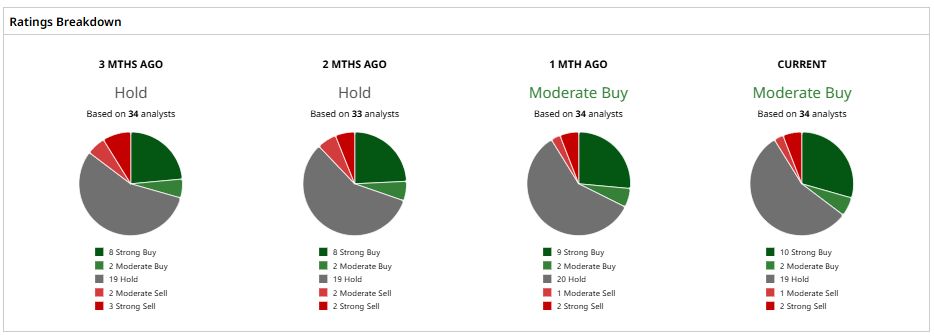
A significant decline in Qualcomm stock and its improving revenue mix have improved analysts’ sentiment.
Two months ago, eight of 34 analysts rated QCOM a “Strong Buy.” That figure has since increased to 10 of 34 analysts.
QCOM stock still faces meaningful near-term risks. However, the steep decline in QCOM's price appears to have priced in some of those concerns. If handset conditions stabilize and Qualcomm successfully executes its diversification strategy, automotive, IoT, and data center growth could provide significant upside over the longer term.
 www.barchart.com
 On the date of publication, Amit Singh did not have (either directly or indirectly) positions in any of the securities mentioned in this article. All information and data in this article is solely for informational purposes. For more information please view the Barchart Disclosure Policy here.
More news from Barchart
Qualcomm Stock: A 38% Drop and Improving Analyst Sentiment Signal a Buying Opportunity Bearish Outlook? Try These 2 Bear Call Spread Trades on Wednesday S&P Futures Muted With Focus on U.S. PCE Inflation Data and Nvidia Earnings Dividend Aristocrat or Dividend Cuts: How to Evaluate the NKE Stock Payout as the Nike Turnaround Drags On