


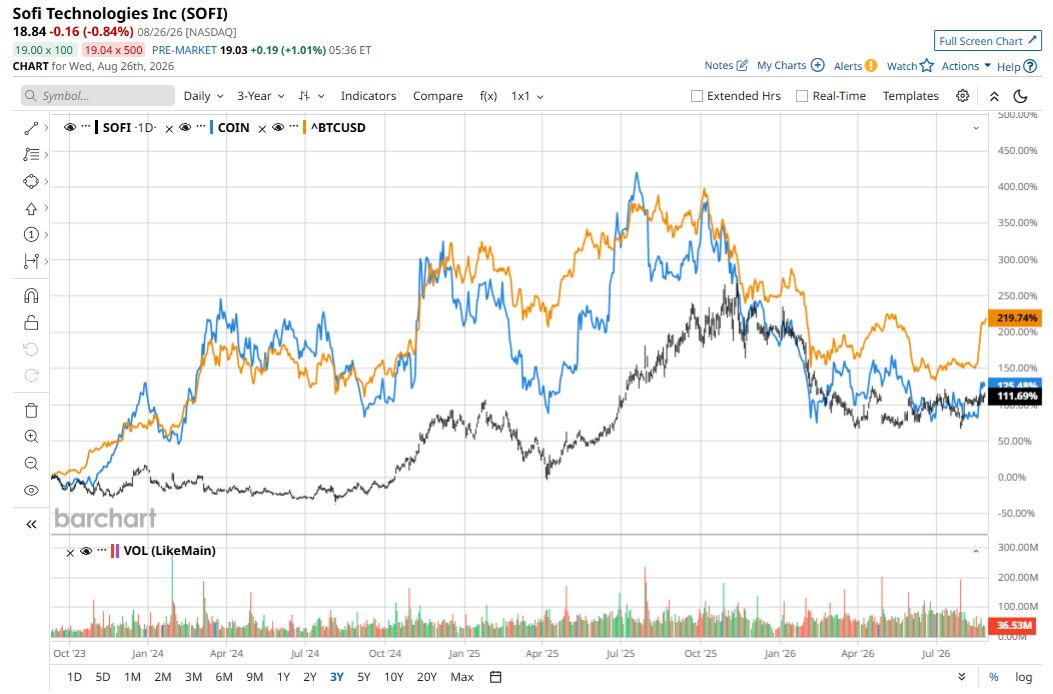
2026 hasn’t been pleasant for SoFi (SOFI) investors, and the stock is down around 27% for the year. After peaking above $30 last year, it hasn't crossed $20 for the past several months. While there have been intermittent rallies and SOFI stock is up almost 14% in a month, it has somehow developed cold feet whenever it gets closer to $20, including amid the recent upswing.
The recent uptrend in SOFI seems driven by the optimism over cryptocurrencies. Notably, SoFi relaunched its crypto trading business late last year, and the timing couldn’t have been worse as digital assets crashed subsequently, pulling down stocks across the cryptocurrency ecosystem. However, digital assets have seen a rebound after U.S. President Donald Trump recently pushed Congress to pass the Digital Asset Market Clarity (CLARITY) Act.
Join 200K+ Subscribers: Find out why the midday Barchart Brief newsletter is a must-read for thousands daily.
Speaking at the White House event, which was attended by the top executives of Coinbase (COIN), Kraken, and Robinhood (HOOD), among others, Trump said, “Now we need Congress to take the next step by passing the Clarity Act — fair version of the Clarity Act.”
While SoFi is not a play on cryptocurrencies in a strict sense, as say COIN or HOOD, it has tended to move in tandem with Bitcoin (BTCUSD) for the last few months.
 www.barchart.com
 SOFI Stock Forecast
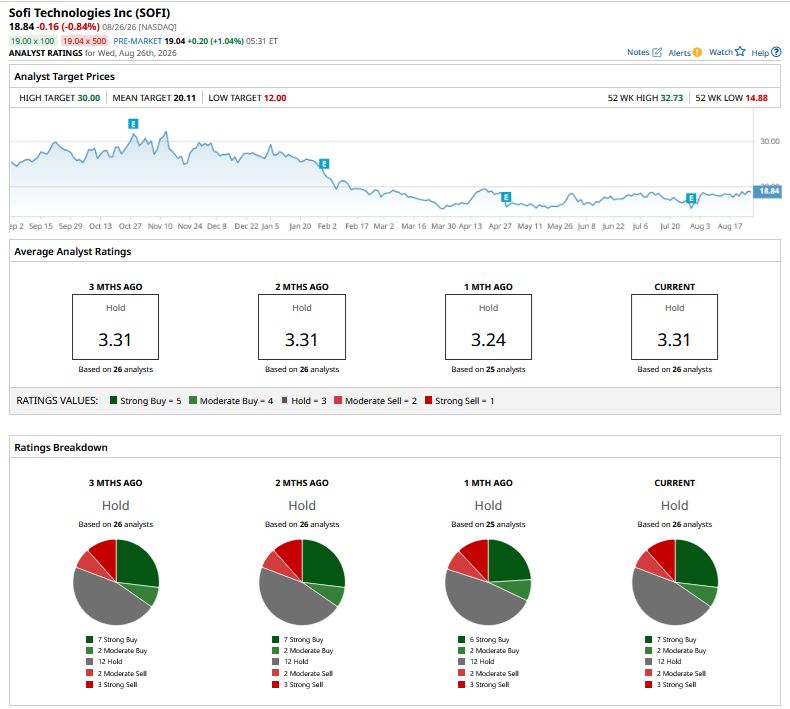
Earlier this month, SoFi scored a new “Buy” rating after Piper Sandler analyst Patrick Moley initiated the stock with an “Overweight” rating and a $22 target price. Overall, SoFi has a consensus rating of “Hold” from the 26 analysts polled by Barchart, and its mean target price of $20.11 is just about 6% higher than current prices. Its Street-high target price (via Citi) is $30.
Several brokerages have lowered SOFI's target price this year, particularly after earnings releases. The stock has tumbled after all three confessionals this year despite beating on earnings. That said, analyst target prices haven’t generally been a good indicator for SoFi, and it outperformed the markets in each of the last three years even as Wall Street firms mostly looked the other way.
 www.barchart.com
 SoFi has been out of favor with markets due to an adverse macro environment. There are fears that the Fed would need to increase rates to tame inflation, and higher interest rates are theoretically negative for SOFI stock. Moreover, the company has talked about increasing investments to support its growth, which is seen as a sign of an impending slowdown after years of breathtaking growth.
What Makes SOFI an Attractive Buy?
I, however, continue to find SOFI stock attractive given its impressive growth flywheel. The company has added over a million members in each of the last three quarters, which builds a funnel for cross-selling. Incidentally, its cross-sell rate improved in the June quarter, with the number of products rising twice as much as the new members, for the first time. Moreover, over half of the new products were opened by existing members, which is quite encouraging.
SoFi also keeps expanding its product portfolio, which means that its members have an increasing number of products to choose from. It has also ventured into the subscription space and had over 200,000 Plus subscribers in Q2 2026. Management is hopeful about that number hitting 1 million in a year, which would mean an annualized recurring revenue run rate of $120 million.
SoFi also has a bank charter, which gives it access to cheap deposits, unlike many other fintech companies that rely on high-cost wholesale borrowing. While SoFi is a lender and its Lending segment originated loans worth $11.7 billion in Q2, it also has a Loan Platform segment that originates loans for third parties, earning a fee in the process. These are customers who don’t meet SoFi’s credit standards, but by originating loans for other lenders, SoFi gets low-risk, high-margin revenues. SoFi also has a tech platform business, and while it lost a major client in Chime, the company has been expanding its capabilities through acquisitions.
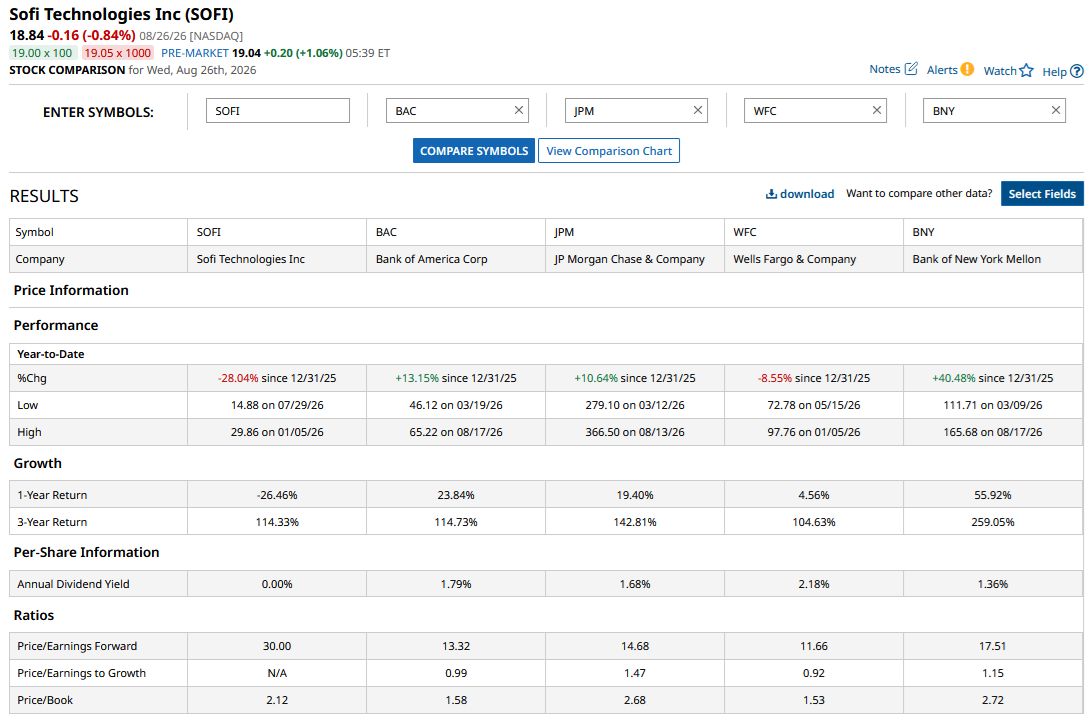
As I have long argued, SoFi is a mix of a traditional bank and a fast-growing fintech, and its valuations should also reflect the nature of its business. Some analysts have been fixated on the price-to-book value multiple, which makes sense for the lending business but is not a gauge for SoFi’s other businesses. The price-to-book multiple has anyway corrected to just about 2.1x, which is not very demanding.
 www.barchart.com
 SoFi’s price-to-earnings (P/E) multiple is 30x, which is again not exuberant for a company whose earnings are expected to grow 56% this year and 33% in the next year. Given SoFi’s growth flywheel, its earnings should continue to grow much faster than traditional banks over the near foreseeable future. As for SOFI stock rising above $20, I would borrow a quote that CEO Anthony Noto used while pointing out the disconnect between the stock price and earnings during the Q2 call: it is “just a matter of when, not if.”
On the date of publication, Mohit Oberoi had a position in: SOFI . All information and data in this article is solely for informational purposes. For more information please view the Barchart Disclosure Policy here.
More news from Barchart
George Soros Is Betting Big on Utility Stocks as AI Power Demand Surges Why Legendary Investor Michael Burry Says Nvidia Stock Is ‘Wildly Undervalued’… and Why He’s Still Cautious on Shares Okta Stock Just Hit a New 3-Year High on Earnings Rally. How You Should Play the Surge. Palo Alto Networks’ Platform Strategy Supports a Bullish Q4 Outlook