


The artificial intelligence (AI) infrastructure boom is entering a more complicated phase. Demand for computing power remains enormous, but the electricity, water, land, and permitting required to build the data centers behind it are becoming political flash points. New York has already imposed a one-year moratorium on large new data centers, while Pennsylvania has moved to impose additional restrictions.
For companies supplying power to AI campuses, that creates an uncomfortable disconnect: The need for electricity is rising, but getting projects approved is getting harder. That tension now hangs over Bloom Energy (BE).
Don’t Miss a Day: From crude oil to coffee, sign up free for Barchart’s best-in-class commodity analysis.
 www.barchart.com
 Bloom's Growth Story Is Facing a Reality Check
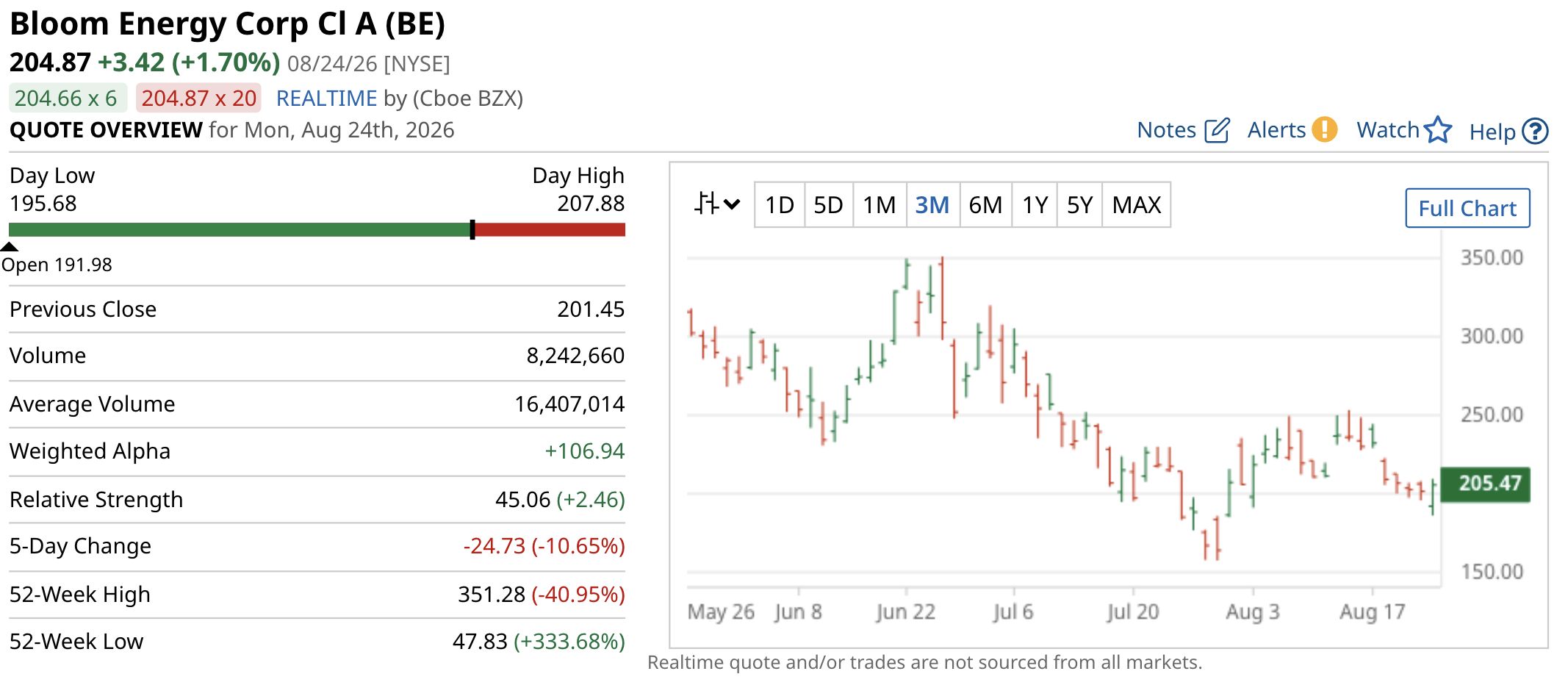
Bloom Energy is still up more than 150% in 2026, but BE stock sits roughly 38% below its June all-time high. That is a remarkable gain hiding a painful correction.
The concern is not that Bloom lacks demand. Its second-quarter results were exceptional. Revenue jumped 166% year-over-year (YOY) to $1.065 billion, while non-GAAP EPS increased to $0.78 from $0.10 a year ago. Management also raised its full-year revenue guidance to a range of $3.9 billion to $4.2 billion.
The problem is execution. Short seller Hunterbrook recently questioned Bloom's long-term growth assumptions, customer concentration, supply chain, and the quality of its reported backlog. Its July short report noted that 74% of Bloom's Q4 2025 revenue came from joint ventures that the company partially owns with financing partner Brookfield (BAM). Bloom disputes the short seller's allegations, but the questions remain because BE stock's valuation assumes years of rapid expansion.
Bloom's own U.S. Securities and Exchange (SEC) filing provides another reason for caution: One customer represented 73% of Q2 revenue.
Project Jupiter Shows the Bigger Problem
Another issue is Oracle's (ORCL) Stargate campus in New Mexico, known as Project Jupiter. The project was supposed to deploy up to 2.45 gigawatts of Bloom's solid oxide fuel cells. But New Mexico regulators rejected the natural gas pipeline needed to supply the project for a second time. Officials cited concerns including water use, emissions, and state revenue.
That matters beyond one project. Communities are increasingly challenging data centers over electricity demand, water consumption, land use, noise, and environmental impacts. New York's moratorium shows how local opposition can become statewide policy. If other states follow, Bloom could face delays even as its addressable market expands.
Pelosi Just Placed a $12 Million Bet
That makes Nancy Pelosi's latest trade particularly interesting. A House filing shows Pelosi's household purchased 15,000 Bloom shares and 200 call options expiring in June 2027. Because congressional disclosures use ranges rather than exact amounts, the four Bloom transactions carry a combined value of roughly $3 million to $12 million.
The timing is also notable. The purchases occurred on July 24 and July 28, the latter being the day that Bloom reported its record quarter and raised guidance.
Pelosi has earned a reputation as one of Congress' most successful investors. Some tracking models estimate her portfolio returned 65% in 2023, 45.6% in 2024, and 54.1% in 2025, although those figures are estimates rather than audited investment returns. Comparisons with Warren Buffett have even shown Pelosi's estimated long-term returns far ahead, though leverage, options, disclosure ranges, and methodology make those comparisons imperfect.
Still, the reputation is real. So is the controversy. Critics have long questioned whether lawmakers can trade stocks while having access to sensitive information through their oversight responsibilities. The STOCK Act prohibits trading on material nonpublic information, but concerns about conflicts remain. Pelosi's Nvidia (NVDA) trades around the 2022 CHIPS Act vote became a prominent example of why.
Congress has now moved to address the broader issue. The House passed the Stop Insider Trading Act, H.R. 7008, by 232 to 198 on July 22. The bill would prohibit members, spouses, and dependent children from purchasing publicly traded securities and require advance disclosure before selling existing holdings. It is now before the Senate.
Pelosi is leaving Congress at the end of her term in January 2027. That makes this one of her final major investments while serving in the House.
Key Takeaway
In short, Pelosi's Bloom purchase is a vote of confidence — but it is not a substitute for execution.
Bloom has the financial momentum, AI demand, and technology to justify optimism. However, a 73% quarterly revenue concentration, regulatory setbacks at Project Jupiter, and growing opposition to data centers create risks that a 150% year-to-date (YTD) gain can obscure.
Smart investors should watch whether Bloom converts its enormous opportunity into diversified, completed projects. Pelosi may be betting that it will. But investors should bet on Bloom's numbers, not Pelosi's reputation.
On the date of publication, Rich Duprey did not have (either directly or indirectly) positions in any of the securities mentioned in this article. All information and data in this article is solely for informational purposes. For more information please view the Barchart Disclosure Policy here.
More news from Barchart
Nancy Pelosi Just Bet $12 Million on Bloom Energy. Here’s What’s Behind Her Vote of Confidence. When Will Crude Oil Prices Stabilize? George Soros Is Betting Big on Utility Stocks as AI Power Demand Surges Ag Market Surge: What's Driving the Buying in Corn, Wheat, and Soybeans to Multi-Year Highs?