


Although Coherent’s (COHR) core business is extremely relevant to artificial intelligence, particularly toward the explosive growth of data centers, the recent performance of COHR stock leaves a lot to be desired. In fact, the equity has dubiously earned a 56% Sell rating from the Barchart Technical Opinion indicator, implying the probability of continued weakness. Still, for contrarians, the red ink could represent a potential opportunity.
Consider for example the 280/290 bull call spread expiring Oct. 16. On the surface, it would seem a reasonable trade with a palatable risk-reward balance. For a net debit (cash outlay) of $490, the speculator can pick up a maximum profit of $510 should COHR stock trigger the $290 second-leg strike price.
Can’t Get Enough Options?: Join the list for Barchart’s daily unusual options report, delivered free.
Granted, it’s an aggressive target, with the full-profitability threshold standing at 6.94% above the current spot. However, the breakeven price sits at a more manageable $284.90, which comes in at a little over 5% above the current price. Still, even with this cushion, Wall Street assigns a rather modest probability of breakeven of only 40.5%.
Making matters more challenging, a reverse-engineering of Barchart’s Expected Move calculator indicates that the odds of Coherent stock triggering the $290 strike at expiration sit at only 33.97%. Obviously, with these stats, an expected value calculation would project a quick sinking of your portfolio as your total losses would outpace your total wins.
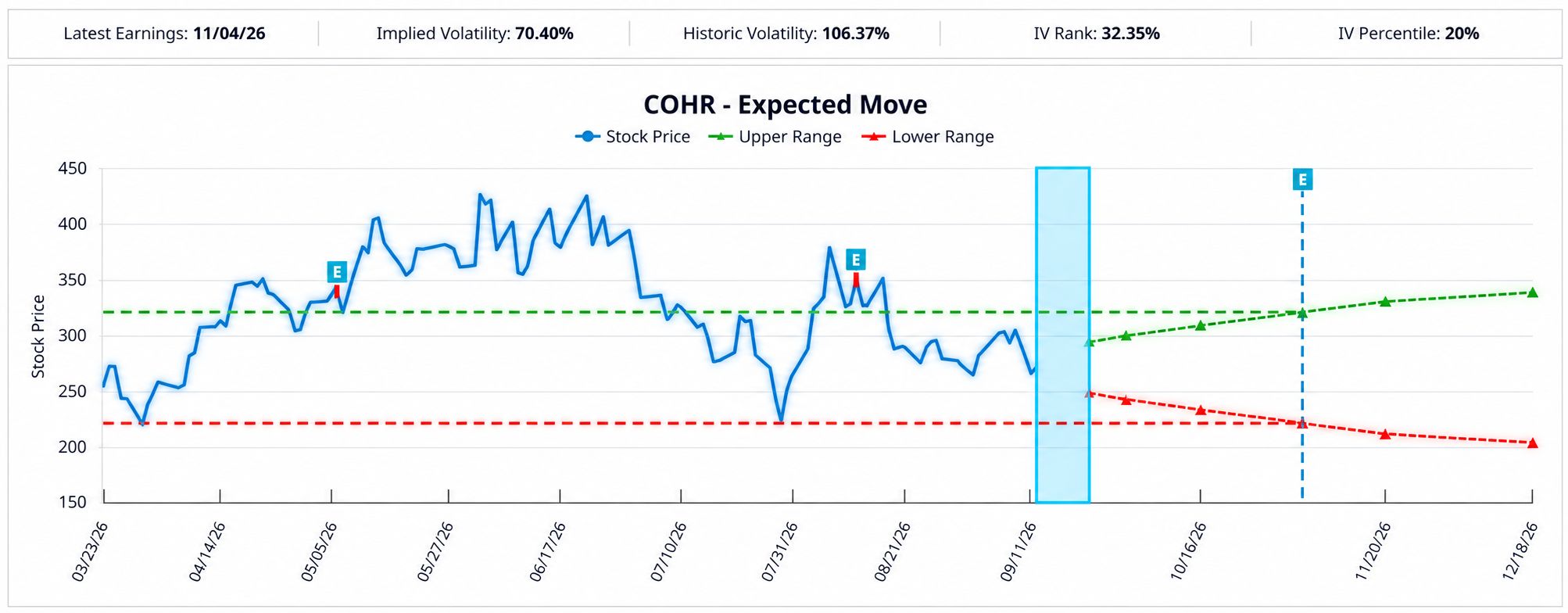
Naturally, then, many (if not most) speculators would likely shy away from the above COHR stock call spread. But the less-than-ideal probabilities presuppose that the framework that calculated the ratios is the best representative of the reality that is to come.
It’s this presupposition that deserves a closer investigation so that you can make a more informed decision.
A Path-Independent Model Might Not Fully Explain COHR Stock
To arrive at a breakeven probability of 40.5% and full-profit probability of 33.97%, one has to infer a particular architecture of the future price discovery process. Here, the Wall Street machinery has a massive problem. With so many optionable securities, you can’t have a bespoke model for each candidate security.
Subsequently, the mathematically elegant compromise is to use a risk-neutral, random-walk framework as a standardized mechanism. This one-size-fits-all solution may not be the perfect representation for every optionable security but it provides a clinical frame of reference.
But when we’re dealing with presuppositional models in a non-determinative, reflexive system, it’s impossible for any one model to adequately explain everything. One of the holes of a random-walk-based mechanism is that the future is mathematically independent of the past. In other words, the aforementioned probabilities stem from path-independent calculations.
It doesn’t matter, then, how Coherent stock arrived at the current price, whether it did so from a bearish cycle or a bullish one. For some tickers, I might be able to accept that premise. It’s difficult for me to do with a tech name like Coherent.
Instead, I believe in the Markov chain principle of state transitions. If the current state, for example, is bearish, that should have a probabilistic influence on the future state. Put simply, the future is dependent on the past — and frankly, why wouldn’t it be?
Technical analysts believe that past patterns embed potential data of a future outcome. Fundamental analysts believe that past financial trends can be extrapolated to create a forecast of the future. Quantitative analysts believe that empirical data conditioned to a particular signal can inductively indicate a future pathway.
What’s the common thread? These practitioners believe that the future is dependent on the past. And so, by this logic, I believe that the future direction of COHR stock will be guided by nonrandom influences.
Quantifying Nonrandom Behavior for Coherent Stock
It’s not just a matter, though, of establishing that COHR stock will likely undergo a nonrandom walk; we need to have an idea of where (and when) the ticker may end up. For that, we can identify an empirical signal, quantify how many times this behavioral state has materialized over a given period and create a composite picture of the likely trajectory.
First, the signal. In the last 10 weeks, Coherent stock has printed four up weeks, leading to an overall downward slope across the period. We can discretize this behavioral state as the 4-6-D (4 up, 6 down, downward slope) sequence. This discretization allows us to run an algorithm on COHR’s historical data and tabulate how many times this state has materialized.
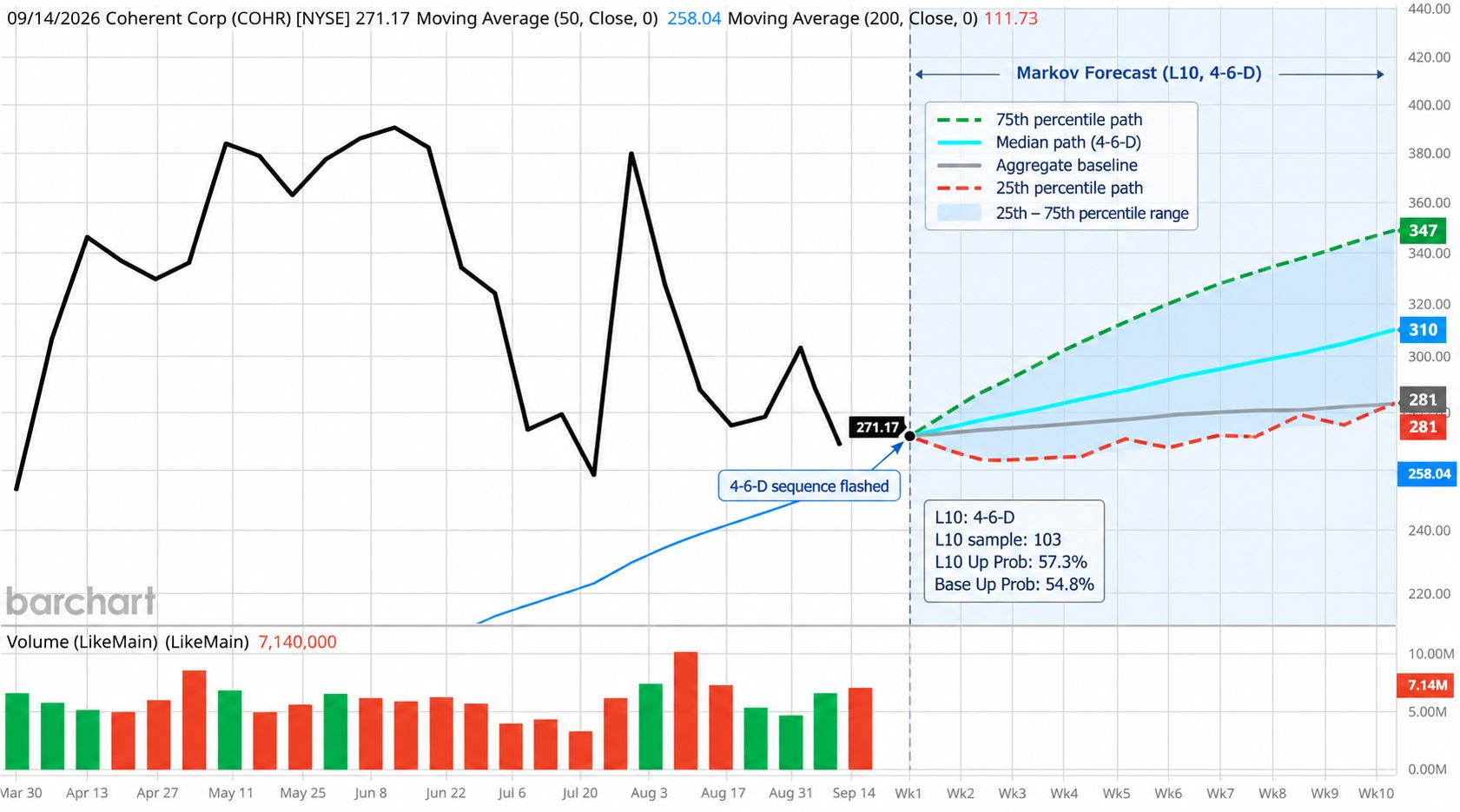
Finally, we run the probability. We know that out of the 103 times that the sequence has flashed on a rolling basis since January 2009, COHR stock has risen (as a median expectation) about 8.4% over the following five weeks (roughly coinciding with the Oct. 16 expiration date). If this trend were to play out as forecasted, we may see a nominal price of $294 — enough to trigger the $290 strike.
Based on this presuppositional nonrandom framework, I’m calculating a full-profitability probability of 58.3% (60 hits out of 103 occurrences) and a breakeven probability of 62.1% (64 hits). While I wouldn’t classify these success ratios as astonishingly good, they may be enough to change the perception of passersby.
Not an Absolute Claim but a Reframing
To be sure, the point of this article is not to say that the Markov-based model above is the absolute best representation of reality. That’s too much of an exaggerated claim and I lack the necessary evidence to present that argument. My point is narrower and more defensible: you don’t always have to accept a given presupposition.
By considering alternative angles, you may be able to find opportunities and perhaps favorably mispriced trades. With the shift in presupposition from a random framework to a nonrandom one, we may decipher that the Street is overpricing the risk for the 280/290 bull spread. As such, this trade may be undervalued.
It’s important to reiterate that the undervalued argument doesn’t mean that the bull spread is truly, objectively undervalued in the abstract. Instead, I’m making a relative claim. If you believe in a nonrandom price discovery, there’s a strong possibility that the random-walk premise has overweighted the risk.
If you find this argument to be convincing, then COHR stock deserves a closer look.
On the date of publication, Josh Enomoto did not have (either directly or indirectly) positions in any of the securities mentioned in this article. All information and data in this article is solely for informational purposes. For more information please view the Barchart Disclosure Policy here.