

With a market cap of around $863 billion, many investors believe Advanced Micro Devices (AMD) is on track to regain its $1-trillion status after losing it in early October 2026. Wall Street analysts are quite optimistic about the stock, and the high target price of $1,250 is more than double today’s closing price.
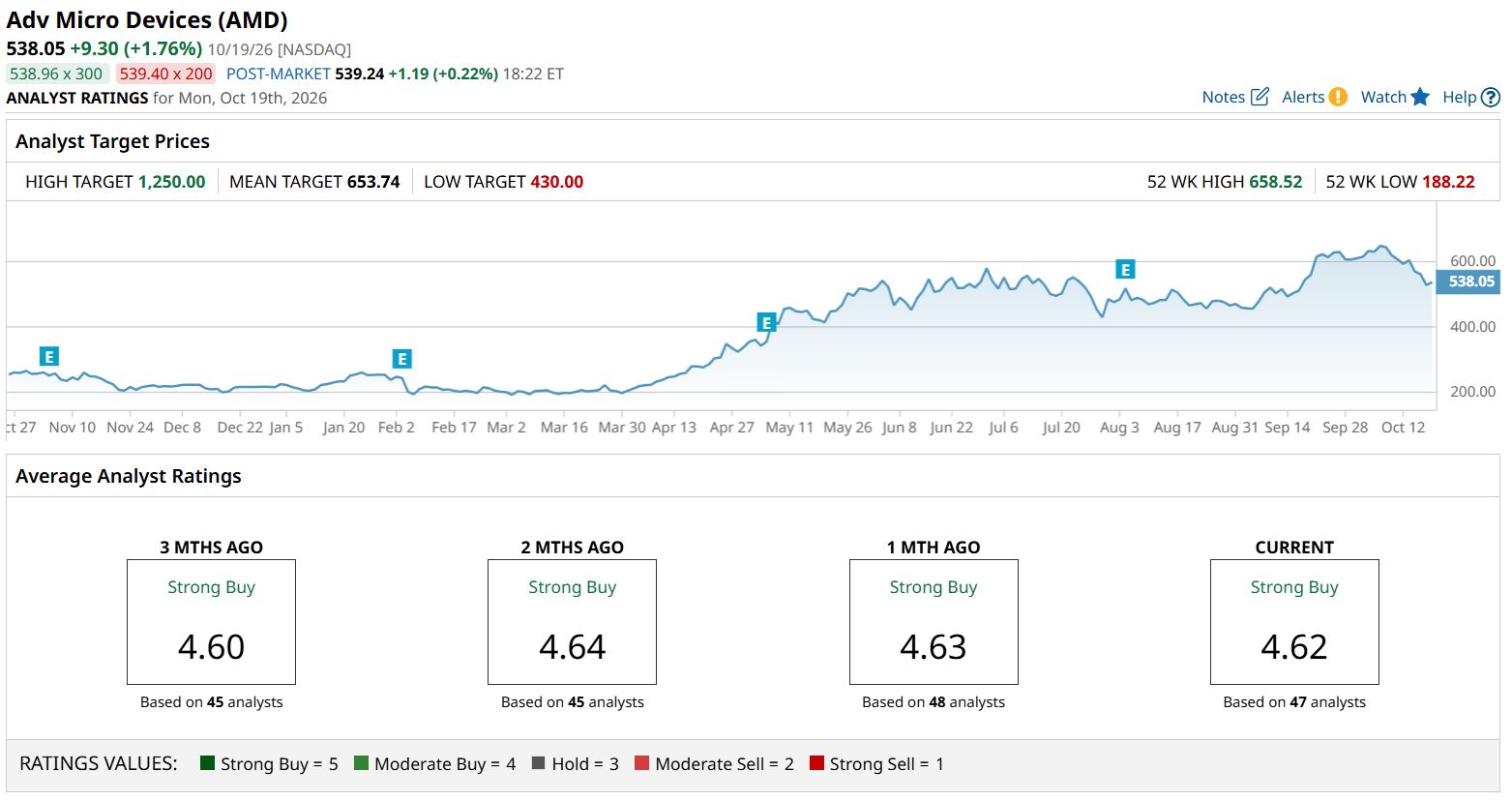 Screenshot courtesy of www.barchart.com
But how can investors play this beyond a typical buy-and-hold strategy?
Can’t Get Enough Options?: Join the list for Barchart’s daily unusual options report, delivered free.
Two option strategies let them capitalize on future upside potential. The only difference is whether you’re willing to pay up front or prefer to earn at the start of the trade. Let’s take a look at both.
How a Deep ITM LEAPS Call Works on AMD
Call options are time-bound contracts that give the buyer the right, but not the obligation, to buy an underlying asset at a set strike price on or before the expiration date. The goal is to benefit from a bullish move in the underlying stock, preferably before the contract expires.
In-the-money (ITM) means an option has real, or intrinsic, value. For call options, this happens when the stock trades above the strike price. If you’re holding a 100-strike call on a stock trading at $150, your option is in the money with $50 of intrinsic value. But options also have time or extrinsic value, so that call will likely sell for more than $50.
Now, LEAPS, or Long-Term Equity Anticipation Securities, are standard option contracts that expire in one year or more.
Put together, a deep ITM LEAPS call is a long-term call option with a strike price well below the underlying stock's current market price. It’s like renting the stock for a fixed period, say, one to two years, allowing you to participate in much of the upside without paying for the full 100 shares outright. These calls also have less theta (time decay) than call options that expire in weeks or months, which measures how much value an option loses each day simply because time passes.
Deep ITM LEAPS calls typically have a delta of around 0.80 to 0.95. Delta, like theta, is an options Greek. It measures how much an option’s price is expected to change for every $1 move in the underlying stock. The higher the delta, the more closely the option’s price tracks the stock.
However, deep ITM LEAPS calls cost more than typical OTM or ITM options, so it’s not for everyone.
AMD LEAPS Example: The 320-Strike Call
If you believe in AMD's future and you have the buying power to buy a 90-delta LEAPS call, here’s a sample trade from Barchart’s AMD Long Call Screener.
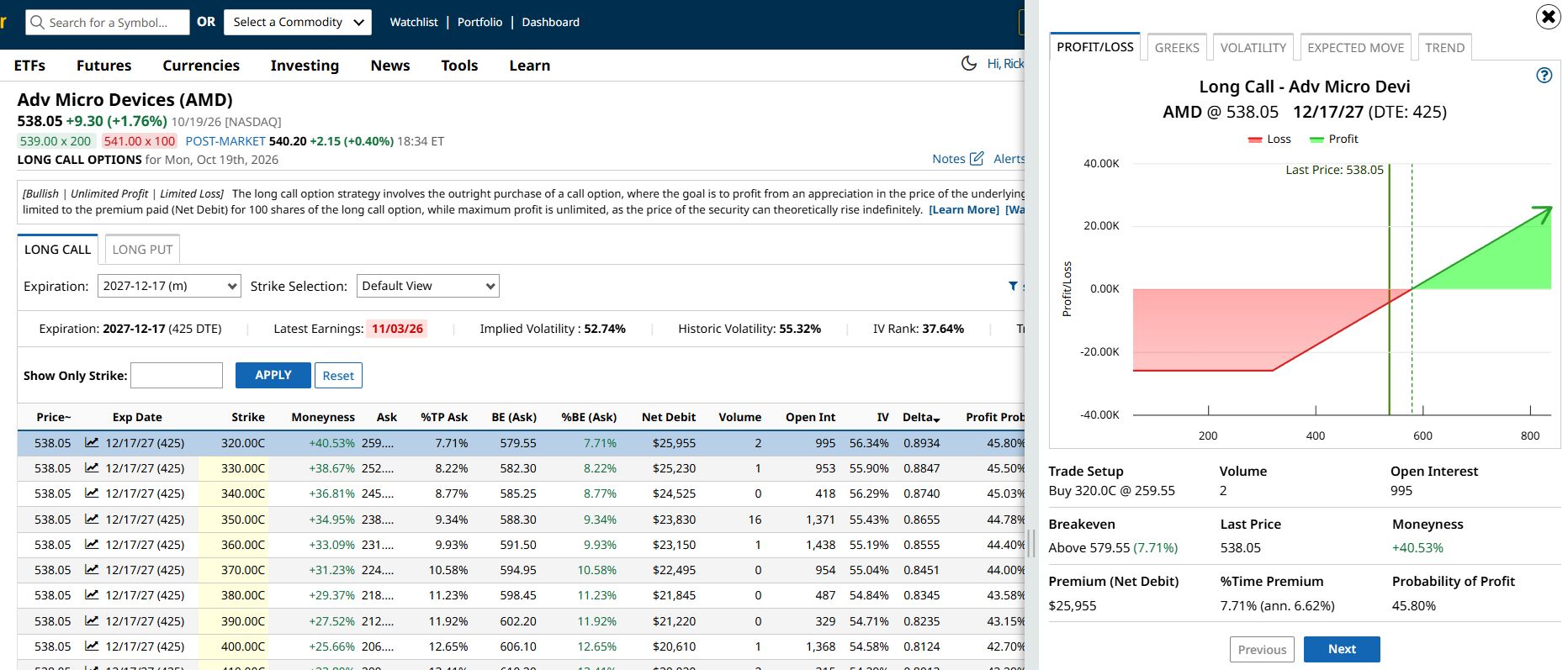 Screenshot courtesy of www.barchart.com
According to the screener, you can buy a 320-strike AMD call that expires on December 17, 2027, 425 days from the time of writing. The option costs $259.55 per share, or $25,955 for the contract, since each call option represents 100 shares. This is the maximum you can lose on the trade, and it happens if the stock trades at or below your strike price at expiration.
The option is 40% in the money, and the breakeven price is $579.55. That means every dollar that the stock is above $579.55 is pure profit. A smart way to trade this is to capitalize on the time value. As mentioned earlier, options prices depend on several factors, but one of the biggest is how much time the contract has left. In practice, most traders never hold a LEAPS to expiration; instead, they sell them during favorable uptrends.
What Is a Bull Put Spread?
Understandably, not many of us have $26k to throw at a single options trade, let alone almost $54k to buy 100 shares of AMD. The great thing about options trading is that you can capitalize on any specific outlook in multiple ways.
Case in point: the bull put spread.
A bull put, or put credit spread, is an options strategy traders use to earn premium when the stock stays above a certain level. As such, the strategy is usually used during moderately bullish or neutral markets. It involves selling a put option and simultaneously buying another put option with a lower strike price on the same underlying asset, with the same expiration date. The strategy starts with a net credit.
As long as the stock trades above the short put's strike price at expiration, the contract expires worthless, and the seller has no further obligation. If the stock trades between the strike prices, the trade ends at a partial loss or profit, depending on how close it is to the breakeven price.
But, if the stock trades below the long strike at expiration, the trade ends at its maximum loss.
AMD Bull Put Example: Collect $680 a Contract With the 480-440 Spread
Barchart’s Bull Put Screener takes much of the guesswork out of its results. Every bull put screener lets you sort results from lowest to highest probability of loss, so I used the lowest as an example for AMD bull put spreads that expire between 30-45 days:
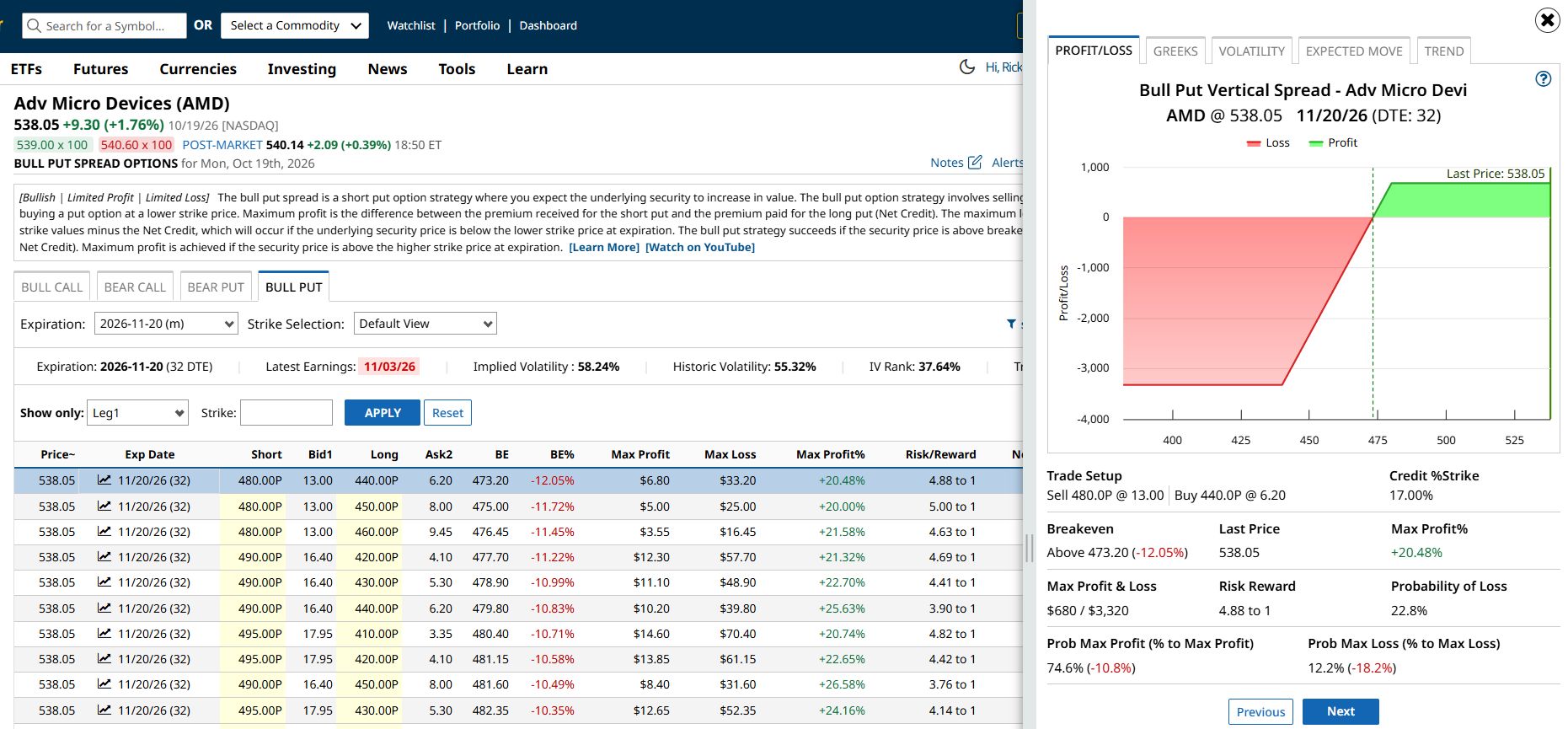 Screenshot courtesy of www.barchart.com
According to the screener, you can sell a 480-440 bull put and get $6.80 per share, or $680 total for the spread. This contract expires on November 11, 2026, 32 days from the time of publication. The trade has a reasonably low 23% max-loss probability and a decent 5-to-1 risk/reward ratio. If AMD trades below $440 at expiration, the trade will end with a maximum loss of $3,320.
But if AMD trades at or above $480 at expiration, you keep the entire $680 and call it a day. And the chances of that happening? 75%.
LEAPS Call vs. Bull Put Spread: Which AMD Trade Fits You?
AMD’s potential return to a $1-trillion market cap offers two ways to play the upside beyond buying shares: a deep in-the-money LEAPS call for stock-like exposure with $25,955 at risk, or a bull put spread that collects $680 upfront against a maximum loss of $3,320.
The LEAPS call suits those with the capital and a long-term bullish view, while the put spread is a cheaper, higher-probability trade that profits if AMD simply stays above $480.
On the date of publication, Rick Orford did not have (either directly or indirectly) positions in any of the securities mentioned in this article. All information and data in this article is solely for informational purposes. For more information please view the Barchart Disclosure Policy here.
More news from Barchart
AMD Lost Its $1 Trillion Status: Two Options Trades to Play the Comeback AutoZone Stock is Up and Price Targets are Still High - What's the Best AZO Play? Newmont Mining Earnings Play: Profiting from Volatility with a Naked Put Macy's Shows Huge, Unusual Put Option Volume - Is M Stock Set to Drop or Is It Cheap Here?