

Valued at a market capitalization of $1.6 trillion, Tesla, Inc. (TSLA) is an electric vehicle and clean energy company that designs and manufactures electric cars, battery energy storage systems, and solar energy products. The Texas-based company is also expanding into autonomous driving, robotaxis, and artificial intelligence.
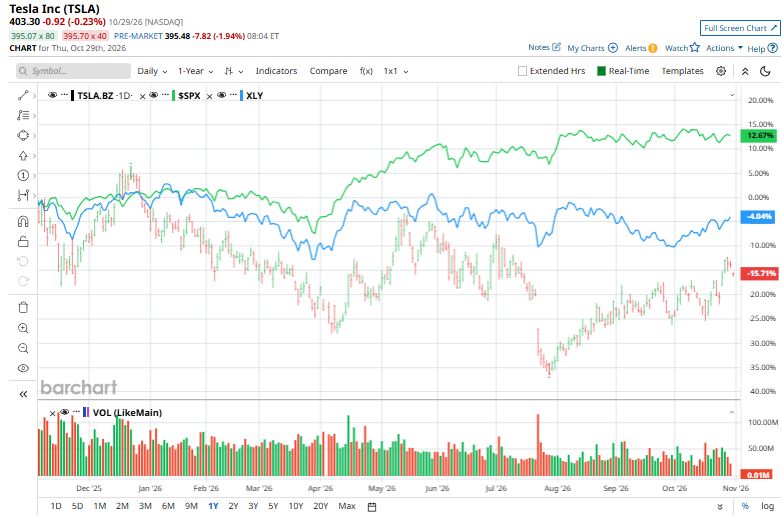
Tesla has struggled to win over investors amid intensifying competition in the EV market, with shares tumbling 12.6% over the past 52 weeks, sharply underperforming the S&P 500 Index ($SPX), which has gained 12% over the same time frame. Over the past six months, however, both the stock and the index have rallied 8.2%.
More Top Stocks Daily: Go behind Wall Street’s hottest headlines with Barchart’s Active Investor newsletter.
The sector-specific State Street Consumer Discretionary Select Sector SPDR ETF (XLY) is down 2.8% over the past 52 weeks, outperforming Tesla, but has dipped marginally over the past six months, trailing the stock.
 www.barchart.com
Tesla shares popped 3.4% on Oct. 21, after the company delivered a mixed third-quarter 2026 performance, beating analysts’ earnings expectations and improving automotive margins, but continued to face pressure from rising operating expenses, declining energy revenue, and substantial investments in autonomous driving and AI.
It reported adjusted earnings of $0.48 per share, exceeding analysts’ consensus estimate of $0.45. Revenue, however, remained essentially unchanged at $28.05 billion. Gross profit increased 8.7% to $5.49 billion, lifting the gross margin to 19.6% from 18% a year earlier. Yet operating expenses surged 39.2% to $4.78 billion, dragging operating income down 55.8% to $718 million.
On the vehicle front, Tesla produced 464,391 vehicles and delivered 486,532 during the quarter, but automotive revenue slipped 3% to $20.56 billion. Services and other revenue provided a bright spot, climbing 32.5% to $4.61 billion. Tesla’s autonomous-driving ambitions remained firmly in focus, as investors assessed whether growing demand for Full Self-Driving software and progress in robotaxis could unlock new revenue streams and offset rising investment costs.
For FY2026 ending in December, Wall Street analysts expect Tesla’s EPS to decrease by 38.5 YOY to $0.67 on a diluted basis. However, EPS is expected to rebound and improve 61.2% year over year to $1.68 in fiscal 2027.
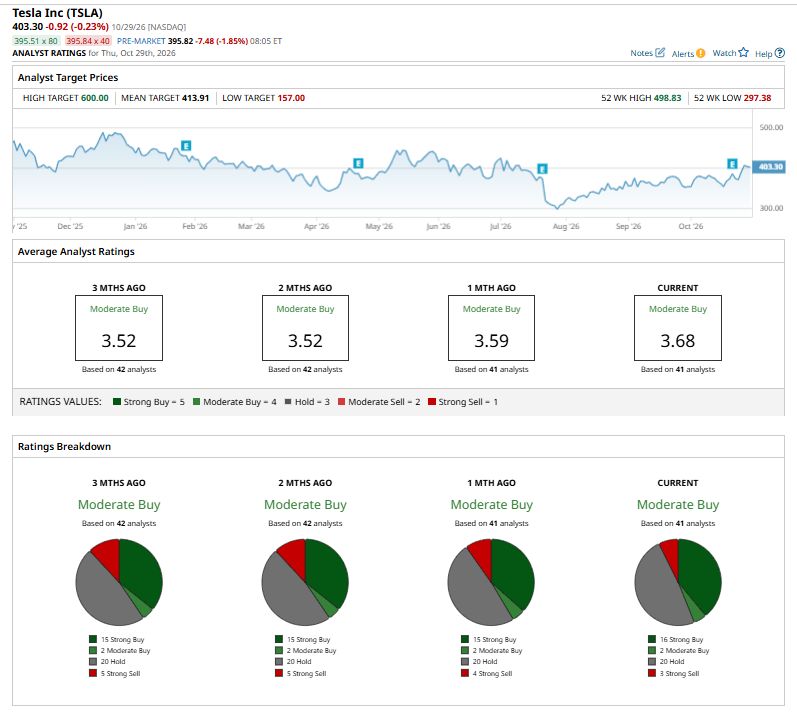
Among the 41 Wall Street analysts covering TSLA’s stock, the consensus is a “Moderate Buy.” That’s based on 16 “Strong Buy” ratings, two “Moderate Buys,” 20 “Holds,” and three “Strong Sells.”
 www.barchart.com
The ratings configuration is more bullish than it was a month ago, with 15 “Strong Buy” suggestions.
On Oct. 24, Bank of America maintained its “Buy” rating on Tesla and reaffirmed its $460 price target, signaling confidence in the EV maker’s long-term growth prospects. However, the bank lowered its 2027 earnings estimate by 8.4%, citing elevated research and development spending ahead of upcoming product launches.
Tesla’s mean price target of $413.91 indicates a 2.6% downside from current market prices. However, the Street-high price target of $600 implies a potential upside of 48.8%.
On the date of publication, Kritika Sarmah did not directly have a position in any of the securities mentioned in this article. All information and data in this article is solely for informational purposes. For more information please view the Barchart Disclosure Policy here.
More news from Barchart
What to Expect From Apple’s Q4 Dear CoreWeave Stock Fans, Mark Your Calendars for November 10 This LNG Stock is Breaking Out. Here’s What I’m Watching on the Chart. Chipotle Delivers Strong Q3 Results, Although FCF Dipped - Is CMG Cheap Here?