


Let's stop for a moment and think. When was the last time you went about your day and didn't hear the words “artificial intelligence”?
Developers are pushing the boundaries of science with each new model they release. Companies are racing to adopt it. Even everyday users see it used consistently, from answering the most mundane questions to helping them with their livelihoods.
More Top Stocks Daily: Go behind Wall Street’s hottest headlines with Barchart’s Active Investor newsletter.
But for all that glitz and glam, artificial intelligence is just that: artificial.
These AI models operate through pattern recognition. To teach it those patterns, developers need to feed it metric tons of data. That means whatever answer AI gives you is built from patterns it picked up in its training data, remixed and reorganized to fit your question. Image classifiers and recommendation engines work in much the same way. And to be fair, they’re extraordinarily good at it.
Researchers worldwide argue about whether these systems can actually understand the same way humans do. Genuine human understanding lets us take what we’ve learned, recognize the principles underneath, and apply them in ways nobody explicitly taught us. But even if AI models can produce lightning-fast results, they cannot think outside their parameters. AI cannot teach and reason itself into a new skill.
And that’s exactly where today's artificial intelligence falls short. A model can produce the right answer without clearly showing it grasps the problem it’s solving. In many ways, it’s closer to mimicry.
So here’s the question keeping the biggest names in tech up at night: can we build a machine that doesn’t just remember, but actually understands?
Artificial General Intelligence: A Step Closer
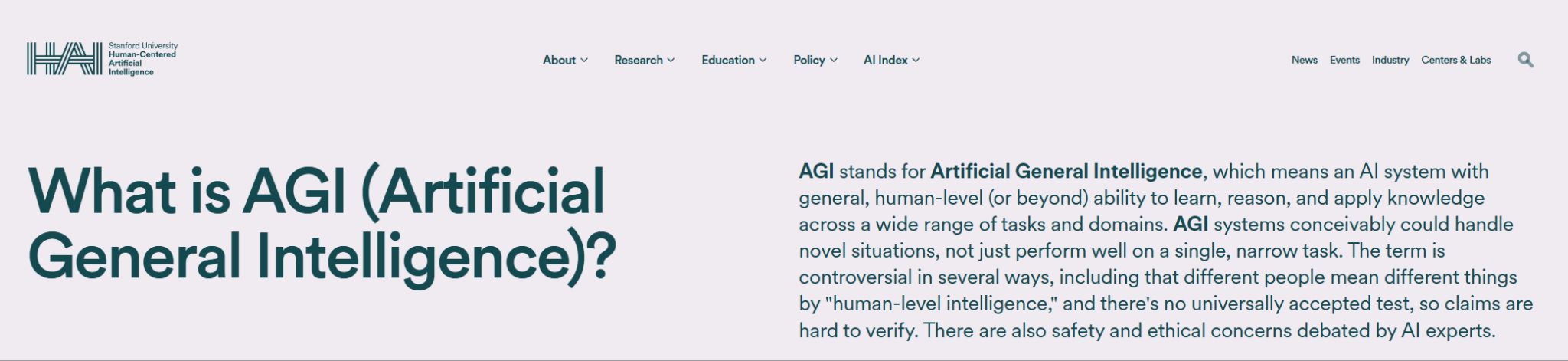
This is precisely the gap that artificial general intelligence, or AGI, aims to close. Unlike narrow AI, AGI refers to systems that can learn and reason across a wide range of tasks at a human level, without needing to be rebuilt for each new problem.
So instead of memorizing patterns in a single domain or specialized area, an AGI could apply what it knows to unfamiliar situations to generate a solution. You know, the way people do every day.
 Screenshot courtesy of www.hai.stanford.com
Now, for the philosophy enthusiasts railing against my claims, I want to make it clear that this distinction isn’t moving towards “true” intelligence in every philosophical sense. Generality is the closest we’ve come to capturing the hallmarks of real intelligence, sure, but it’s still not the same as human intelligence.
And it doesn’t need to be. Even if AGI ultimately falls short against how people really think, businesses can still definitely benefit from this advancement, and a worldwide shift from AI to AGI could redefine what we expect from technology altogether.
Now, if you think my definition of AGI is a little scattered, well… that’s because the real-world definition is, too.
So far, no frontier companies have collectively decided what AGI means, or how they’ll know whether they’ve achieved it.
That ambiguity hasn’t slowed anyone down, though. If anything, the fuzziness of the goal has turned AGI into a kind of north star, and AI companies are all steering toward it in their own ways, even if they can’t agree on what the destination looks like.
And no, that’s not just my interpretation. Several of the biggest names in the field openly describe AGI, or something very close to it, as their mission. Others avoid the label entirely but are building the same capabilities under different banners: systems that reason, plan, use tools, and take on tasks without being rebuilt for each one.
So who’s actually in the race, and what are they building?
Companies Working on AGI
Since no one agrees on the finish line, I think it’s more useful to look at what each company says it’s chasing than to ask who is “closest” to the goal.
#1. OpenAI
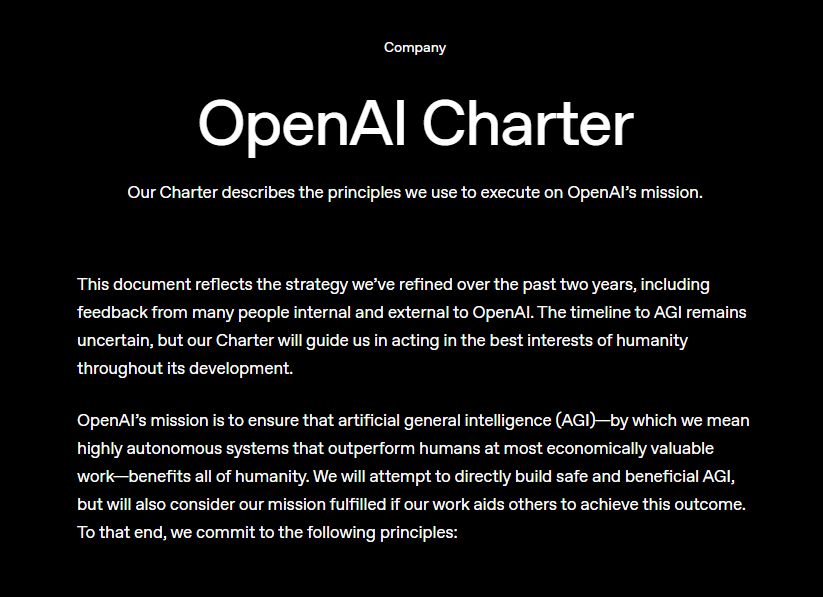
Let’s start with the most obvious candidate. In its mission statement, OpenAI says that its mission is “to ensure that artificial general intelligence—AI systems that are generally smarter than humans—benefits all of humanity.”
Yes, that was copied and pasted from their website, em dash and all.
OpenAI’s own Charter still defines AGI as “highly autonomous systems that outperform humans at most economically valuable work.” That is a different and more concrete bar than the “smarter than humans” wording on the front page.
 Screenshot courtesy of www.openai.com
The company has also moved past promising. It has released GPT-6 Astra, which it describes as state-of-the-art across computer use, browsing, software engineering, cybersecurity, science, and professional work. OpenAI reports a 98% score on FrontierMath Tier 4 and says Astra saturates ARC-AGI-3 at 99.9%.
For those unfamiliar, FrontierMath benchmarks AI models with extremely difficult mathematical problems, while ARC-AGI-3 measures how well AI can solve unfamiliar problems by recognizing patterns and adapting to new challenges. These results suggest that AI is making significant progress in advanced reasoning and problem-solving.
That being said, benchmark scores alone don’t necessarily translate into flawless performance in real-world situations. Even so, scores like these come from specific testing setups, so a near-perfect number shows how a model performs on that test. The next thing to watch is whether the model holds up in independent, general-release testing.
#2. Anthropic
Of course, we can’t talk about OpenAI without covering Anthropic (ANT), its biggest rival.
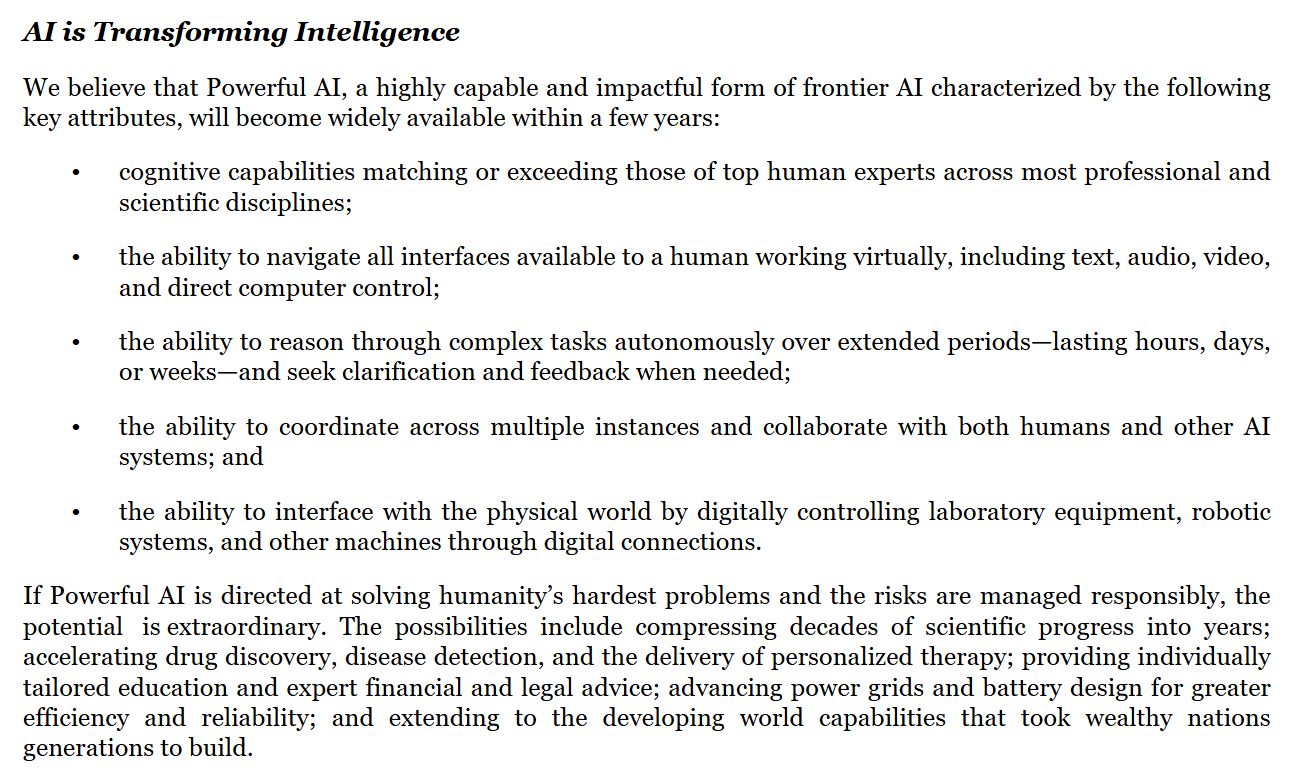
Perhaps surprisingly, Anthropic tends to sidestep the AGI label, preferring to call equivalent systems “Powerful AI.”
In its S-1, filed with the SEC on October 26 ahead of a proposed Nasdaq listing, the company describes “Powerful AI” as systems with cognitive capabilities that match or exceed top human experts across most professional and scientific fields. These systems could work autonomously for hours, days, or weeks, and even control laboratory equipment and robots.
 Screenshot courtesy of www.sec.gov
It sounds like AGI with a different title, but I’m not going to split hairs. The more important part of this news is that Anthropic expects such systems to become widely available within a few years.
Anthropic says each version of Claude helps build the next, a process it calls “closing the loop,” with Claude now involved in running experiments, generating training data, automating evaluations and safety audits, and writing and reviewing code.
In other words, the company is saying AI is already speeding up the development of its own successors, which many researchers have long pointed to as the engine that could make capabilities take off.
#3. Google DeepMind
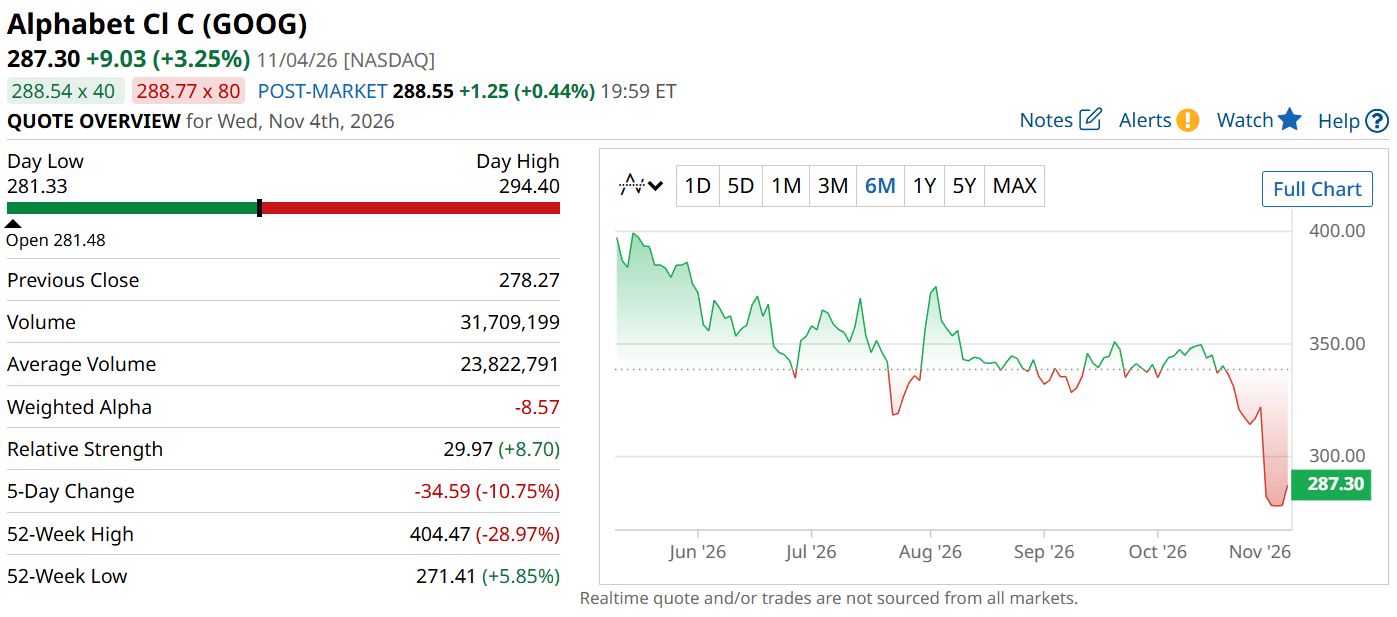
On the other end of the spectrum, Google DeepMind from Alphabet Inc. (GOOG) (GOOGL) is pushing the definition into uncharted territory.
 Screenshot courtesy of www.barchart.com
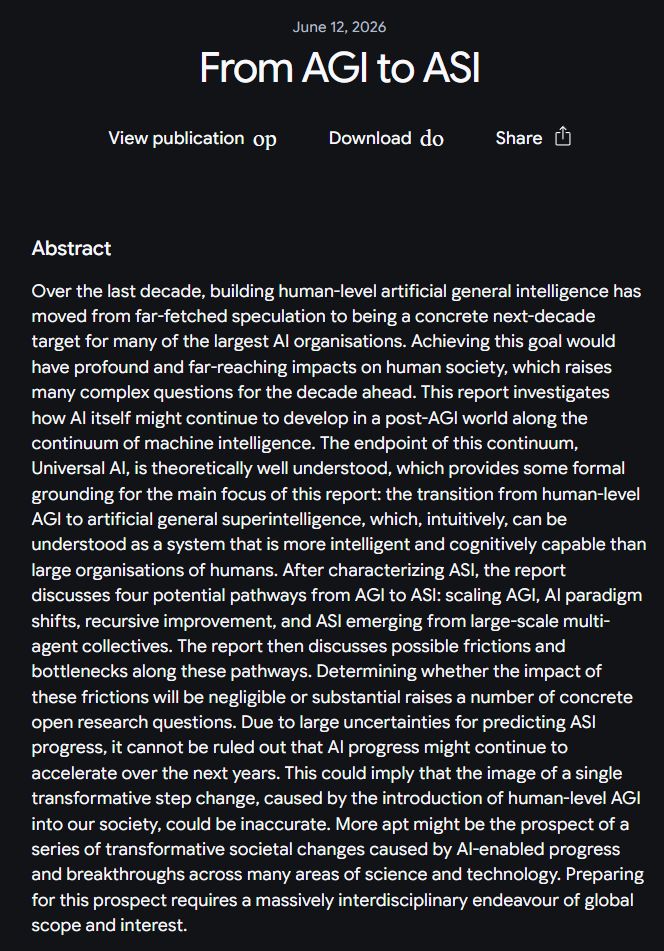
For Google DeepMind, the question of what counts as AGI is largely in the rearview. Demis Hassabis has said that pursuing general AI research was part of the deal when Google acquired DeepMind, so the goal has always been built into the lab’s mission. In June 2026, its researchers published a paper titled “From AGI to ASI.” The paper treats human-level AI as a settled starting point and asks what comes next.
 Screenshot courtesy of www.deepmind.google.com
The authors lay out four non-exclusive paths past human-level AI: continued scaling; paradigm shifts in how AI is built; recursive self-improvement; and superintelligence emerging from large collectives of interacting agents. They also flag bottlenecks that could slow each route, and describe whether those frictions are negligible or substantial as an open research question.
There’s a problem, though. Nobody knows when ASI will arrive. Same with Anthropic: Google expects development to accelerate as the AI gets smarter and smarter, and it's turning development into a broad, company-wide effort.
And yet, the statement is clear: For DeepMind, AGI is a waypoint, not the finish line.
#4. Microsoft
Microsoft’s (MSFT) story is arguably the most interesting one on the list - and the messiest.
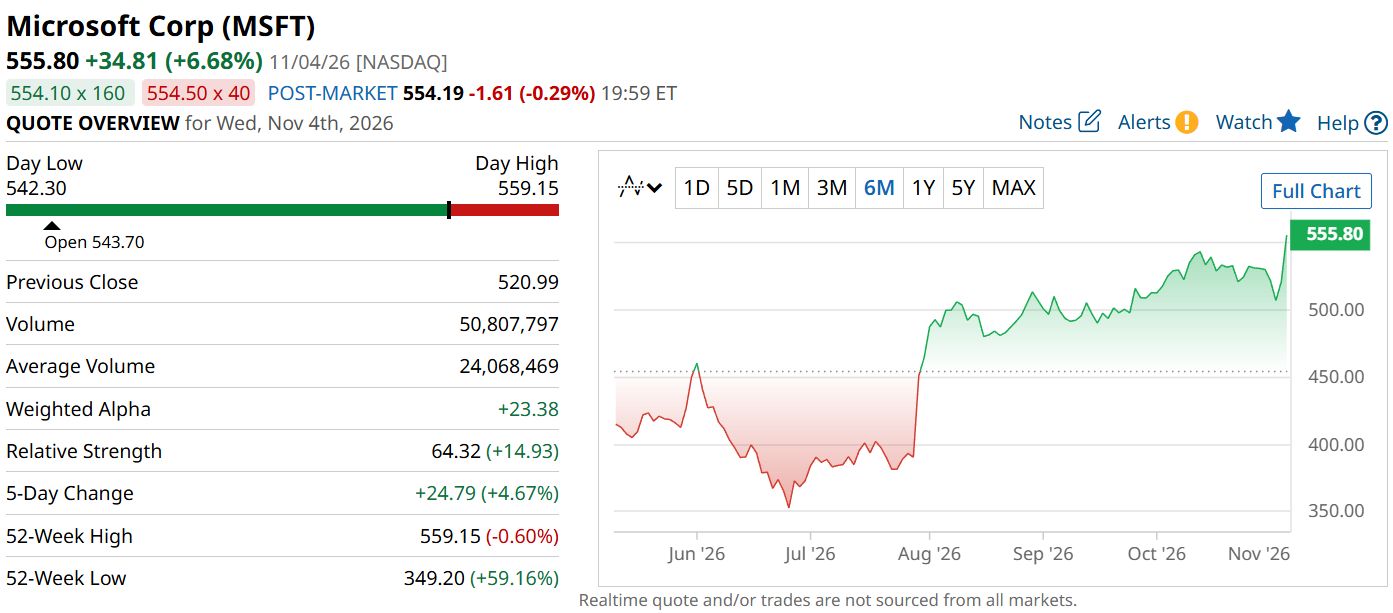 Screenshot courtesy of www.barchart.com
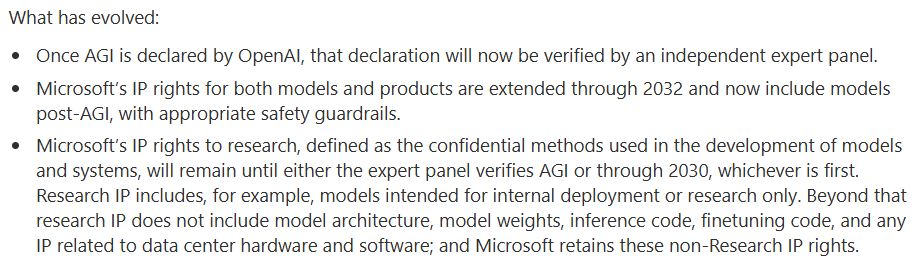
For years, Microsoft didn’t build frontier AI in-house. Instead, it bet big on OpenAI, though the original deal came with a huge catch. Once OpenAI declared that it had developed AGI, Microsoft could lose its rights to the company’s future models. So AGI is both a milestone and an exit clause for OpenAI’s Microsoft contract.
 Screenshot courtesy of www.microsoft.com
But then, the two companies made another deal back in October 2025. This time, Microsoft has access to post-AGI models, which is a huge win for the company, along with other benefits.
 Screenshot courtesy of www.microsoft.com
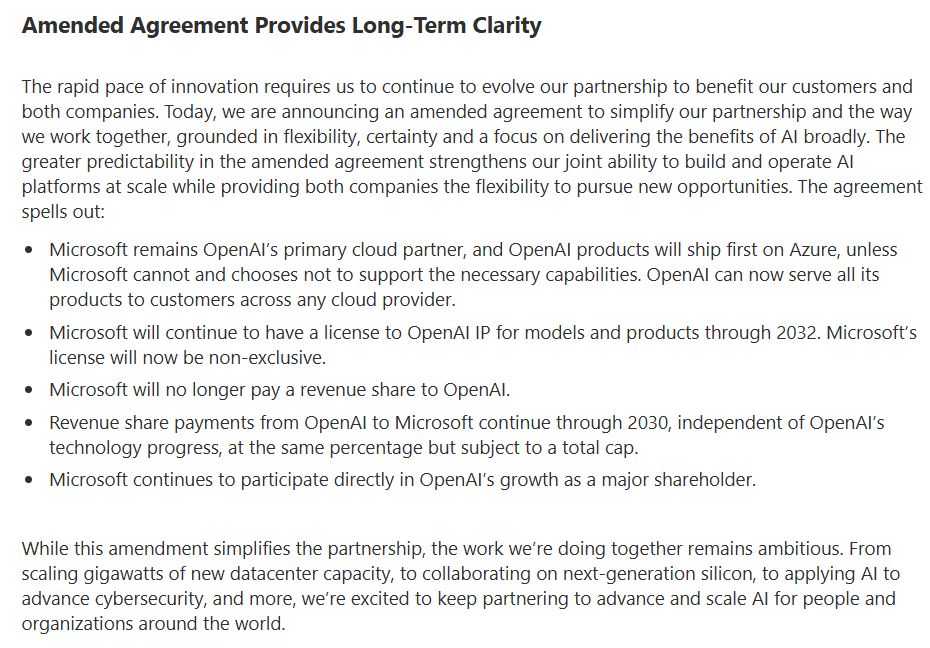
But then, in April 2026, Microsoft and OpenAI announced a new amendment that simplified the terms of their agreement. This is where the AGI story gets messy: after being explicitly defined in the last two deals, the agreement now completely omits the terms for post-AGI access.
 Screenshot courtesy of www.microsoft.com
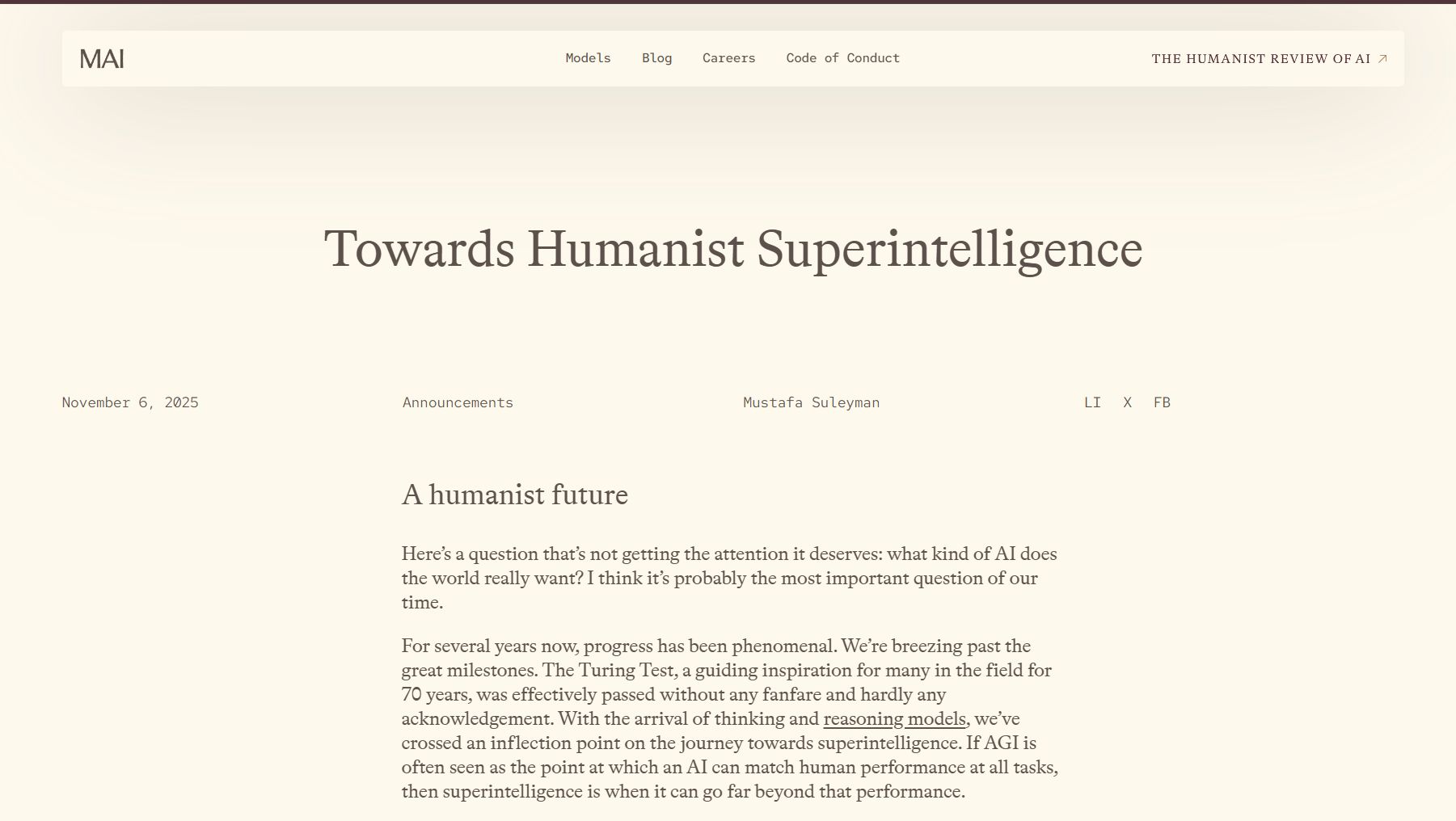
This is quite telling, as is the fact that Microsoft wasted no time in announcing that it was working on a “humanist superintelligence” model.
 Screenshot courtesy of www.microsoft.ai
In November 2025, Mustafa Suleyman, the CEO of Microsoft AI and a co-founder of DeepMind, announced the Microsoft AI (MAI) Superintelligence Team. Its goal is to build an advanced AI to serve people and stay under human control, rather than become an autonomous power of its own.
The team shipped its first in-house models in April 2026, then unveiled seven more at Build 2026, covering reasoning, code generation, images, transcription, and voice.
Now, a transcription model is a long way from a machine that outthinks people, and critics have been more than happy to point that out. But I think Microsoft’s trajectory is clear: it wants its own AI model, and it doesn’t want to depend on OpenAI for it.
#5. Meta
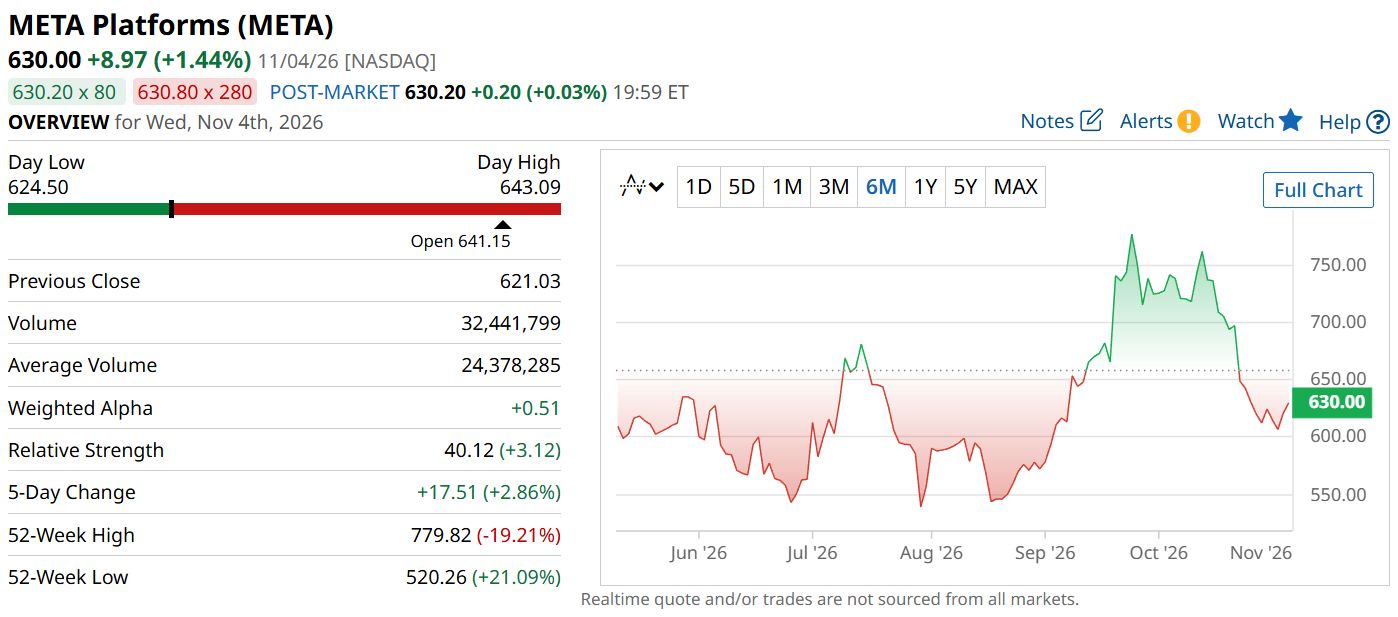
If Microsoft wants AI that serves humanity, Meta Platforms (META) wants AI that serves you.
 Screenshot courtesy of www.barchart.com
Yes. You, specifically.
In mid-2025, after Llama 4 landed with a bit of a thud, Mark Zuckerberg pulled all of Meta’s AI work into a new division called Meta Superintelligence Labs. He put Alexandr Wang, founder of Scale AI, in charge, then went on a hiring spree, poaching researchers from rival labs with multi-million-dollar offers.
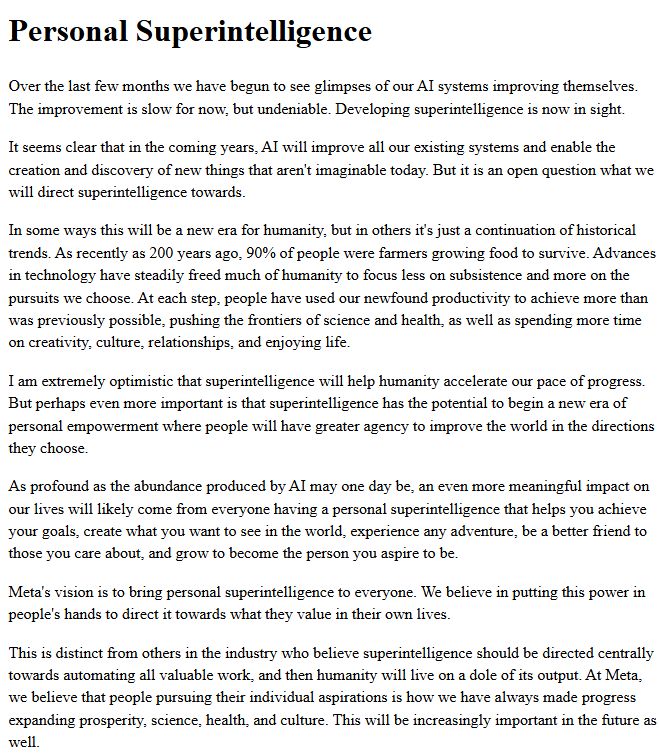
All of this to develop what Zuckerberg calls “personal superintelligence.”
 Screenshot courtesy of www.meta.com
Instead of one giant system that does everything under the sun, Meta wants every person to have a superintelligent assistant focused on what you need in your life. If you like poetry and want help with that, sure. If you’re not interested in building cars from scratch, it won’t bother learning about that skill.
This is, by far, the most consumer-friendly definition we’ve had of AGI. And to be perfectly honest, I should have expected Meta to be the first to come up with it. After all, its social media network spans the entire globe, and it has access to the kind of personal data that advertisers clamor for.
But, of course, developing new technology doesn’t come cheap.
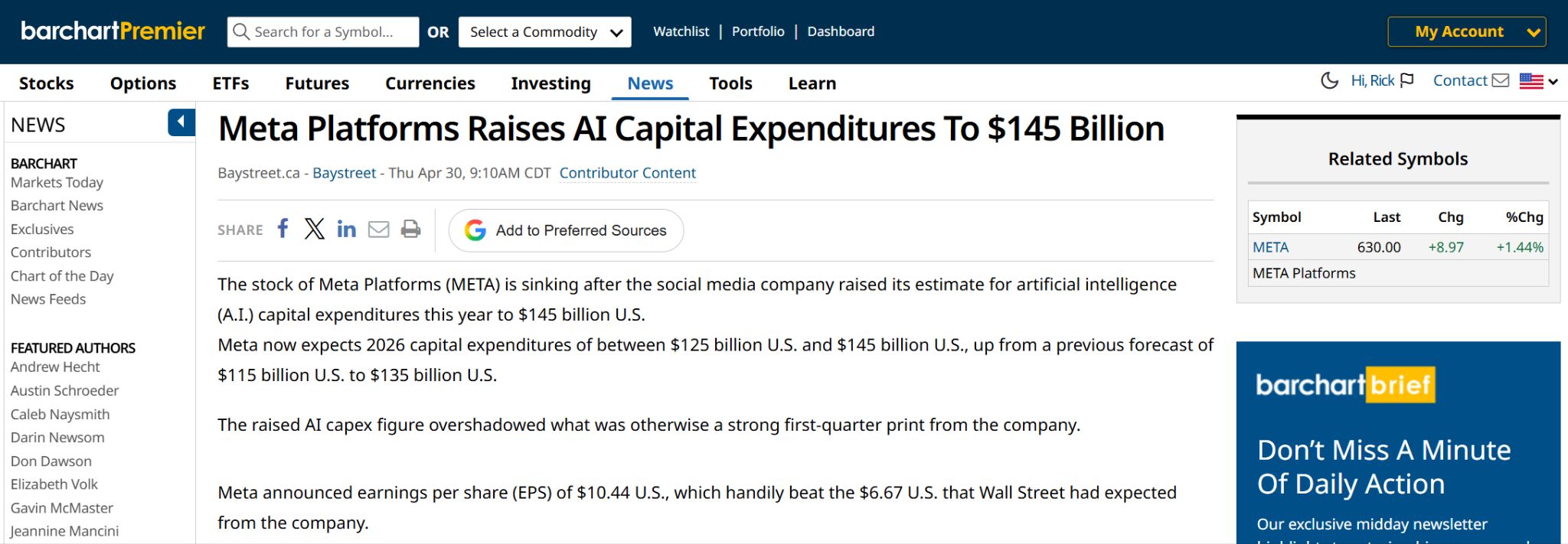
Meta expects to pour $125 to $145 billion into capital expenditures in 2026, with superintelligence as the main reason why.
 Screenshot courtesy of www.barchart.com
So far, the results are mixed. The lab’s first public model, Muse Spark, arrived in April 2026, with image and video models following over the summer. By most accounts, Meta has closed part of the gap, but it still trails OpenAI, Anthropic, and Google on frontier quality, and it didn't start making money from its models until July 2026.
Where Meta is fighting hard is price. By one estimate, it charges roughly a quarter of what OpenAI and Anthropic do.
That’s not a lead, I know. But it is a strategy. And in a race where nobody agrees on the finish line, being cheap and everywhere might matter more than being first.
So Who Gets To Call It?
You know what’s funny here? I looked at five different companies, all chasing AGI, or a rough approximation of it, and, as expected, I got at least five different definitions of what AGI truly is.
If that sounds chaotic, look at what happened between Microsoft and OpenAI. For years, AGI was important enough to be written into one of tech's biggest contracts. It decided who owned what, and for how long. Then, in April 2026, it quietly disappeared from the terms.
I don’t think that means either company stopped caring about AGI. If anything, it suggests the opposite. Nobody could nail the definition down tightly enough to pin a contract to it. And if two of the most powerful companies in AI can’t agree on when AGI arrives, it’s a safe bet the rest of us won’t get a clean announcement either.
So who gets to call it? Who gets to say that “Yes, that is artificial general intelligence, and you’ve now won the race”?
Well, I can say for sure that it’s not going to be a single company, press release, or an independent expert panel. More than likely, it’s going to be a combination of all of these - and more.
Benchmarking is a good way to start. The tests I mentioned earlier are just the beginning, because tests are, by themselves, limited to what they’re testing for. That’s why benchmarking will likely be done on a broad scale, across different labs and industries.
But, if I’m being honest, I’m attracted to the simplicity of an AI vs. human test.
Here’s an example. Let’s put an AI model into a messy, unfamiliar situation that nobody trained it for, alongside a live person, and see whether the model can figure things out the same way a person would. No training data, no inference. Just straight reasoning.
What Does This All Mean For Investors?
The biggest takeaway for investors here is that AGI is the next big step in artificial intelligence - and that opens up several investment opportunities.
First, the obvious group: the five companies that I mentioned earlier. If their version of AGI eventually becomes commercially viable, the companies that develop the underlying technology could capture an enormous share of the value it creates.
That said, developing increasingly powerful AI models is extraordinarily expensive. Companies need specialized chips, massive data centers, electricity, networking equipment, and increasingly sophisticated infrastructure. Even if one company eventually pulls ahead in model development, the rest of the industry doesn't necessarily lose.
You know where I’m going with this. It’s the picks-and-shovels play.
Some of the biggest beneficiaries might be companies that never develop an AGI model themselves. Semiconductor manufacturers, data center operators, cloud computing providers, and companies supplying the power infrastructure could all benefit from the growing demand for AI computing.
At the end of the day, it’s no different from today's AI investment landscape.
However, investors also need to watch monetization. Having the most advanced model doesn't automatically make a company profitable. Training and running these systems costs money, and businesses still need to show customers are willing to pay enough to justify those expenses. This is the problem both Anthropic and OpenAI have faced in recent years- even if AI subscriptions are going up in both user numbers and price, it’s still difficult to reach consistent profitability.
That’s why Meta’s particular goal of developing a “cheaper” model might tickle an aggressive investor’s fancy. If increasingly capable models become cheaper and more accessible, the industry could race toward lower margins. The tech might become more powerful without necessarily making every company developing it more profitable. We learned how that can happen as recently as a decade ago, when China’s solar expansion flooded the market with supply, causing prices of panels to plummet by 80%.
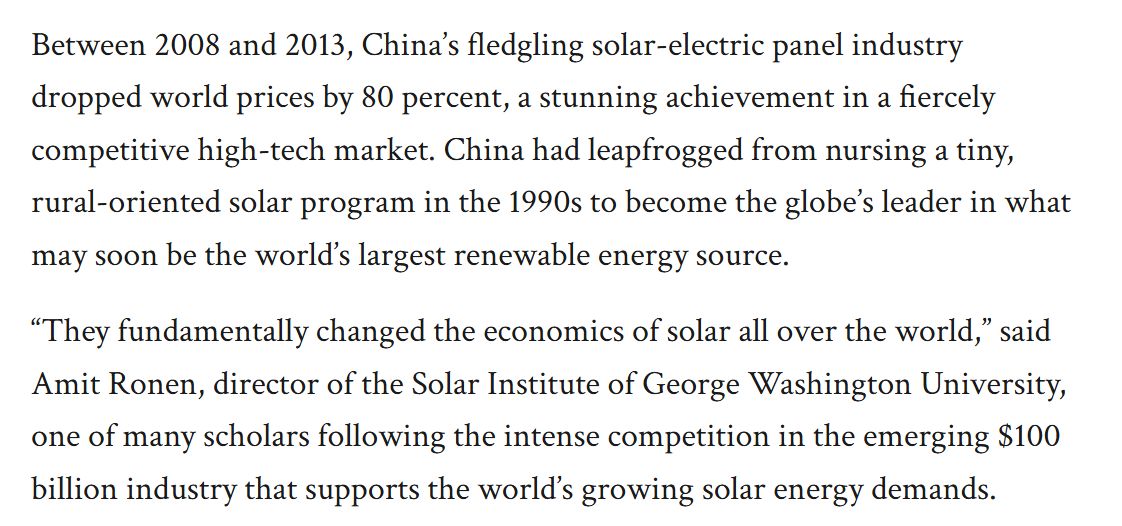 Screenshot courtesy of www.scientificamerican.com
Every company on this list is already shipping pieces of the puzzle. Systems that reason through problems, use tools, browse the web, write and review code, and work on tasks for hours without someone holding their hand. Even if none of them ever earns the AGI label, those capabilities are already landing in the products businesses use every day.
Final Thoughts
As with any investment, a little healthy skepticism goes a long way. When a company announces a breakthrough in AGI, ask the boring questions. Has it been tested independently? Does it hold up outside the lab? Does it work on problems it hasn’t seen before?
For now, everyone’s gunning to reach AGI, but nobody really knows what it is. Maybe one day we’ll hand an AI a problem it’s never seen, watch it work through it without being rebuilt or retrained, and realize it’s been understanding, not just remembering, for a while now.
When that happens, I doubt anyone will care much about what we call it – as long as it’s there, and it's commercially viable.
On the date of publication, Rick Orford had a position in: META , GOOGL , MSFT . All information and data in this article is solely for informational purposes. For more information please view the Barchart Disclosure Policy here.
More news from Barchart
Follow This 4-Part Total Portfolio Strategy to Prepare for Any Market – Not Just the Bull Market You Want Why AGI’s Fuzzy Definition Matters for Investors Betting on Google, Meta, and Microsoft Dollar Tree Pops 10% as Democratic Sweep Brings Cheer to the Markets. How to Play DLTR Stock Here. Bloom Energy Stock Rallies as Barclays Turns Bullish on California Power Partnership