

International Business Machines (IBM) is giving investors another reason to pay attention to its growing position in enterprise artificial intelligence (AI). On Nov. 10, IBM and Microsoft (MSFT) announced Imagine Enterprise, a new platform designed to help businesses build, deploy, and govern AI agents for industry-specific workflows. The offering combines more than 6,000 AI agents and assets from IBM Consulting with Microsoft’s AI, cloud, data, and security technologies, including Microsoft Foundry, Azure, GitHub Copilot, and Copilot Studio.
The partnership is significant because it could strengthen the company’s ability to monetize the next phase of enterprise AI adoption. Rather than simply providing generative-AI tools, Imagine Enterprise is aimed at helping companies move AI agents into actual business processes, particularly in highly regulated industries such as financial services, insurance, and retail. The platform also incorporates governance, security, and integration with existing enterprise systems, areas where IBM has long-standing expertise.
More Top Stocks Daily: Go behind Wall Street’s hottest headlines with Barchart’s Active Investor newsletter.
Moreover, the announcement comes as IBM continues positioning its consulting, hybrid-cloud, and software businesses around agentic AI. By combining IBM’s enterprise relationships and consulting capabilities with Microsoft’s massive cloud and AI ecosystem, the partnership could create additional opportunities for IBM to win AI transformation projects and generate recurring software and services revenue. Here’s what the new IBM-Microsoft AI agent partnership could mean for IBM stock.
About International Business Machines Stock
International Business Machines is a global technology and consulting powerhouse headquartered in Armonk, New York. Founded in 1911 as the Computing-Tabulating-Recording Company and rebranded in 1924, IBM today operates in more than 170 countries and offers a broad portfolio spanning hybrid cloud platforms, AI solutions, infrastructure hardware, software, consulting services, and financing. IBM’s market cap is around $234.6 billion.
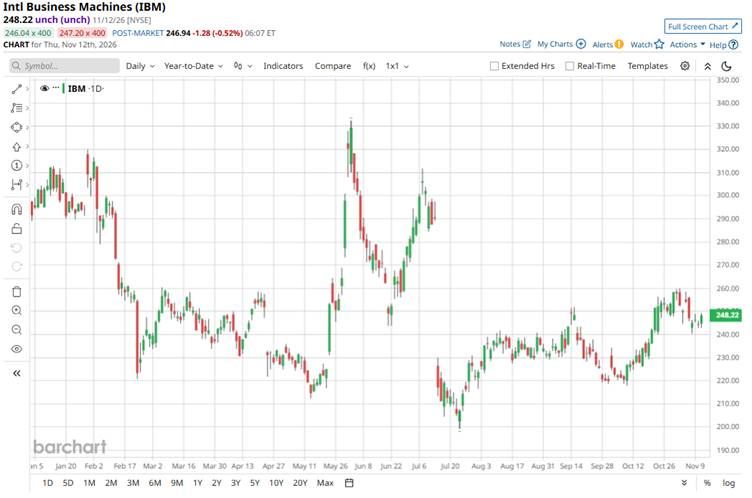
IBM stock has remained under pressure despite the company’s expanding focus on artificial intelligence, with shares down 20.9% over the past year and 16.2% year-to-date (YTD). The stock is also trading roughly 25.3% below its 52-week high of $332.46, underscoring the significant correction from its earlier peak.
More recently, shares have remained volatile, falling about 2.4% over the past five trading sessions. The new Microsoft partnership provided a modest positive catalyst, but it has not yet triggered a meaningful turnaround in IBM shares. IBM stock was down slightly on Nov. 10, the day the companies announced Imagine Enterprise, before rising 1.5% on Nov. 11. It ended the week at $247.13, up. 1.7% from the week before.
The muted initial reaction suggests that investors are viewing the agreement as strategically positive but are waiting for evidence that it can translate into material incremental revenue and earnings growth rather than immediately assigning a higher valuation to IBM.
The stock’s performance suggests that investors remain cautious about IBM’s ability to translate its AI investments into sufficiently strong growth. While the company continues to benefit from demand for hybrid cloud, software, and AI services, expectations surrounding AI have risen sharply across the technology sector.
 www.barchart.com
The stock is currently trading at a discounted valuation compared to industry peers at 19.82 times forward earnings.
IBM’s Q3 2026 Results Show Stronger Software Growth and Higher Cash Flow
IBM reported its third-quarter 2026 results on Oct. 21, with the quarter showing continued momentum in Software, stronger profitability and improved cash generation, although growth remained uneven across its businesses. Revenue increased 5% year-over-year (YOY) to $17.1 billion. Software remained the primary growth engine, with revenue rising 8% to $7.8 billion.
Within Software, Hybrid Cloud revenue increased 11%, Data rose 19%, and Transaction Processing grew 9%, while Automation declined 3%. Software segment profit increased to $2.7 billion from $2.4 billion.
IBM’s Consulting revenue was essentially unchanged at $5.3 billion. Segment profit declined to $653 million from $686 million. Meanwhile, Infrastructure revenue rose 4% to $3.7 billion, with Hybrid Infrastructure increasing 8%. Distributed Infrastructure was particularly strong, with revenue up 31%, although IBM Z revenue fell 20%.
Profitability improved more substantially, with its adjusted net income increasing 12% YOY to $2.8 billion, while adjusted EPS increased 11% to $2.95, exceeding expectations, and adjusted EBITDA rose to $4.9 billion from $4.6 billion.
Cash generation was another positive element of the quarter. Operating cash flow increased to $4 billion from $3.1 billion, while free cash flow rose to $3 billion. Through the first nine months of 2026, operating cash flow reached $11.8 billion, compared with $9.2 billion in the same period of 2025, while free cash flow increased to $7.8 billion.
Furthermore, for 2026, IBM maintained its outlook for 4% to 5% constant-currency revenue growth and raised its free cash flow expectations. The company now expects full-year free cash flow to increase by more than $1 billion YOY.
Analysts predict EPS to be around $12.42 for fiscal 2026, up 7.2% YOY, before surging by another 6.5% annually to $13.23 in fiscal 2027.
What Do Analysts Expect for IBM Stock?
Evercore ISI reiterated its “Outperform” rating on IBM on Nov. 6, with a $275 price target, maintaining its bullish stance following IBM’s third-quarter results. Previously, Goldman Sachs maintained its “Buy” rating on IBM and raised its price target to $300 from $270 on Oct. 22, following IBM’s better-than-expected third-quarter results. Analyst James Schneider said IBM’s upbeat Software performance and improving trends in Consulting pointed to better execution and a potential inflection in the company’s growth trajectory.
On the other hand, BMO Capital Markets maintained its “Market Perform” rating on IBM on Oct. 22, while raising its price target to $265 from $230. Analyst Keith Bachman remained cautious despite the higher target, noting that IBM’s quarterly performance benefited from the closing of delayed transactions, particularly in Transaction Processing, while growth in segments like Automation remained weak.
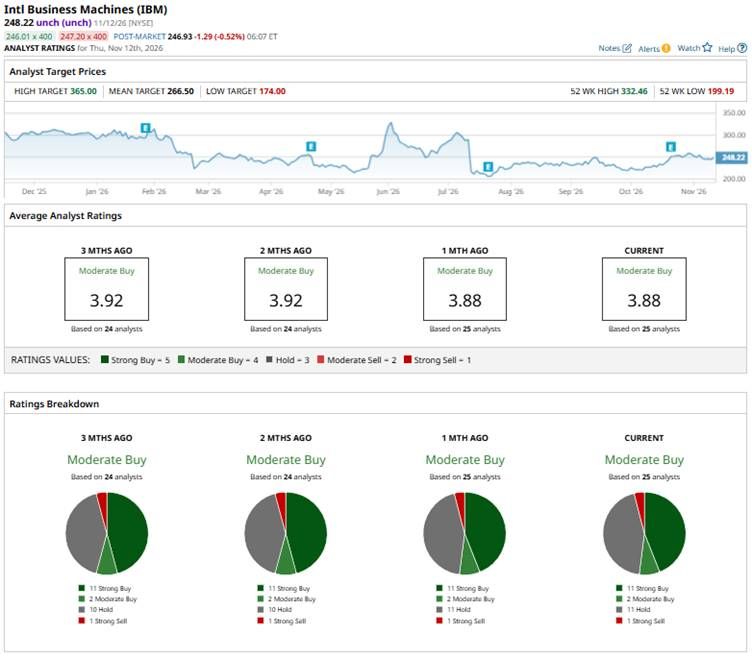
Overall, IBM has a consensus “Moderate Buy” rating. Of the 25 analysts covering the stock, 11 advise a “Strong Buy,” two suggest a “Moderate Buy,” 11 analysts are on the sidelines, giving it a “Hold” rating, and one “Strong Sell.”
The average analyst price target of $266.50 indicates an upside of 7.4%, and the Street-high target price of $365 suggests that the stock could rally as much as 47%.
 www.barchart.com
On the date of publication, Subhasree Kar did not directly have a position in any of the securities mentioned in this article. All information and data in this article is solely for informational purposes. For more information please view the Barchart Disclosure Policy here.
More news from Barchart
Novo Nordisk vs. Amgen: 1 Has the Blockbuster Weight-Loss Drugs, the Other Has a Promising Rival Cathie Wood and Jim Cramer Disagree on Nvidia Stock Without Jensen Huang. Earnings Could Decide Who's Right A $1.3 Billion Reason to Buy Firefly Aerospace Stock Here Why at Least 1 Analyst Says Nvidia Stock Has Already Bottomed – Or Is Very Close