


Ship traffic through the Strait of Hormuz jumped almost 400% in two weeks. The report landed on Saturday, with oil markets shut. Monday is the first chance traders get to price it.
On the surface, that should ease supply fears and pull crude lower. More ships means more oil. Yet the shipping data carries a catch that argues the drop may never arrive.
Hormuz Traffic Recovers But Stays Far Below Pre-War Levels
The surge is real, and it is easy to check. UK Maritime Trade Operations (UKMTO), the British naval body that tracks merchant shipping in the Gulf, publishes a weekly transit count.
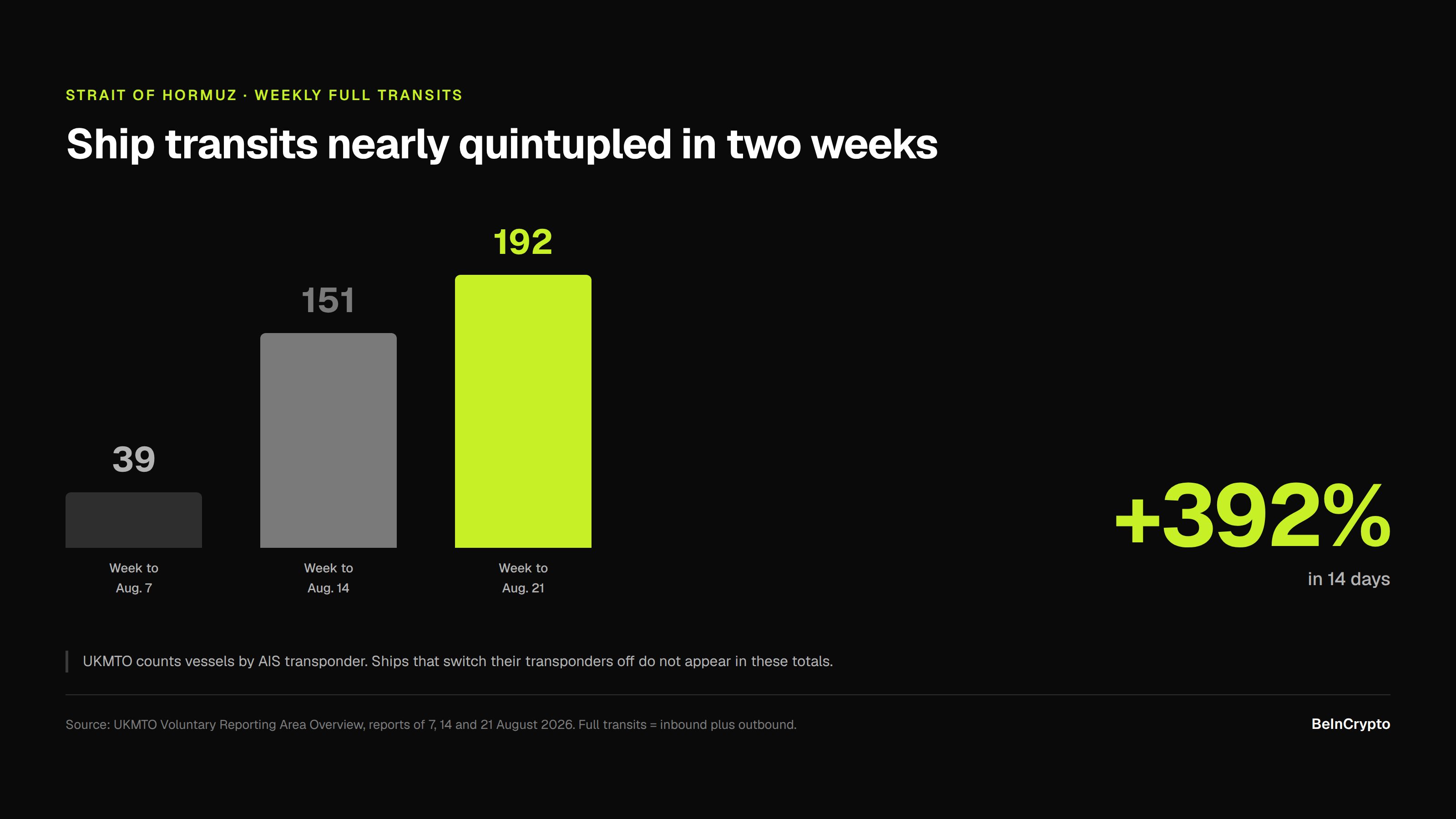
In the week to August 7, it logged 39 full transits. A week later, 151. In the week to August 21, 192, according to its latest report. That is a rise of 392% in 14 days, so the headline number holds up.
 hormuz-transits
 The baseline is another matter. Before the war, roughly 20.9 million barrels a day moved through the strait, EIA figures show. That is close to a fifth of everything the world burns.
Today's traffic sits about 90% below that mark, by UKMTO's own reckoning. Going from almost nothing to slightly more than almost nothing still produces a spectacular percentage.
Most of the returning ships hug Oman's coast, on a corridor backed by Washington and rejected by Tehran, which cannot levy a toll on it.
The arrangement has a precedent. In 1987 the US reflagged 11 Kuwaiti tankers and sent the Navy to escort them through the same water. The first convoy sailed on July 22. Two days later the tanker Bridgeton struck a mine.
"It increasingly looks like Iran has at least partially lost control of the strait," Homayoun Falakshahi, head of crude oil analysis at Kpler, told CNN.
Follow us on X to get the latest news as it happens
Why the 400% Is Weaker Than It Looks
Start with how the count is made. UKMTO tracks vessels by their transponders, and in a war zone many captains simply switch them off.
Windward, a maritime data firm, recorded nine ships crossing the southern corridor dark overnight on August 21. It called that the largest single night on record.
So part of the 400% is not new ships at all. It is old ships turning their signals back on. The count has risen faster than the cargo, a gap earlier analyst timelines for Hormuz had already flagged.
Barrels tell the sober version. Energy Secretary Chris Wright puts outflows near 9 million a day. Rory Johnston, who writes the Commodity Context newsletter, reckons the peak is closer to 7 million.
Here's what I wrote in Oil Context Weekly today on this exact topic:
— Rory Johnston (@Rory_Johnston) August 14, 2026
"Let’s begin with the 9 million barrels a day figure. According to our analysis using tanker tracking data from Kpler, the recent peak—over the past week or so—in confirmed Hormuz transits is roughly 7.5 MMbpd… https://t.co/0KtQtQ24KU
Either way, the strait is running at under half its pre-war norm.
Refined fuel is tighter still. The US diesel crack spread, the margin refiners earn turning crude into diesel, hit an all-time high of $102.20 on August 17, Reuters reported. In calmer periods it sits in the teens or low twenties.
That squeeze, rather than any shortage of crude itself, is what has been setting Brent crude prices.
Both benchmarks gained about 5% across the week, so crude enters Monday with momentum behind it rather than against it.
Prices held up once before, when supertankers resumed Hormuz transit earlier in the war. That remains the closest precedent for Monday.
WTI and Brent Test the May Downtrend Before Monday
US crude spot settled at $87.57 on Friday, up 0.43%. UK crude spot closed at $92.40, up 0.75%. Both are spot contracts, the series these charts track, and they run a little under the front-month futures.
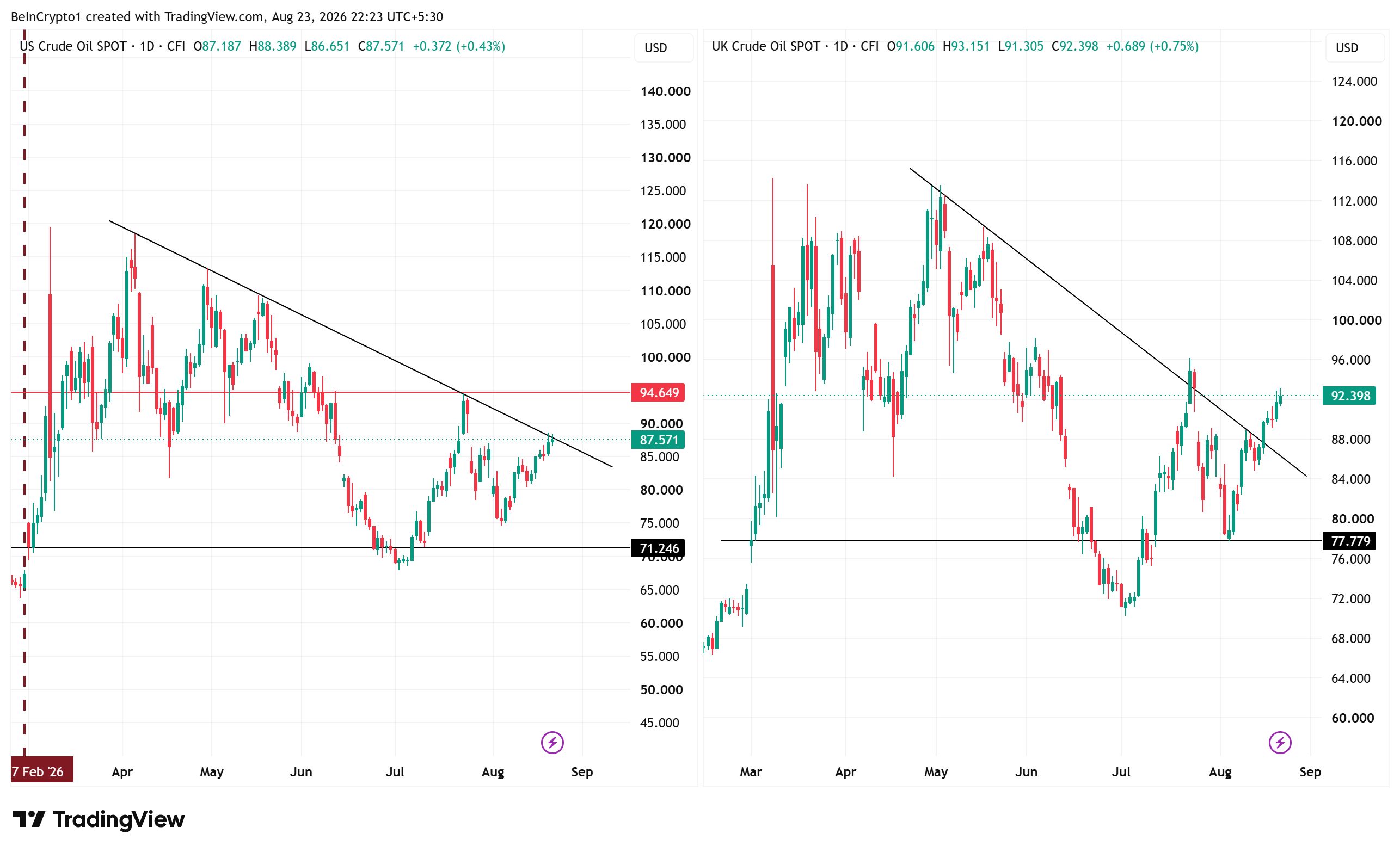 US (WTI) and UK (BRENT) Crude Oil Spot Prices. Source: TradingView
 Those are the levels Monday opens from. Each sits just below a descending trendline drawn from the May highs. Brent has already breached its line, while WTI trades a fraction beneath its own.
Futures reopen on Sunday evening in New York, which makes Monday the first full session. It opens with a policy headline attached.
Treasury Secretary Scott Bessent has called a Monday press conference to unveil new Iran sanctions. Mohsen Rezaei, who runs Iran's Supreme National Security Council, has warned Tehran will strike at the interests of any country that joins in.
Speaking in South Carolina on Friday, President Donald Trump restated his claim on the waterway.
"We don't even know if we won, because I view the Strait of Hormuz as an American territory right now," Trump, quoted by UPI.
So which way does Monday cut? Sanctions restrict supply, and that argues for higher prices rather than lower ones.
For oil to break lower, the package would have to land softer than trailed, or carry a hint that talks are back on.
A rejection at the trendline would be the first confirmation. It keeps May's pattern of lower highs alive and puts $71.25 on WTI and $77.78 on Brent back in view.
A close above the line does the opposite. It would mark the first genuine break since the war began, and every Brent price forecast built on that downtrend would need rewriting.
Read the Original story 400% Strait Traffic Surge Eases Supply Fears, Will Oil Break Lower Monday? by Lockridge Okoth at beincrypto.com