

Gold has lost nearly a quarter of its value since the US-Iran war began. On Friday, it briefly fell to $3,975 an ounce before recovering to around $4,020 on Monday.
Yet investors have been pouring billions into gold ETFs throughout much of the decline. Gold ETF holdings have surged while prices crashed.
So, who is driving the selloff, and what happens next?
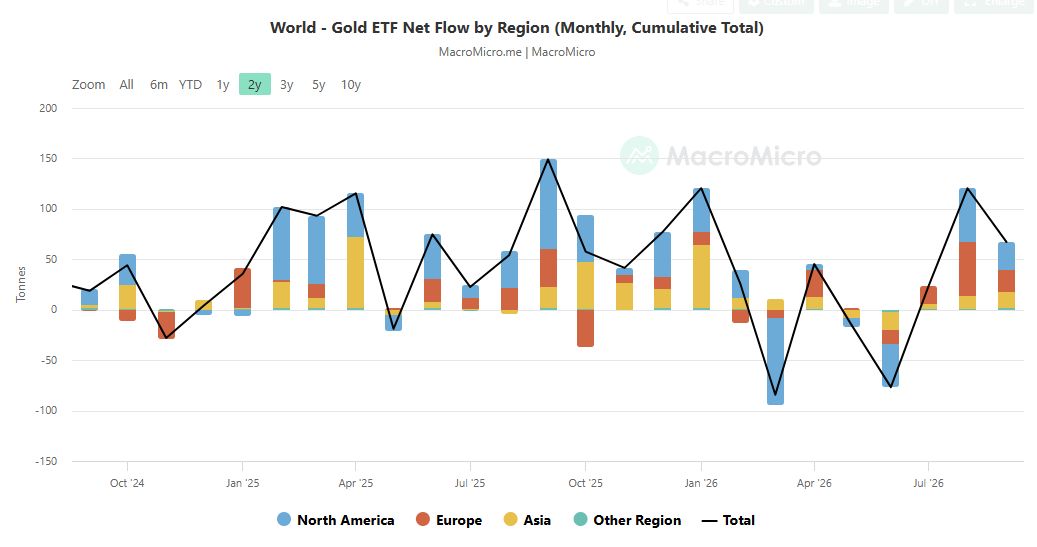 Monthly gold ETF net flows by region in tonnes / Source: MacroMicro
Why is Gold Price Falling?
Surging oil prices have revived inflation fears, making further US interest-rate increases more likely.
The Federal Reserve raised rates in September, and markets now see roughly an 80% chance of another increase in December.
Higher rates make interest-bearing bonds more attractive than gold, which pays no yield. Last week's technology-stock selloff added pressure as investors sold assets to raise cash.
Meanwhile, CFTC data show money managers have steadily reduced bullish gold futures positions, reaching a net 104,206 contracts on October 20.
There is a massive GAP between gold demand and gold prices:
— Global Markets Investor (@GlobalMktObserv) October 26, 2026
Physical-gold backed ETFs tracked by Bloomberg have recorded 14 consecutive WEEKS of inflows. $GLD
This has brought gold ETF holdings to nearly 102 million troy ounces, their highest level since mid-2022.
However,… pic.twitter.com/Ks6mSQ2Gzw
Why Are Investors Still Buying Gold?
According to the World Gold Council, gold ETFs attracted a record $31 billion in the third quarter. Holdings increased by 67 tonnes in September alone, despite falling prices.
This suggests longer-term investors continued accumulating gold while speculative traders reduced exposure.
However, that support is weakening.
Global ETF holdings fell approximately 6.8 tonnes in the week of October 19, according to BoldETF, their first weekly decline since July.
The largest US gold fund, GLD, lost $2.3 billion over five days, although smaller gold ETFs attracted inflows.
What Happens to Gold Next?
The $4,000 level is now the immediate test.
Wednesday's Fed decision and Thursday's US inflation report could determine whether gold stabilizes or faces another selloff.
Gold stocks have rarely been this oversold.
— The Kobeissi Letter (@KobeissiLetter) October 25, 2026
~92% of stocks in the gold miners ETF, $GDX , are now trading below their 50-day moving average, the highest proportion since late July.
This figure has risen +80 percentage points in just 21 sessions.
Furthermore, 90% of stocks in… pic.twitter.com/iELU7EV549
StoneX strategist Bob Haberkorn told Reuters he expects gold to "hang around the $4,000 level into the Fed announcement."
For investors, sustained ETF demand and easing rate expectations could support a recovery. Continued outflows and stubborn inflation would leave gold vulnerable to further losses.
Read the Original story Gold Price Crashed 25%, But Investors are Still Buying by Jakub Dziadkowiec at beincrypto.com