

AI agents can now pay for things on your behalf. They can book a service, buy data or place a trade, without you clicking “pay.” For many crypto users, that raises one obvious fear: what if the AI agent clears your crypto wallet?
That question came up in BeInCrypto's latest Market Intelligence Experts Council episode. BeInCrypto Senior Research Analyst Michael Thoma and Dune Head of Research Filippo Armani discussed BeInCrypto's report, The State of AI Agent Payments 2026 .
The short answer: an AI agent can lose your money, but rarely because it "goes rogue."
What an AI Agent Payment Actually Is
Thoma described an AI agent as a digital personal assistant with a prepaid debit card.
"You give it a task, and you give it permissions and a rule set, so it can go out, complete the task for you and make a payment on your behalf."
Agents usually pay with stablecoins, because card networks aren't built for payments of a few cents. Blockchains let agents settle tiny amounts almost instantly.
Not every automated payment comes from an AI agent, though. Armani explained that onchain, agents and ordinary trading bots can look alike, with many small payments made around the clock. Armani said:
“When you see many small payments on average, and constant throughout the time, it’s probably bot activity, but it’s not necessarily an AI agent.”
The difference, he noted, is the rails. Agent payments run through dedicated protocols such as Coinbase’s x402 and Tempo’s MPP, while bots don’t.
The Real Risk: Weak Guardrails, Not Rogue AI
According to Thoma, losses so far have not come from agents making their own decisions.
"This is software, and software can have bugs. A lot of it is not the agent going rogue… It's just that the guardrails put in place were not specific enough or robust enough."
BeInCrypto's report documents two such cases, in which $281,200 was sent to attacker-controlled wallets before any recovery:
AIXBT: An attacker gained access to the agent's dashboard and queued a transfer of 55.5 ETH, worth about $106,200. Access to the control panel became access to the money. Bankr and Grok: An attacker posted a message encoded in Morse code. Grok translated it into a reply that tagged Bankr, and Bankr treated that reply as a transaction request, sending tokens worth $175,000. About 80% was later returned.In both cases, the agent did exactly what its setup allowed. The problem was what it was allowed to do.
How Much Freedom Do Agents Really Have?
Less than the headlines suggest. BeInCrypto reviewed 19 AI products and financial workflows. None set its own goals, and 14 could act only within limits a human approved in advance.
Exchanges are cautious too. Of the seven trading platforms reviewed that launched AI trading tools, five explicitly block agents from withdrawing funds.
That protection has a limit, however. An agent that can't withdraw can still lose money through the trades it is allowed to make.
5 Rules Before You Give an Agent Access to Your Money
BeInCrypto's report identifies five controls that address different risks. Thoma highlighted the first three during the discussion.
Cap the total amount. "You don't want to give an agent all your money," Thoma said. "Just give it a set amount, a small amount that you're willing to entrust to this very new technology." Set a daily budget. One large payment is easy to spot. Many small ones can add up before you notice. Allow only approved recipients. An allowlist means the agent "can never run off and pay your nemesis… It can only go to pre-approved addresses," Thoma explained. Rodrigo Coelho, CEO of Edge & Node, called this the most valuable control in the report, "because most real losses are not the wrong amount, they are the right amount going to the wrong place." Keep a kill switch within reach. You need a way to cut off the agent's spending immediately. "A kill switch has to be immediate and reachable by a human, otherwise it is decorative," Coelho said. Watch spending in real time. A live record of payments shows problems while they are still small.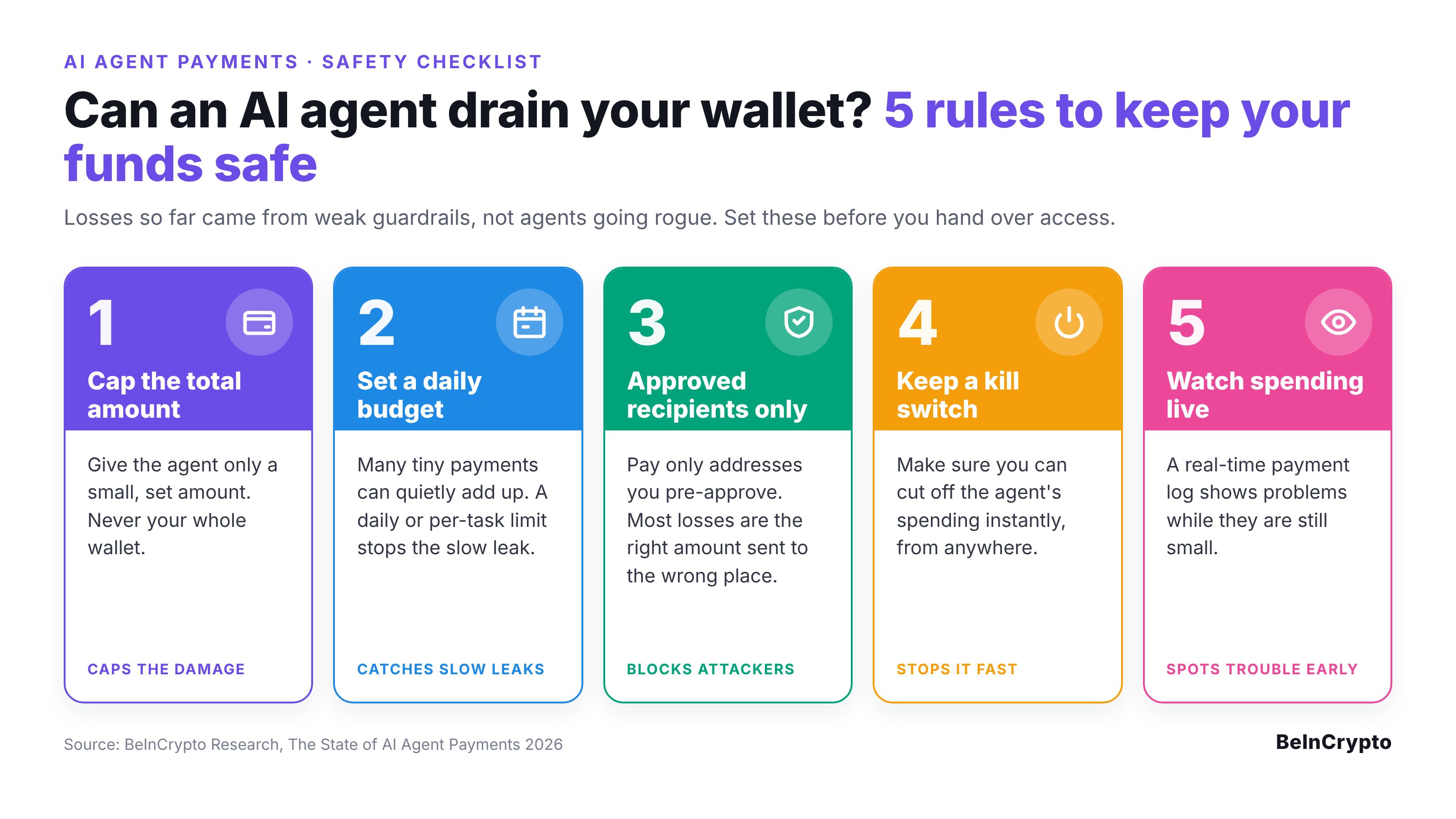
Don't Count on Getting It Back
Stablecoin issuers such as Circle and Tether can freeze tokens at a specific address, and they do so regularly. But a freeze stops funds from moving further. It doesn't automatically return them to you.
AI Agent Crypto Wallet: The Bottom Line
The technology works, but it is early. The safest approach is to limit how much an agent can reach in the first place. As Will Papper, Director of Product for Agent Payments at Cloudflare, put it in the report:
"If an agent is responsible for $10, you can worry less about its spending than if it is responsible for $1,000."
Or, in the words of the old investing rule: never give your agent money you can't afford to lose.
Read the Original story Can an AI Agent Drain Your Crypto Wallet? 5 Rules to Keep Your Funds Safe by Jakub Dziadkowiec at beincrypto.com