


Imagine waking up one morning to find your life savings frozen. Your exchange cannot release the money, customer support cannot disclose the name of the court case, and recovering your funds could involve legal proceedings in a foreign country.
Some Binance users are now facing that reality. One trader on X claims to have roughly 400,000 USDT locked.
Affected users have until November 24 to contact the plaintiffs' lawyers and raise objections.
How a Court Order Can Freeze Your Crypto
On October 29, a Colorado judge signed a temporary restraining order targeting Huione Group and Xinbi, two Southeast Asian networks accused of laundering criminal proceeds.
The US Treasury says Huione laundered at least $4 billion between 2021 and 2025. Xinbi processed over $24 billion, mostly in USDT on TRON, according to TRM Labs.
The court order instructed Binance and OKX to freeze accounts linked to specified deposit addresses. Plaintiffs served notice to 27,304 TRON addresses.
The problem is that blockchain tracing can also capture funds belonging to unrelated individuals.
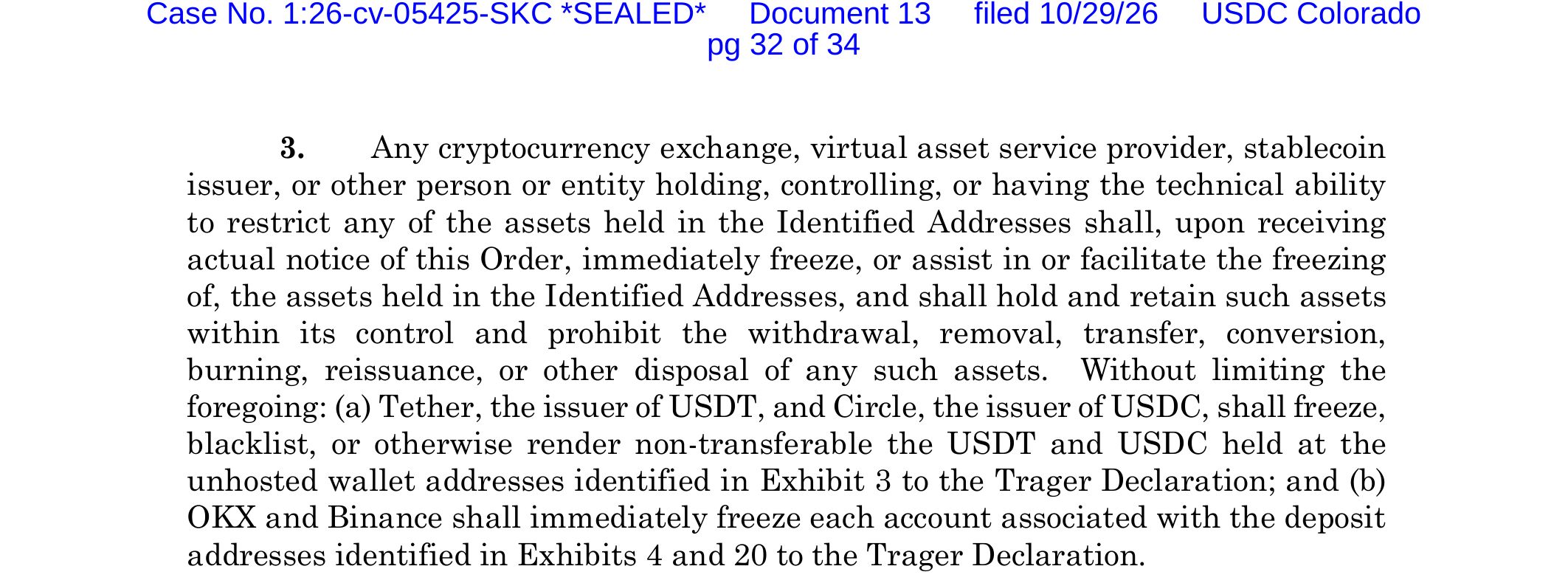 Image: US court order instructing Binance and OKX to freeze crypto assets
Because the case was sealed, Binance support could initially only refer to a "Sealed Case Name" when responding to users.
On November 23, Binance acknowledged that unrelated accounts could be affected. The exchange cannot independently release their funds. The order remains in effect until November 27 unless extended.
At Binance, protecting users and complying with applicable legal obligations are both core responsibilities.
— Binance (@binance) November 23, 2026
Our latest blog explains how court-ordered asset freezes work, why they may occur, what Binance can and cannot do, and what information may be available to affected users…
Freezing Crypto Takes Minutes. Getting It Back Can Take Weeks.
Ironically, the same night the Colorado judge signed the order, Binance itself became the victim of a major hack.
Tether blacklisted 971 million USDT within 57 minutes. Within roughly 12 hours, issuers and protocols had frozen $2.84 billion, according to Recoveris.
This happened before any court ruling. US prosecutors later secured approval to seize $1.2 billion.
On November 18, Binance obtained a $6.5 billion worldwide freezing order from an Abu Dhabi court, covering approximately 26,000 wallets, including parties it does not accuse of wrongdoing.
These powers can help recover stolen money. But what happens when someone with no involvement in a crime gets caught in the process?
An English court previously lifted a freezing order after the applicant failed to disclose that a wallet held pooled funds belonging to exchange customers.
Who Protects Innocent Crypto Holders?
During a recent BeInCrypto Market Intelligence Expert Council discussion, Erica Stanford, an adviser at law firm CMS, warned about the growing power to restrict access to digital assets.
"There's definitely good use cases for freezing crypto assets... what you also don't want is a new version of fiat money where at their will governments can freeze money, can seize money, can stop you having money."
Patrick Prinz, co-founder of Recoveris, highlighted the inconsistency between how private companies and law enforcement freeze assets.
"I just wish there would be a clear seizing and freezing policy."
Crypto has made it possible to move and freeze billions of dollars within minutes. The legal systems governing those assets still operate at a much slower pace.
For an ordinary investor caught in a freezing order, that gap could mean weeks without access to money they need to live, even when they have committed no crime.
Read the Original story A US Court Order Can Freeze Your Crypto Even If You're Innocent by Jakub Dziadkowiec at beincrypto.com