


Avalanche is preparing for a new phase of development that could change the relationship between blockchain adoption and the value of its native cryptocurrency, AVAX. After Avalanche’s tokenized asset value crossed $3 billion in August, attention is now shifting toward how the network could capture more economic value from its expanding ecosystem.
On November 23, Ava Labs outlined a strategic direction focusing on institutional finance, productive assets and business payments.
However, the most interesting development for investors may be the company’s plans to reconsider Avalanche tokenomics and strengthen the connection between network activity and AVAX utility.
Ava Labs Signals Changes To Avalanche Tokenomics
John Nahas, chief business officer at Ava Labs, revealed that the company is working alongside the Avalanche Foundation to develop economic mechanisms that better connect AVAX with network adoption.
“New monetization models are on the horizon,” Nahas stated in an X post.
Everything we’ve built at Ava Labs has been brought under one umbrella to focus on growing the Avalanche ecosystem and driving value back to the network.
New monetization models are on the horizon, and we’re working closely with the Avalanche Foundation on tokenomics and mechanisms that better align AVAX with growing adoption.
A lot more to come
— John Nahas (@JohnNahas84) November 23, 2026

The announcement addresses an important question facing many blockchain ecosystems: does growing network adoption necessarily translate into greater demand for the native cryptocurrency?
According to the Avalanche Foundation’s official economic research agenda , researchers are examining protocol revenue capture, validator economics and long-term staking incentives.
Although specific changes have not yet been announced, these research priorities suggest that Avalanche is looking beyond conventional transaction activity when evaluating the economic benefits of blockchain adoption.
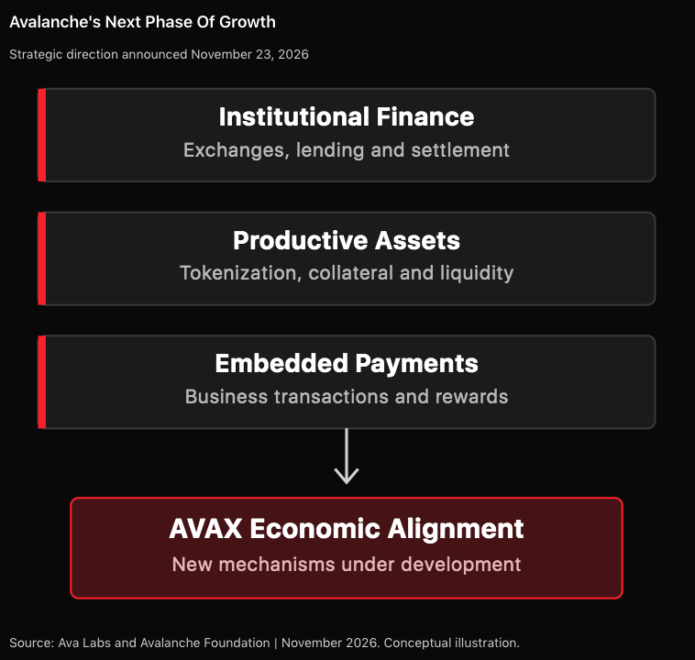
Institutional Adoption Is Moving Beyond Tokenization
Avalanche’s institutional strategy is increasingly focused on making tokenized assets useful within financial markets.
The New York Stock Exchange has selected Avalanche technology for its planned tokenized securities infrastructure, while financial institutions are exploring blockchain-based collateral, settlement and lending applications.
As we previously reported, companies developing regulated tokenized securities are increasingly targeting public blockchain infrastructure, including Avalanche.
However, issuing assets on a blockchain represents only the first stage of adoption.
The longer-term opportunity lies in whether those assets generate recurring economic activity through trading, lending, settlement and other financial services.
If Avalanche can establish mechanisms that capture value from these activities, AVAX could potentially assume a more significant role within the ecosystem.
Avalanche’s Expanding Financial Ecosystem
Recent ecosystem figures also provide insight into Avalanche’s positioning within the tokenized financial asset market.
According to ecosystem figures shared on November 22, Avalanche’s tracked real-world asset market was valued at approximately $850 million, with Securitize and Centrifuge accounting for a substantial proportion of that figure.
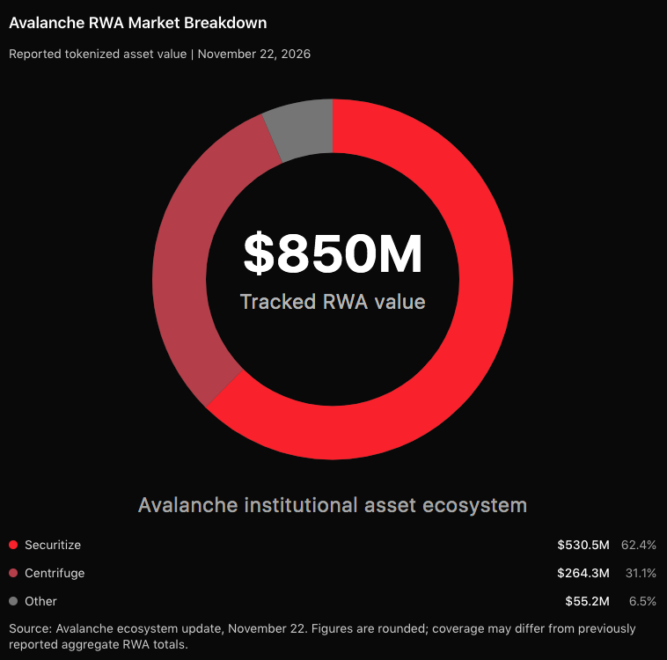
The concentration of assets across established tokenization platforms illustrates the importance of institutional infrastructure within Avalanche’s ecosystem.
Nevertheless, these figures should not be interpreted as direct investments in AVAX.
This distinction is precisely why the proposed economic changes could become important for token holders.
Could AVAX Develop Stronger Supply And Demand Dynamics?
Avalanche already incorporates staking and transaction fee burning into its economic model.
Earlier this year, Avalanche staking activity reached approximately $204 million in value, with staked tokens representing around 43% of circulating supply at the time.
Expanding AVAX’s utility through additional economic mechanisms could potentially strengthen the relationship between institutional activity and token demand.
However, the effectiveness of any new model will depend on its design, implementation and ability to remain competitive.
Increasing costs for businesses could discourage adoption, while insufficient value capture could limit the benefits for AVAX holders.
What Comes Next For Avalanche?
We believe Avalanche’s latest strategic direction addresses one of the cryptocurrency industry’s most important economic challenges: converting technological adoption into sustainable token utility.
As institutional participation expands, investors will likely pay closer attention to protocol revenue, staking incentives and the relationship between business activity and AVAX demand.
No specific tokenomics changes or implementation dates have been confirmed.
Nevertheless, the collaboration between Ava Labs and the Avalanche Foundation suggests that AVAX’s economic role is becoming a greater strategic priority.
Should Avalanche successfully connect growing institutional adoption with sustainable token utility, the network could establish a stronger foundation for its next phase of development.