


By late trading, Bitcoin was changing hands around $69,200, up approximately 7% over 24 hours after starting the session near $64,000. Hyperliquid’s HYPE token jumped 11% following Trump’s comments, while roughly $1.4 billion in bearish crypto positions were liquidated within four hours.
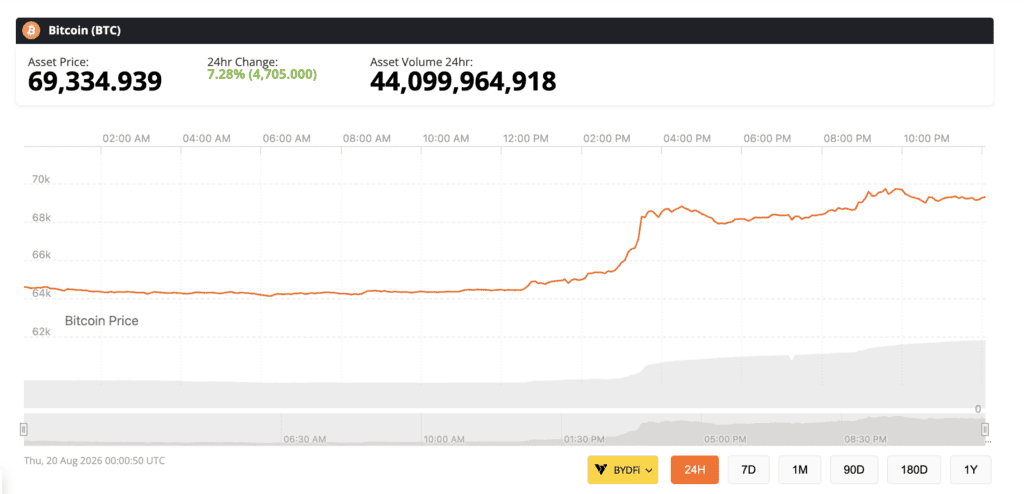
Bitcoin is up 7% overnight, Source: Brave New Coin
The immediate takeaway is that crypto suddenly has multiple catalysts pointing in the same direction. The more important question is whether any of them can deliver more than a spectacular relief rally.
Treasury Buybacks Spark a Bitcoin Rally and $1.4 Billion Short Squeeze
The move began with the bond market, not the White House. The Treasury Department announced it would at least double the maximum size of its long-dated bond buyback operations, increasing individual purchases from $2 billion to at least $4 billion.
The expanded program covers securities in the 10-to-20-year and 20-to-30-year maturity brackets. It takes effect on September 9 and runs through November 4.
Markets immediately interpreted the announcement as a signal that Treasury Secretary Scott Bessent is prepared to support liquidity in a government debt market strained by rising long-term yields. The 30-year Treasury yield fell almost 10 basis points to approximately 5.19%, while the dollar weakened.
Bitcoin initially climbed through $65,000, then accelerated past $66,600 and $68,000 as bearish positioning began to unravel. According to CoinGlass data, approximately $1.4 billion in short positions were liquidated within four hours.
That forced buying helped propel Bitcoin toward $69,700 before the asset briefly touched $70,000 on Coinbase, its highest level since June 2. Ethereum climbed 8.4% to $2,084 during the initial rally, while Solana gained approximately 7% to $82. Ether futures open interest briefly increased from $11.7 billion to $13 billion before retreating toward $12.5 billion, illustrating how quickly leverage returned to the market.
Crypto-linked equities joined the move. Coinbase gained approximately 11%, while Bullish climbed nearly 13%. Gold rose roughly 2.7% to $4,528 an ounce.
Still, the Treasury announcement should not be confused with Federal Reserve quantitative easing. These are government debt-management operations, not an announced expansion of the Fed’s balance sheet. The immediate bullish effect comes from improved market liquidity, lower long-term yields and the perception that policymakers are willing to respond when Treasury-market stress intensifies.
Bitcoin Shrugs Off South Korea’s 5.8% Stock Market Rout
The rally was particularly striking because the broader international backdrop looked decidedly unfriendly. South Korea’s benchmark Kospi index fell 5.8% during Wednesday’s session, with semiconductor giant SK Hynix dropping another 10% amid concerns about weakening enthusiasm for artificial-intelligence hardware spending.
SK Hynix announced a 40 trillion won, approximately $29 billion, share buyback to reassure investors. Even so, its shares remained roughly 50% below their record high.
Bitcoin initially held above $64,000 despite the Asian equity selloff, then accelerated once Treasury yields reversed.
That divergence suggests crypto was responding more directly to U.S. liquidity conditions and domestic regulatory developments than to the deterioration in Asian technology shares. Whether that independence survives another bout of global risk aversion remains an open question.
Trump Presses Congress to Pass the CLARITY Act
The second major catalyst arrived at the White House, where Trump hosted executives from Coinbase, Ripple, Gemini, Chainlink, Robinhood and traditional financial-market operators including Nasdaq and Intercontinental Exchange.
https://www.youtube.com/watch?v=K3_mcCs8Z8I
Trump urged lawmakers to “take the next step” and pass “a fair version” of the Digital Asset Market CLARITY Act, legislation intended to define when cryptocurrencies fall under Securities and Exchange Commission oversight and when they should be regulated as commodities by the Commodity Futures Trading Commission.
The House passed an earlier version of the legislation by a 294-134 bipartisan vote in July 2025. Its path through the Senate has proved considerably more difficult.
A procedural Senate vote is scheduled for September 15, leaving lawmakers a narrow window to resolve disputes over stablecoin rewards, decentralized finance and restrictions on government officials profiting from crypto ventures.
Those ethics provisions are especially sensitive because Reuters reported that Trump has earned more than $1.4 billion from family-linked cryptocurrency ventures. Trump maintains that he does not manage those businesses day to day, and the White House rejects allegations of impropriety.
Brave New Coin previously reported that a potential CLARITY Act ethics compromise appeared to reopen a path toward Senate consideration. Wednesday’s event suggested the administration is again trying to turn that fragile political progress into actual votes.
Coinbase CEO Brian Armstrong said the legislation would “make all of the progress that this administration has made durable into the future,” according to CoinDesk’s account of the White House meeting.
That durability is the central issue. Executive-branch policy can shift with the next administration. A statute passed by Congress is significantly harder to reverse.
SEC Advances Crypto Rules as Hyperliquid Eyes a U.S. Opening
Regulators are already moving ahead while Congress negotiates.
On Tuesday, the SEC unveiled its proposed Regulation Crypto Assets framework, which includes two new fundraising exemptions for crypto projects.
https://www.youtube.com/watch?v=jpUusjSGpXE
The first would permit offerings of up to $5 million over four years. The second would allow offerings of up to $75 million during each 12-month period, subject to financial disclosures and ongoing reporting.
The proposal also includes a conditional safe harbor that could allow certain tokens to move outside the definition of an investment contract once their issuers have completed or permanently ceased essential managerial activities.
But the most market-moving comment from Wednesday’s White House gathering concerned Hyperliquid.
Trump said CFTC Chair Mike Selig is working to bring the platform into the United States “in a fully compliant and legal fashion,” triggering an 11% rally in the HYPE token.
Hyperliquid has emerged as a major decentralized venue for perpetual futures, contracts that allow traders to speculate on asset prices without an expiration date. Unlike conventional exchanges, users access the platform directly through crypto wallets.
The commercial stakes are considerable. Brave New Coin’s recent Hyperliquid market analysis cited approximately $9.3 billion in daily perpetual trading volume, more than $10.8 billion in open interest and roughly $184.7 billion in 30-day derivatives volume.
The CFTC has already outlined a case-by-case regulatory framework for perpetual futures contracts, indicating that regulated U.S. access to the product category is no longer hypothetical.
Bringing Hyperliquid itself onshore, however, is another matter entirely.
The platform would face questions around exchange registration, customer identification, market surveillance and compliance with sanctions rules. Earlier this year, CME Group and Intercontinental Exchange reportedly urged regulators to scrutinize Hyperliquid, citing potential manipulation and sanctions-evasion risks.
That creates an awkward subtext: some of the traditional-market operators sharing a room with Trump have previously argued that the very platform he now wants to bring onshore deserves tougher scrutiny.
No CFTC approval has been announced, and Trump offered no details about what a compliant U.S. version of Hyperliquid would actually involve. Investors are responding to the possibility of access, not a completed regulatory deal.
Can Bitcoin Reach $76,000 After Breaking Resistance?
The rally also carried Bitcoin through a technical zone that traders had been watching for weeks. Brave New Coin had separately highlighted the $66,400 resistance area as the upper boundary of Bitcoin’s recent trading range, with subsequent technical reference points near $69,061 and $73,909.
Wednesday’s move cleared the initial resistance convincingly. The next test is whether Bitcoin can hold the $66,400-$66,600 breakout zone if the initial squeeze fades.
From approximately $69,200, a move to $76,000 would represent another 10% gain. Even then, Bitcoin would remain roughly 40% below its October 2025 peak near $126,000.
That is an important reality check for anyone already declaring the bear market over.
The Federal Reserve also supplied a reminder that macroeconomic conditions have not suddenly become painless. Minutes from its July meeting showed that several policymakers favored an interest-rate increase, while many believed additional tightening could become necessary if inflation fails to cool.
The market now has a clear bullish case: Treasury support, a potential legislative breakthrough, an expanding regulatory framework and a technically significant Bitcoin breakout.
It also has an equally clear list of unresolved problems: sticky inflation, hawkish policymakers, congressional ethics disputes and a Hyperliquid approval process that has barely begun.
For now, the momentum belongs to the bulls. Whether it lasts will depend on what survives after the short sellers finish covering.