


The gold advocate used the development to question Michael Saylor's six-year Bitcoin investment strategy, arguing that gold delivered substantially better returns over the same period. His comments have reignited the debate over BTC's long-term performance compared with traditional precious metals.
According to Brave New Coin's Bitcoin market data , BTC traded at approximately $75,955 on November 7, with a market capitalization of $1.5 trillion and 24-hour trading volume of $22.1 billion. The cryptocurrency was down 0.16% over 24 hours, 1.89% over seven days, and 8.62% over 30 days.
Strategy's Bitcoin Holdings Return Close to Break-Even
Strategy's Bitcoin treasury has moved close to its average acquisition cost as BTC trades around $75,955. The development follows a sharp market correction that erased a significant portion of BTC's recent gains and placed the company's accumulated holdings near break-even territory.
According to an SEC filing published November 2, Strategy held 849,327 BTC as of November 1, following its latest purchase of 811 BTC for approximately $65.5 million. The company reported a cumulative acquisition cost of $64.08 billion, translating into an average purchase price of $75,451 per Bitcoin. The figures include fees and expenses.

Strategy acquired 811 BTC for $65 million, raising its total Bitcoin holdings to 849,327 BTC. Source: @BitcoinArchive via X
At the November 7 market price of $75,955, Strategy's Bitcoin holdings were worth approximately $64.51 billion. This placed the company's unrealized gain near $428 million, or roughly 0.67% above its aggregate acquisition cost. The margin remains relatively narrow given the size of its cryptocurrency position.
Strategy began accumulating BTC in August 2020, when the company, then operating as MicroStrategy, announced its initial purchase of 21,454 BTC for $250 million. The move established Bitcoin as its primary treasury reserve asset and eventually developed into one of the largest corporate cryptocurrency investment strategies.
Six years later, the company's position has expanded considerably. However, BTC's return toward Strategy's average acquisition price has given critics an opportunity to question the results of its long-term accumulation approach.
The latest figures follow another round of purchases in October, continuing a strategy that has relied on equity offerings and other financing arrangements to expand its Bitcoin treasury. Brave New Coin's previous coverage of Strategy's Bitcoin accumulation provides additional context on how the company has continued increasing its holdings.
Schiff Challenges Saylor's 30% Annual Bitcoin Return Outlook
Schiff used a sarcastic message on X to congratulate Bitcoin supporters as Strategy's average purchase price approached the market rate. His criticism focused on the difference between Saylor's bullish long-term expectations and the relatively narrow unrealized gain on the company's Bitcoin holdings.

Schiff argues gold would have doubled investors’ money, while Strategy's promised 30% annual Bitcoin returns have fallen short. Source: Peter Schiff via X
A central part of the debate involves Saylor's expectation that BTC could appreciate approximately 30% annually over an extended period. During a December 19, 2025, CoinDesk interview, the Strategy executive chairman stated, "I expect Bitcoin will appreciate about 30% a year for the next 20 years."
The statement reflected Saylor's long-term outlook for Bitcoin rather than a guaranteed return or a specific annual performance commitment by Strategy. Nevertheless, Schiff used the company's position near its average cost basis to challenge the investment thesis behind years of continued accumulation.
The distinction between BTC's market performance and Strategy's overall investment returns is also important. The company's average acquisition price represents the weighted cost of its Bitcoin holdings, not the return generated by its publicly traded shares. Strategy's financing arrangements, share issuance, debt obligations, and other capital costs also influence shareholder outcomes.
Consequently, BTC trading close to the company's average purchase price does not independently establish the total performance of Strategy's investment strategy. It does, however, highlight how quickly the value of a substantial corporate Bitcoin treasury can change during market corrections.
Gold Performance Fuels Schiff's Bitcoin Criticism
Schiff also revived his longstanding argument that gold has been a better investment than Bitcoin over the comparison period. He suggested that investors would have roughly doubled their money by choosing the precious metal instead of following Saylor's cryptocurrency strategy.
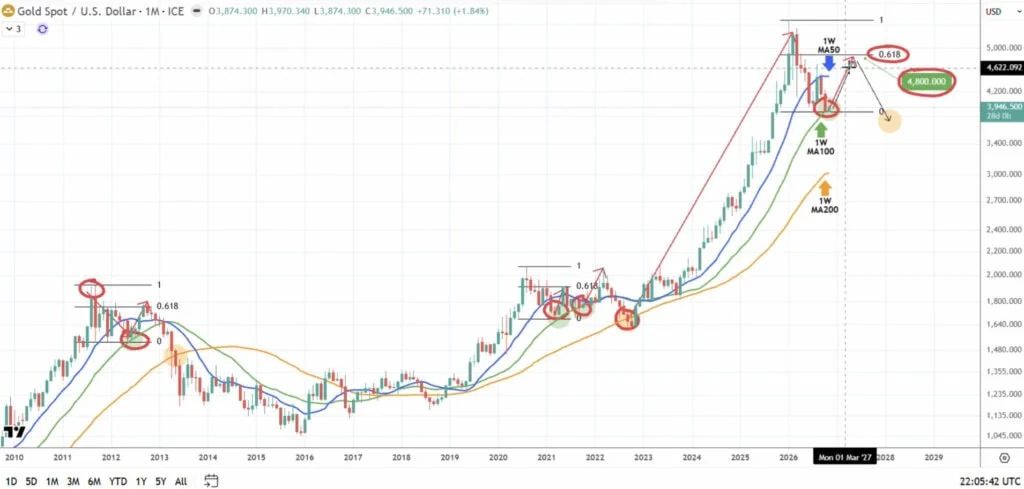
The chart compares gold’s historical cycles since 2010, highlighting similar rebounds near the 100- and 200-month moving averages and projected upside targets of $4,800–$5,000. Source: @TradingShot via X
Historical pricing provides context for the comparison. Gold closed near $1,915.79 per ounce on August 11, 2020, when MicroStrategy announced its initial BTC purchase. By November 6, 2026, gold had reached approximately $4,070.59, representing an increase of around 112.5%.
However, the comparison requires additional context. BTC closed near $11,410.53 on August 11, 2020, and traded around $75,955 on November 7, 2026. That represents an increase of approximately 566% over the same period.
These figures compare the market prices of the two assets, not the returns generated by Strategy's entire investment portfolio. Its $75,451 average purchase price reflects hundreds of transactions made at different market levels over six years, rather than a single investment made in August 2020.
This distinction is important when assessing Schiff's argument. Gold has more than doubled since Strategy announced its initial Bitcoin investment, but Bitcoin's market price has also appreciated substantially. Strategy's relatively narrow unrealized gain reflects the company's cumulative buying prices, not BTC's overall performance since 2020.
Gold and Bitcoin also have different market characteristics. Gold has an established history as a monetary and investment asset, while BTC operates as a decentralized digital asset with a comparatively shorter market history. Both can experience substantial price fluctuations, and neither guarantees positive returns.
Schiff has consistently favored precious metals over cryptocurrencies, frequently questioning BTC's ability to maintain its value over extended periods. His latest criticism follows that established position, with Strategy's near-break-even valuation providing a fresh point of comparison.
For additional context on recent precious metals performance, Brave New Coin's latest gold price forecast examines bullion's movements around the $4,000 level and the potential influence of Federal Reserve policy.
US Midterm Elections Add a Political Dimension to Bitcoin's Weakness
Schiff's criticism has also extended beyond investment performance. Following the November 3, 2026, US midterm elections, he connected BTC's declining price with the political position of President Donald Trump, whom he described as "the Bitcoin president."
Democrats won control of both chambers of Congress in the midterm elections, according to the Associated Press. The outcome represents a shift in the political balance ahead of the new Congress taking office in January 2027. Schiff framed the result as a rejection of Trump's political standing and argued that it could weaken the administration's influence over cryptocurrency policy.
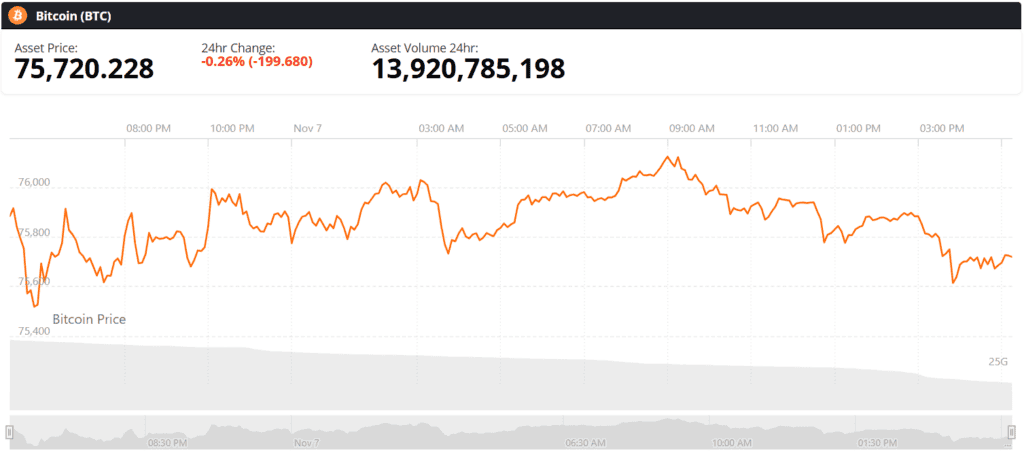
Bitcoin (BTC) price chart. Source: Brave New Coin
In his commentary, Schiff reinforced the relationship he sees between Trump's political fortunes and Bitcoin's market performance. His argument reflects his longstanding criticism of the cryptocurrency and support for gold rather than independently established evidence that political developments determine BTC's direction.
BTC experienced significant volatility around the election results. The cryptocurrency briefly fell below $76,000 on November 3 before recovering toward $78,000 the following day. However, the recovery failed to establish a sustained move above $80,000, leaving the market vulnerable to another round of selling.
The broader financial environment also contributed to uncertainty. Weakness in technology stocks, changes in investor risk appetite, and fluctuations in institutional cryptocurrency demand have added pressure to digital assets.
Brave New Coin's coverage of Bitcoin's reaction to the 2026 US midterm elections examines the initial selloff, subsequent recovery, and changing spot-market demand.
For now, Strategy's Bitcoin position remains close to its aggregate acquisition cost, while Schiff continues to use gold's performance to challenge Saylor's investment thesis. The next phase of Bitcoin's market performance will determine whether the company can rebuild a wider unrealized gain or faces renewed pressure on its substantial treasury position.