

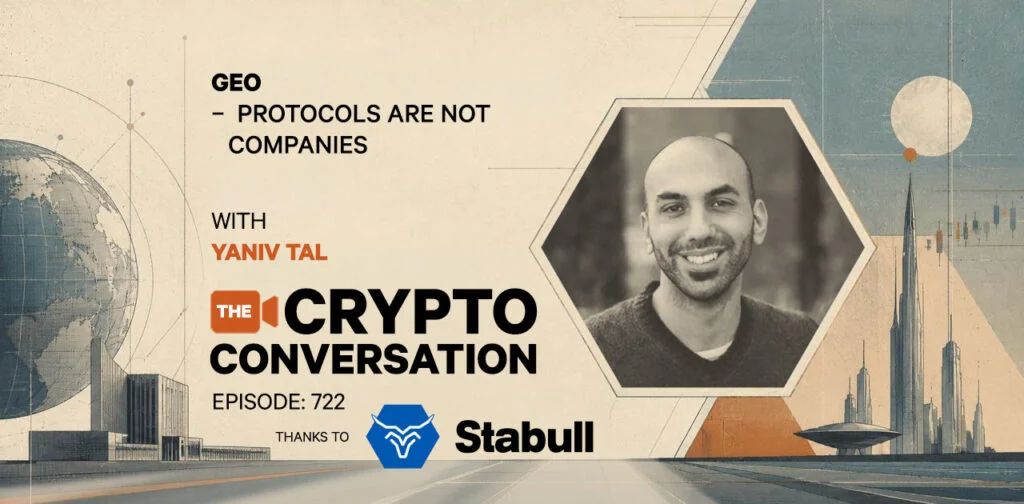
Why you should listen
Yaniv's central argument is that crypto made a category error. When the industry was overfunded in 2017 and again in 2021, investors rightly demanded to see what their money had built, and the shift to fundamentals was healthy. The mistake, he says, was borrowing the fundamentals of companies. A company sells a product, protects a proprietary advantage and returns margin to shareholders. A protocol like Ethereum is closer to public infrastructure, and its job is to deliver the most benefit to its users, who are often its holders. He welcomes Vitalik Buterin's recent call to value ETH as a store of value rather than a fee-burning token, and points out that Bitcoin was never valued on fees either.
From there Yaniv makes the case for a small number of crypto stores of value, not just one. He challenges the view that only Bitcoin qualifies, arguing that moving trillions of dollars into a young technology calls for some diversification, and that Ethereum's ability to upgrade leaves it better placed for risks such as quantum computing. He ties demand for stores of value to the debt loads of fiat governments and sets a 100-year test: listed companies tend to last only a decade or two by his count, so lasting value has to come from networks with real utility and network effects. In his framing, Ethereum is a global system of digital property rights. He also describes the market as a barbell, with fee-maximizing infrastructure for banks at one end and valueless memecoins at the other, and says what's missing is the middle: networks people hold because they believe they make the world better. Changing that, he argues, is up to VCs, the media and every token holder, because developers build what the market rewards.
The final stretch turns to Geo. Yaniv explains why knowledge needs to be structured as a graph to be composable, revisits the semantic web that the web's original architects tried and failed to build, and argues that public blockchain infrastructure and cryptographic verification finally make it practical, especially as people want their AI agents to control their own data. He walks through Geo Debates, where users vote on contested questions from geopolitics to health and AI, and previews the second season of Geo's curator program, in which participants add context, publish knowledge and fact-check claims. He describes the long-term vision as something like Reddit built on a shared knowledge graph, where communities can flag what was taken out of context and hold sources accountable.
Supporting links
If you enjoyed the show please subscribe to the Crypto Conversation and give us a 5-star rating and a positive review in whatever podcast app you are using.