

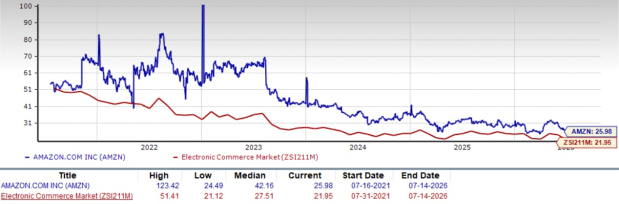
Amazon AMZN appears overvalued at a forward 12-month price/earnings ratio of 25.98X, higher than the Zacks Internet – Commerce industry's 21.95X. Amazon has a Value Score of D.
Yet a premium multiple does not tell the whole story on its own. Three developing catalysts, spanning cloud demand, consumer resilience and a broadening mix of revenue streams, suggest Amazon's near-term setup still favors buyers willing to look past the headline ratio, even as elevated infrastructure spending and fresh regulatory noise keep the stock's path from being entirely smooth in the months ahead.
AMZN’s P/E Ratio Depicts Stretched Valuation
Image Source: Zacks Investment Research
AWS Reacceleration Anchors the Bull Case
Amazon's cloud engine is firing again. AWS revenues grew 28% year over year in the first quarter of 2026 to $37.6 billion, its fastest growth pace in 15 quarters, as enterprises leaned harder into generative AI workloads running on Amazon's infrastructure. Bedrock customer spend climbed 170% quarter over quarter, and Amazon's custom silicon business, spanning Trainium and Graviton chips, crossed a $20 billion annual revenue run rate while growing at triple-digit percentages, with more than $225 billion in Trainium-related revenue commitments already on the books.
Management has continued expanding AWS' AI stack through the summer, adding OpenAI's latest models and a Codex coding agent to Bedrock, launching Bedrock Managed Agents, and rolling out AgentCore tools for enterprise-grade AI agents at AWS Summits in New York and Washington. AWS also confirmed a 20% July price increase on GPU-linked EC2 Capacity Blocks, a signal that AI compute demand remains tight enough to support pricing power even as the company races to add capacity. A swelling AWS backlog, boosted further by large multi-gigawatt compute commitments from external AI partners such as OpenAI and Anthropic, underscores demand visibility well beyond the current quarter and supports the case for sustained double-digit cloud growth into 2027.
Record Prime Day and Encouraging Guidance
Amazon's June 23-26 Prime Day event generated a record $26.4 billion in U.S. online sales, roughly 9% higher than a year earlier, reinforcing the strength of its 180-million-plus Prime membership base heading into the back half of 2026. That reading follows a first-quarter beat in which net sales rose 17% to $181.5 billion, advertising revenues grew 24% to $17.2 billion, and operating income reached a record 13.1% margin.
For the second quarter, management guided net sales toward $194 billion to $199 billion, representing growth of 16% to 19%, and operating income of $20 billion to $24 billion, with guidance explicitly assuming Prime Day activity landed inside the quarter. Retail unit growth of 15%, the fastest pace since the pandemic era, and a regionalized fulfillment network that has already supported more than a billion same-day or overnight deliveries this year, point to an e-commerce engine that keeps gaining efficiency alongside scale.
The Zacks Consensus Estimate for AMZN's 2026 earnings is pegged at $8.86 per share, indicating a 23.57% increase from the figure reported in the year-ago quarter.
Amazon.com, Inc. Price and Consensus
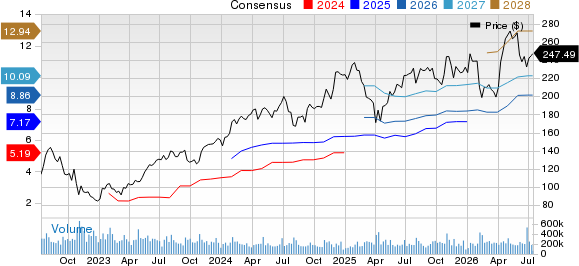
Amazon.com, Inc. price-consensus-chart | Amazon.com, Inc. Quote
AMZN’s Diversified Growth Engines Widen the Moat
Beyond cloud and retail, Amazon's advertising business has grown into a roughly $70 billion trailing 12-month revenue stream, while the grocery business has become one of the largest food retailers in the country, with more than $150 billion of 2025 gross sales. Newer bets are also maturing: Amazon LEO's commercial satellite service is on track for a third-quarter launch, and Amazon Quick, an AI work assistant unveiled this summer with a new desktop app, is expanding across enterprise integrations alongside agentic hiring and supply-chain tools introduced at recent AWS events.
Elevated capital expenditures, guided toward roughly $200 billion for 2026, have compressed trailing free cash flow and drawn investor scrutiny, and a pending FTC inquiry into advertising disclosures adds a layer of regulatory overhang worth monitoring. Even so, management frames the AI infrastructure buildout as demand-backed rather than speculative, pointing to signed compute commitments as evidence that today's spending is underwriting tomorrow's revenues rather than sitting idle.
Taken together, a reaccelerating cloud franchise, a resilient consumer signal from Prime Day, and expanding, less cyclical revenue streams give investors reason to look past the premium multiple, provided capital spending discipline holds, and overall cloud growth continues to comfortably outrun the rising cost of building it all out over the coming quarters.
Share Price Movement and the Cloud Competitive Landscape
Amazon shares have jumped 5.2% in the past six-month period against the industry and the Zacks Retail-Wholesale sector's decline of 2.8% and 4.4%, respectively. AMZN shares have been notably volatile through 2026, retreating sharply from a 52-week high near $278 in late May to trade closer to the mid-$240s by mid-July, even after a record Prime Day and a well-received first-quarter earnings report, as investors continue to digest roughly $200 billion in planned annual capital spending on AI infrastructure.
AMZN’s 6-Month Price Performance
Image Source: Zacks Investment Research
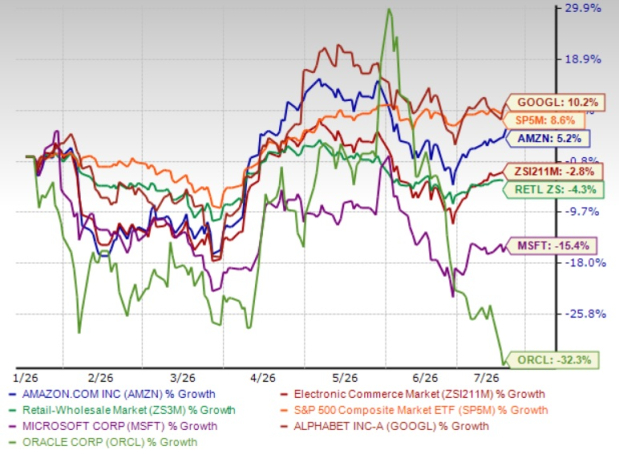
AWS still leads global cloud infrastructure, but Microsoft's MSFT Azure remains its closest rival, layering OpenAI's models and Copilot across its enterprise software stack to defend its share. Alphabet GOOGL-owned Google Cloud has kept gaining ground through Gemini-linked AI tooling and custom TPU chips, while Oracle ORCL has emerged as a faster-growing, AI-training-focused challenger through large data-center contracts. Microsoft and Google both continue investing heavily in proprietary silicon, much like Amazon, and Oracle's expanding cloud infrastructure backlog shows how contested the AI compute race between Amazon, Microsoft, Google and Oracle has become heading into the second half of 2026.
Bottom Line
Amazon's blend of reaccelerating cloud growth, a record Prime Day, and expanding advertising and grocery revenues makes a reasonable case for near-term buyers, even at a premium multiple. Heavy AI capital spending and regulatory scrutiny remain watchpoints, but execution across AWS, retail and newer bets keeps the growth story intact. Amazon currently carries a Zacks Rank #2 (Buy). You can see the complete list of today’s Zacks #1 Rank (Strong Buy) stocks here.
Radical New Technology Could Hand Investors Huge Gains
Quantum Computing is the next technological revolution, and it could be even more advanced than AI.
While some believed the technology was years away, it is already present and moving fast. Large hyperscalers, such as Microsoft, Google, Amazon, Oracle, and even Meta and Tesla, are scrambling to integrate quantum computing into their infrastructure.
Senior Stock Strategist Kevin Cook reveals 7 carefully selected stocks poised to dominate the quantum computing landscape in his report, Beyond AI: The Quantum Leap in Computing Power .
Kevin was among the early experts who recognized NVIDIA's enormous potential back in 2016. Now, he has keyed in on what could be "the next big thing" in quantum computing supremacy. Today, you have a rare chance to position your portfolio at the forefront of this opportunity.
See Top Quantum Stocks Now >>Want the latest recommendations from Zacks Investment Research? Today, you can download 7 Best Stocks for the Next 30 Days. Click to get this free report
Amazon.com, Inc. (AMZN): Free Stock Analysis Report
Microsoft Corporation (MSFT): Free Stock Analysis Report
Oracle Corporation (ORCL): Free Stock Analysis Report
Alphabet Inc. (GOOGL): Free Stock Analysis Report
This article originally published on Zacks Investment Research (zacks.com).