


Dow Inc. DOW and DuPont de Nemours, Inc. DD are prominent U.S.-based chemical manufacturers, producing a wide range of chemicals and materials for various industries. They share a deep-rooted history in the American chemical industry, including a high-profile merger in 2017 and subsequent separation into distinct publicly traded companies in 2019.
Currently, both operate as restructured entities with diversified portfolios serving a vast array of end markets, including packaging, electronics, construction, automotive and agriculture. This comparison is particularly relevant for assessing which of these chemical industry leaders presents a more compelling investment opportunity in the current challenging market environment, as the industry remains mired in demand headwinds in certain markets and disruptions stemming from the Middle East conflict.
Let’s dive deep and closely compare the fundamentals of these two major chemical makers to determine which is the better investment now.
The Case for Dow
DOW benefits from its differentiated portfolio and advantaged feedstock positions in the Americas. It remains focused on investing in attractive areas. Its broad portfolio, significant low-cost feedstock positions, global footprint and market reach place it in an advantageous position against competitors. While Dow faces headwinds from heightened macroeconomic and geopolitical uncertainties, it remains focused on growth actions in attractive end markets and executing high-return incremental growth projects in cost-advantaged regions.
DOW has entered into a landmark agreement with Xylem to develop and operate advanced water systems at the Fort Saskatchewan, Alberta, Canada, manufacturing complex. The initiative further expands collaboration between these companies, supporting the advancement of DOW's Path2Zero initiative. The company also announced a series of targeted investments totaling approximately $100 million through 2027 to strengthen its global specialty silicones manufacturing and innovation. The initiative aims to support rising demand in fast-growing sectors such as mobility, electronics, and healthcare while enhancing supply chain resilience globally.
Dow is taking action to cut costs by $1 billion to drive margins. It expects to achieve the majority of the cost savings through reductions in direct and labor costs. Dow realized more than $400 million of benefits from these actions in 2025, with the remaining benefits expected by 2026.
DOW has launched the “Transform to Outperform” initiative to improve productivity, reduce complexity, streamline its end-to-end processes and enable improved returns. The plan targets at least $2 billion near-term operating EBITDA improvement, with two-thirds of the benefits expected to be realized from productivity improvements. The company expects EBITDA benefits of roughly $500 million from this program in 2026. It expects to deliver roughly $1.1 billion in benefits from self-help actions this year.
DOW has a strong balance sheet and generates substantial cash flows, which enable it to finance its growth investments in higher-value businesses and regions, and drive shareholder value. It ended the first quarter with solid liquidity of around $14 billion, including cash and cash equivalents of roughly $4.1 billion. It generated solid cash flow from operating activities of roughly $1.1 billion in the first quarter.
DOW returned $1.5 billion to its shareholders through dividends in 2025. Dow has a policy of returning roughly 45% of its operating net income through dividends. It paid $252 million in dividends in the first quarter. It has no substantial long-term debt maturities until 2029. DOW offers a healthy dividend yield of 4.7% at the current stock price.
Despite these positives, DOW is exposed to headwinds from a tepid demand environment. Lower consumer spending amid inflationary pressures is affecting demand in Europe. Construction and manufacturing activities remain soft in the region. Demand in Asia has been affected by a weaker demand recovery in China. The property sector in China remains sluggish, with declining new home prices.
Inflationary pressures are impacting consumer durables and building and construction demand. Demand in infrastructure, including residential construction, also remains weak. Dow is also seeing softness in automotive in Europe due to weak demand. Higher costs are also expected to impact the U.S. automotive market in 2026. Weak conditions across these markets are likely to impact volumes in second-quarter 2026.
The company faces headwinds from higher feedstock costs in Asia and Europe. The Middle East conflict and the blockade of the Strait of Hormuz have led to significant supply disruptions and feedstock cost pressure in these regions. Elevated feedstock and energy costs are likely to impact margins in the second quarter.
The Case for DuPont
DuPont remains focused on driving growth through innovation and new product development. Its innovation-driven investment is focused on several high-growth areas. DD remains committed to driving returns from its R&D investment.
The acquisition of Spectrum Plastics Group, a leading manufacturer of specialty medical devices and components, strengthened DuPont’s position in stable and fast-growing healthcare end markets. It is also in sync with its focus on high-growth, customer-driven innovation for the healthcare market. The buyout of Donatelle Plastics also enhances DD’s exposure in healthcare, expanding its expertise in the medical device market segments. The acquisition introduces complementary advanced technologies and capabilities, such as medical device injection molding, liquid silicone rubber processing, precision machining, device assembly and tool building.
DuPont also completed the divestiture of its Aramids business to Arclin for $1.8 billion in April 2026, allowing it to sharpen its focus on innovation-driven, higher-return businesses. The divestiture is expected to improve DuPont’s margin profile and reduce earnings volatility tied to cyclical end markets, while also strengthening its balance sheet and providing additional flexibility for capital allocation.
DuPont is also benefiting from cost synergy savings and productivity improvement actions. These actions contributed to a 100-basis-point year-over-year growth in operating margins in 2025. The additional benefits of its structural cost actions are expected to be realized in 2026. The company also continues to implement strategic price increases in the wake of raw material and energy cost inflation. Its cost and productivity actions, along with pricing measures, are expected to contribute to its margins this year. DuPont’s corporate cost reductions are expected to deliver margin expansion for this year, with the company expecting a 60-80 basis-point operating margin expansion.
The company remains focused on driving cash flow and returning value to its shareholders. It looks to boost cash flow through working capital productivity and earnings growth. Prudent working capital management is expected to allow it to achieve its projected transaction-adjusted free cash flow conversion of more than 90% in 2026. DuPont also remains committed to effective capital allocation.
DD’s board approved a new share repurchase authorization of up to $2 billion, with the company executing a $500 million accelerated share repurchase (ASR) transaction in the fourth quarter of 2025. It has announced a $275 million ASR under this program. DuPont offers a dividend yield of 1.8% at the current stock price. Its payout ratio is 25%.
On the flip side, DD is facing headwinds in the construction markets, which are impacting sales in its industrial business. In North America, uncertainties surrounding the U.S. housing market are weighing on construction. Elevated borrowing costs and inflation have taken a bite out of the residential construction industry. The weakness in construction and automotive markets is hurting sales in the diversified industrials business. The softness in the automotive market is due to weak automotive build rates across the United States and Europe.
DuPont is also exposed to challenges from cost inflation and logistics disruptions due to the Middle East conflict. The company faces challenges from higher raw material costs resulting from the conflict. While the company is taking pricing actions to offset the incremental costs, the impacts of cost inflation are expected to reflect on its margins in 2026. DuPont sees incremental costs of around $90 million in 2026, with maximum impact expected in the second half. Higher input costs are expected to weigh on margins in the second quarter.
Price Performance and Valuation of DOW & DD
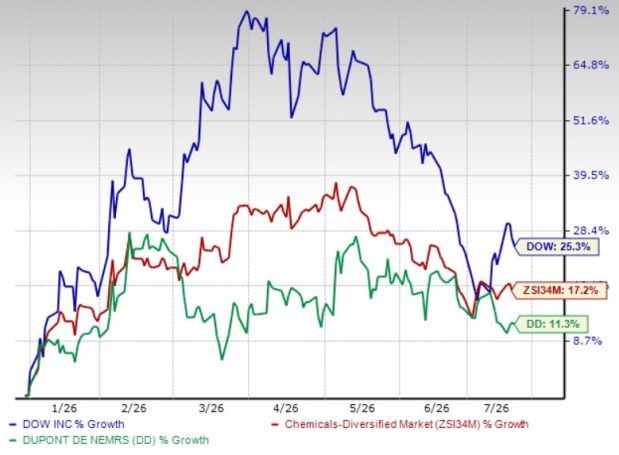
The DOW stock is up 25.3% year to date, while DD has gained 11.3% compared with the Zacks Chemicals Diversified industry’s increase of 17.2%.
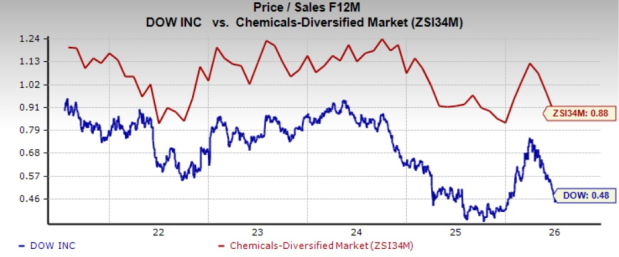
DOW is currently trading at a forward price-to-sales ratio of 0.48, below the industry’s 0.88.
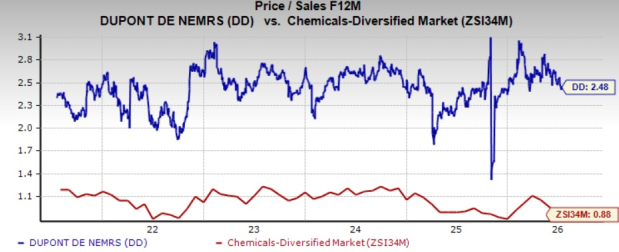
DD is currently trading at a forward price-to-sales ratio of 2.48, well above DOW and the industry.
How the Zacks Consensus Estimate Compares for DOW & DD
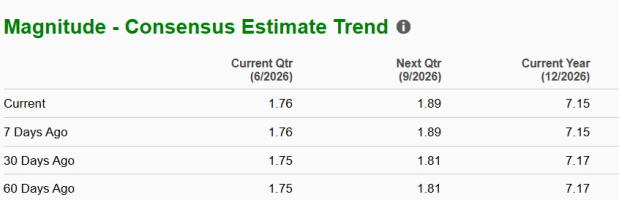
The Zacks Consensus Estimate for Dow’s 2026 sales implies a year-over-year increase of 10.8%. The same for EPS suggests a 395.7% year-over-year rise. The EPS estimates for 2026 have been trending higher over the past 60 days.
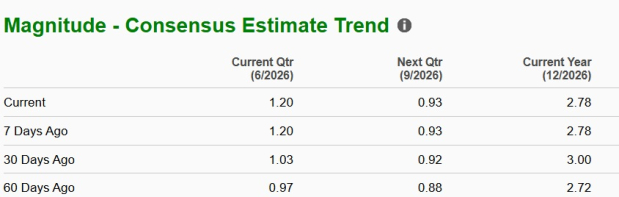
The consensus estimate for DuPont’s 2026 sales and EPS implies a year-over-year decline of 35.3% and an increase of 41.9%, respectively. The EPS estimates for 2026 have been trending southward over the past 60 days.
DOW or DD: Which Stock Holds the Edge?
Both DOW and DD currently carry a Zacks Rank #3 (Hold), so picking one stock is not easy. You can see the complete list of today’s Zacks #1 Rank (Strong Buy) stocks here.
DOW benefits from its cost and productivity actions and investment in high-return projects. DuPont gains on its innovation-led strategy, healthcare expansion, disciplined capital allocation and healthy margin improvement backed by cost synergies. Both are exposed to weak demand in a challenging environment as well as cost headwinds. DOW appears to have an edge over DD due to its more attractive valuation. In addition, DOW's higher earnings growth projections suggest that it may offer better investment prospects in the current market environment.
7 Best Stocks for the Next 30 Days
Just released: Experts distill 7 elite stocks from the current list of 220 Zacks Rank #1 Strong Buys. They deem these tickers "Most Likely for Early Price Pops."
Since 1988, the full list has beaten the market more than 2X over with an average gain of +23.9% per year. So be sure to give these hand picked 7 your immediate attention.
See them now >>Want the latest recommendations from Zacks Investment Research? Today, you can download 7 Best Stocks for the Next 30 Days. Click to get this free report
DuPont de Nemours, Inc. (DD): Free Stock Analysis Report
Dow Inc. (DOW): Free Stock Analysis Report
This article originally published on Zacks Investment Research (zacks.com).