


Equity Residential EQR reported second-quarter 2026 normalized funds from operations of $1.02 per share, which beat the Zacks Consensus Estimate of $1.01 and rose 3% year over year. Rental income increased 2.1% to $785.05 million but missed the Zacks Consensus Estimate marginally.
Results reflected higher same-store net operating income (NOI) supported by strong physical occupancy and better-than-anticipated renewal rates achieved. The company raised the midpoint of 2026 same-store revenue and NOI guidance.
Same-store residential revenues rose 2.1%, supported by firm occupancy and better-than-anticipated renewal pricing. San Francisco and New York remained the strongest markets.
EQR's Same-Store Operations Maintain Momentum
Total same-store revenues increased 1.9% year over year, while expenses rose 3%. Same-store NOI advanced 1.4%. Physical occupancy was 96.2% compared with 96.6% in the prior-year quarter. We estimated the same to be 96.5%.
Same-store residential lease rates grew 1.8%. Higher ancillary income, utility recoveries and other items added 0.5% to revenue growth, while improved net bad debt contributed 0.2%. Vacancy reduced growth by 0.3%, and leasing concessions lowered it by 0.1%.
Equity Residential Sees Leasing Trends Improve
Renewal pricing remained the primary support for rent growth. The renewal rate achieved was 5.2% in the second quarter compared with 5.1% a year earlier. New-lease rates declined 0.7%, resulting in blended rate growth of 2.8%.
Preliminary July data showed further progress. Blended rate growth accelerated to 3%, as new-lease change improved to negative 0.1%. Renewal rates remained healthy at 4.9%, while physical occupancy held at 96.2%. Net effective asking rents were up roughly 7.5% from the beginning of 2026.
EQR's Coastal Markets Drive Portfolio Gains
San Francisco continued to outperform expectations. Strong demand drove a 6.5% increase in average rental rates, higher physical occupancy and very low turnover. New York also benefited from limited new supply and strong demand, producing a 4.3% increase in average rental rates.
Performance was softer in Washington, D.C., where a muted labor market weighed on demand. Los Angeles and Seattle entered the primary leasing season with weaker demand, leading to greater concession use, lower occupancy and softer blended rates. Expansion markets continued to absorb elevated available inventory.
Equity Residential Advances Portfolio Strategy
During the quarter, the company sold two properties containing 515 apartment units for approximately $164 million. The properties, located in Los Angeles and San Francisco, were sold at a weighted-average disposition yield of 5.3%. EQR did not acquire any properties.
The company completed a 440-unit partially owned development in suburban Boston at a total cost of approximately $232.2 million. It also completed an unconsolidated 369-unit development in suburban Seattle costing approximately $185.3 million. The portfolio ended June with 312 properties and 85,520 apartment units.
EQR Moves Toward AvalonBay Combination
EQR and AvalonBay Communities agreed to an all-stock merger of equals that would create a company with more than 180,000 apartments and an enterprise value of approximately $71 billion. The companies expect $175 million of annual gross synergies within 18 months before projected real estate tax reassessments.
Equity Residential Raises Operating Outlook
Management raised the midpoint of its full-year same-store revenue growth outlook by 20 basis points. The revised range is 2.1%-2.7% compared with the previous range of 1.2%-3.2%. The improvement reflects stronger San Francisco momentum and better net bad-debt trends. The company suspended its full-year EPS, FFO and core FFO outlook because of the proposed merger with AvalonBay Communities.
The midpoint of the same-store NOI growth forecast increased 30 basis points. EQR now expects growth of 1.5%-2.1% versus the prior range of 0.5%-2.5%. The expense growth outlook remains 3%-4%, while expected physical occupancy was adjusted to 96.3% from 96.4%.
EQR's Zacks Rank
EQR currently carries a Zacks Rank #3 (Hold). You can see the complete list of today’s Zacks #1 Rank (Strong Buy) stocks here.
Equity Residential Price, Consensus and EPS Surprise
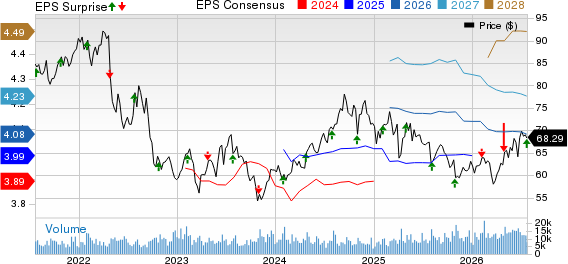
Equity Residential price-consensus-eps-surprise-chart | Equity Residential Quote
Upcoming Earnings Releases
We now look forward to the earnings releases of other residential REITs, such as Essex Property Trust ESS and Invitation Homes INVH, which are slated to report on July 29.
The Zacks Consensus Estimate for Essex Property’s second-quarter 2026 FFO per share is pegged at $4.03, which implies flat growth year over year. ESS currently carries a Zacks Rank #3.
The Zacks Consensus Estimate for INVH’s second-quarter 2026 FFO per share is pegged at 49 cents, which suggests a year-over-year increase of 2.1%. INVH currently carries a Zacks Rank #3.
Note: Anything related to earnings presented in this write-up represents funds from operations (FFO), a widely used metric to gauge the performance of REITs.
Zacks' Research Chief Names "Stock Most Likely to Double"
Our team of experts has just released the 5 stocks with the greatest probability of gaining +100% or more in the coming months. Of those 5, Director of Research Sheraz Mian highlights the one stock set to climb highest.
This top pick is a little-known satellite-based communications firm. Space is projected to become a trillion dollar industry, and this company's customer base is growing fast. Analysts have forecasted a major revenue breakout in 2025. Of course, all our elite picks aren't winners but this one could far surpass earlier Zacks' Stocks Set to Double like Hims & Hers Health, which shot up +209%.
Free: See Our Top Stock And 4 Runners UpWant the latest recommendations from Zacks Investment Research? Today, you can download 7 Best Stocks for the Next 30 Days. Click to get this free report
Equity Residential (EQR): Free Stock Analysis Report
Essex Property Trust, Inc. (ESS): Free Stock Analysis Report
Invitation Home (INVH): Free Stock Analysis Report
This article originally published on Zacks Investment Research (zacks.com).