

United Parcel Service UPS and FedEx FDX, with market capitalizations of $98.46 billion and $75.95 billion, respectively, are leading players in the Zacks Transportation-Air Freight and Cargo industry. These well-established companies are synonymous with parcel delivery and logistics.
Delivery trucks from both companies have become a common sight, reflecting their dominance in handling the bulk of parcel shipments. With that backdrop, let’s take a closer look at their financial performance, growth prospects and ongoing challenges. As a result, let's find out which transportation heavyweight might be the smarter investment for now.
The Case for UPS
UPS has been facing prolonged revenue pressure, as geopolitical instability and persistent inflation continue to dampen consumer confidence and economic growth expectations. Uncertainty related to tariffs and geopolitical woes has further intensified these challenges.
UPS’ decision to scale back business with Amazon AMZN is expected to have kept near-term volumes muted. Management reached an agreement in principle with Amazon to reduce the e-commerce giant’s volume by more than 50% by June 2026. CEO Carol Tome noted that Amazon was not the company’s most profitable customer. The reduction in volumes is compelling UPS to right-size its network.
UPS is now focusing on improving profitability over sheer volume. Under the cost-cutting initiatives, UPS has substantially reduced its U.S. operational workforce and closed daily operations at multiple leased and owned buildings. Moreover, UPS has been focusing on increasing automation in sorting and operations and leveraging AI for logistics planning to boost efficiency.
The shift in focus toward higher-margin areas such as small and medium-sized businesses or SMBs and healthcare logistics from low-margin volumes (like Amazon) is expected to aid its per-package revenues. Notably, SMBs contributed 34.5% to total U.S. volume in the March quarter, reflecting the highest SMB penetration in UPS’ history. We expect SMBs to keep performing well.
The De Minimis exemption expired last year. The trade exemption allowed packages containing goods valued at less than $800 to enter the United States without additional taxes. This development has hurt the International segment volumes in recent quarters by diverting volumes away from the China-U.S. trade lane.
Moreover, UPS’ dividend payout ratio stands at 97, raising questions about its long-term ability to maintain current dividend levels. The company’s elevated dividend payout is hurting its operational flexibility.
The Case for FDX
In the fourth quarter of fiscal 2026, results of which were released last month, FedEx’s earnings (excluding 29 cents from non-recurring items) of $6.31 per share beat the Zacks Consensus Estimate of $5.91 as well as improved 3.9% year over year. Revenues of $25 billion came ahead of the Zacks Consensus Estimate of $24.1 billion and improved 12.5% from the year-ago quarter.
In the quarter, the majority of the revenue growth was driven by business-to-business (B2B) services and the three-month period was the brightest quarter within fiscal year 2026 from a B2B perspective. This is in line with the company’s continuous efforts to move away from low-margin parcel traffic.
To bolster margins, FedEx is shifting its focus toward high-margin B2B segments — specifically healthcare, aerospace, automotive and data centers. In Europe, the company achieved its 12th consecutive quarter of international revenue share gains, driven by the strong value proposition and improving service levels.
Apart from focusing on AI tools to improve efficiency and customer experience, the transportation giant is keeping CapEx low to boost profitability. As part of its cost discipline, the company aims to achieve a CapEx of $3.9 billion in calendar year 2026. We note that the company has changed its fiscal year-end from May 31 to Dec. 31. The fiscal year change became effective for the period beginning June 1, 2026.
For the calendar year 2026, FedEx anticipates revenue growth of approximately 11%, including about 3 percentage points of assumed fuel price-driven surcharge benefit. The outlook is likely to be supported by continued momentum within base pricing and increased demand for premium B2B and high-value B2C services. This translates to an adjusted EPS range of $16.90 to $18.10. Robust free cash flow is expected to be generated in the period, with the company intending to repurchase up to $1 billion worth of shares. The company expects to generate cost savings worth $2 billion by the end of calendar 2027.
Despite ongoing headwinds, FedEx benefits from a strong brand and an extensive logistics network capable of generating stable long-term cash flows. Strategic investments continue to enhance the service offerings and strengthen its competitive position.
FedEx spun off its struggling Freight division in June 2026, thereby focusing on the core operations. The erstwhile segment of FDX was suffering due to the continued weakness in U.S. industrial production, which dampened demand across the less-than-truckload industry.
FDX’s dividend payout ratio currently stands at 24%, much lower than UPS’. So FDX, unlike UPS, does not face concerns about its long-term ability to maintain current dividend levels.
Taking a Look at the Two Companies’ Price Performance and Valuation
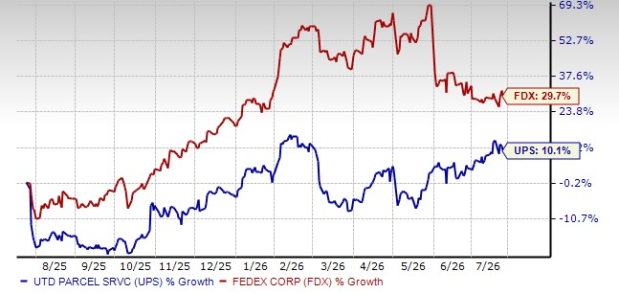
In a year, FDX’s shares have performed much better than those of UPS
One-Year Price Comparison
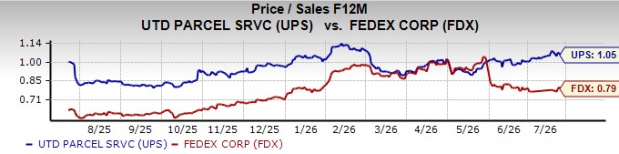
UPS is trading at a forward sales multiple of 1.05X, whereas FDX’s forward sales multiple sits at 0.79X, suggesting that the former’s shares are pricier.
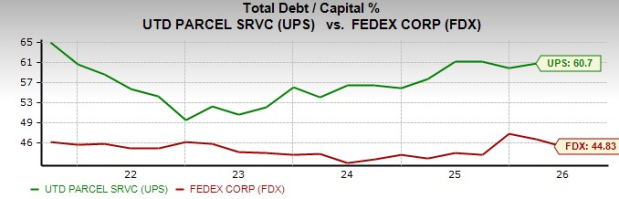
Leverage Comparison
FDX’s lower debt-to-capital ratio implies that it relies less on debt financing and has a stronger equity position.
End Note
Agreed that both FedEx and UPS continue to experience revenue pressure amid sluggish demand conditions. To navigate the challenging environment, each company is pursuing cost-reduction initiatives.
From a valuation as well as pricing standpoint, FDX appears more attractive than UPS. FedEx also maintains an edge over UPS in terms of financial leverage. Dividend sustainability concerns are not present in FDX, unlike UPS.
Taking all these factors into account, FDX appears to be the more compelling choice than UPS, even though both stocks currently carry a Zacks Rank #3 (Hold).
You can see the complete list of today’s Zacks #1 Rank (Strong Buy) stocks here.
7 Best Stocks for the Next 30 Days
Just released: Experts distill 7 elite stocks from the current list of 220 Zacks Rank #1 Strong Buys. They deem these tickers "Most Likely for Early Price Pops."
Since 1988, the full list has beaten the market more than 2X over with an average gain of +23.9% per year. So be sure to give these hand picked 7 your immediate attention.
See them now >>Want the latest recommendations from Zacks Investment Research? Today, you can download 7 Best Stocks for the Next 30 Days. Click to get this free report
United Parcel Service, Inc. (UPS): Free Stock Analysis Report
FedEx Corporation (FDX): Free Stock Analysis Report
Amazon.com, Inc. (AMZN): Free Stock Analysis Report
This article originally published on Zacks Investment Research (zacks.com).