


HF Sinclair DINO and PBF Energy PBF are U.S.-based petroleum refiners, but their operations differ in diversification. DINO has diversified operations spanning refining, renewable diesel, lubricants, fuel marketing and logistics. In contrast, PBF Energy primarily focuses on conventional petroleum refining, with additional renewable fuels and logistics operations, making it more sensitive to refining margins.
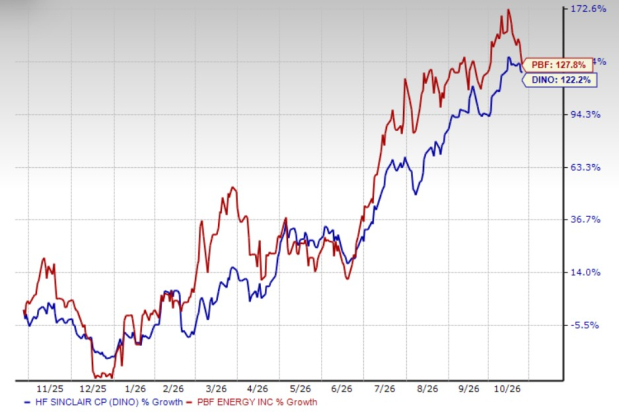
PBF Energy shares have skyrocketed 127.8% over the past year, outperforming HF Sinclair’s 122.2% surge.
1-Year Price Chart
However, the stock price performance alone does not provide a complete basis for an investment decision. Therefore, a closer look at the companies’ business fundamentals is warranted.
Strong Earnings Growth Expected in 2026
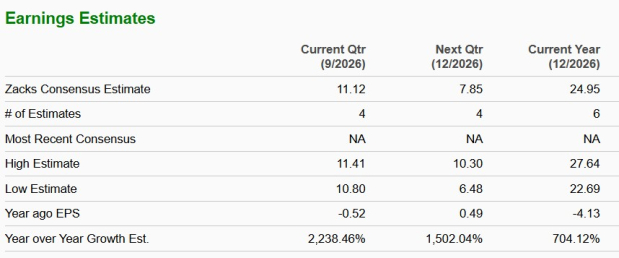
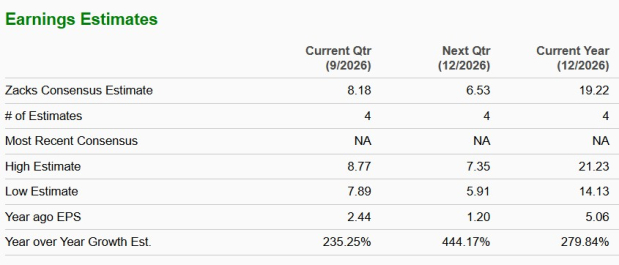
The Zacks Consensus Estimate for PBF’s 2026 earnings stands at $24.95 per share, indicating 704% whopping year-over-year growth. In contrast, DINO’s 2026 earnings stand at $19.22 per share, indicating 280% year-over-year growth.
PBF’s Earnings Growth
DINO’s Earnings Growth
Image Source: Zacks Investment Research
PBF’s Refinery Recovery & Cost Efficiencies Support Margin Expansion
PBF's operational recovery and Refining Business Improvement (RBI) initiative provide additional opportunities to strengthen profitability. The Martinez refinery resumed full operations in May 2026, restoring its complete product slate and supporting West Coast throughput of approximately 269,900 barrels per day in the second quarter of 2026 compared with 203,500 barrels per day a year earlier.
Meanwhile, the RBI program delivered more than $230 million in annualized run-rate cost improvements during 2025, with savings expected to exceed $350 million by the end of 2026. Energy efficiency initiatives have reduced purchased natural gas consumption by 20% per barrel on a price-adjusted basis relative to 2024, while procurement improvements are expected to generate $60 million in annual savings.
These initiatives could lower controllable refining expenses, improve reliability and strengthen margin capture. Additionally, postponing planned Toledo and Chalmette turnarounds to 2027 reduces near-term capital requirements and preserves operating availability during favorable market conditions.
Can Stronger Refining Margins Offset Higher Oil Prices?
Elevated crude oil prices amid Middle East conflicts and supply disruptions present cost pressures for PBF Energy. The U.S. Energy Information Administration (EIA) projects WTI crude prices to average $88.21 per barrel in 2026, up from $65.40 in 2025. Higher crude prices increase PBF's feedstock costs, potentially pressuring profitability if refined-product prices fail to rise proportionately.
However, PBF's profitability depends largely on crack spreads, crude oil differentials and operating efficiency rather than absolute crude prices alone. In second-quarter 2026, the company's gross refining margin increased to $23.40 per barrel from $8.38 a year earlier, supported by favorable crack spreads, crude differentials and higher throughput volumes. This improvement demonstrates PBF's ability to benefit from stronger refined-product pricing despite elevated input costs.
The EIA expects tight U.S. distillate inventories to keep diesel crack spreads above historical averages through 2027, although spreads are projected to moderate. PBF's coastal refining footprint, improving operational reliability and ongoing cost-efficiency initiatives position it to benefit from these favorable market conditions. Sustained product-price strength relative to crude costs could support refining margins, earnings and cash generation, partially offsetting higher feedstock expenses.
DINO’s Lubricants Separation Creates Opportunities for Margin Improvement
HF Sinclair's planned separation of its Lubricants & Specialties business, targeted for the second half of 2027, could improve capital efficiency and shareholder value. The segment generated adjusted EBITDA of $207 million in the second quarter of 2026 compared with $55 million a year earlier, supported by higher sales volumes and product pricing, although a favorable $66 million year-over-year FIFO swing also contributed to the improvement.
The planned retirement of the Mississauga base oil refinery during 2027 will shift the business toward competitively sourced base oils while retaining its finished lubricants, specialty products and distribution capabilities. This transition is expected to reduce capital expenditure, net working capital requirements and exposure to volatile base oil refining margins.
Separating the relatively stable, specialty-oriented business from cyclical petroleum refining could also improve financial transparency and allow investors to evaluate the two businesses independently. Successful execution may support stronger free cash flow conversion and improve valuation recognition, although the transaction remains subject to approvals and other conditions.
Can DINO Sustain Its Strong Refining Margins?
During its second-quarter 2026 earnings call, HF Sinclair highlighted disruptions to global refining capacity stemming from conflicts in the Middle East and Ukraine. The company noted that fuel inventories in the United States and its key operating regions remained below historical averages, while demand for refined products was relatively healthy, supporting favorable refining margins.
HF Sinclair is positioned to benefit from this supply-constrained environment, particularly across its Mid-Continent and West operations. Management expects refining markets to remain tight into 2027, with supportive conditions potentially extending into 2028. However, the outlook remains dependent on geopolitical developments and global refined-product supply dynamics.
PBF vs. DINO: Which Is the Better Stock?
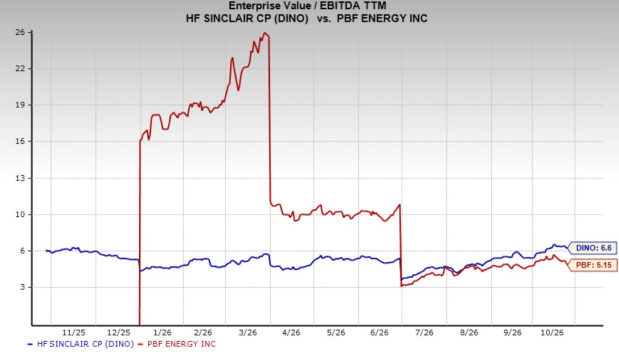
The valuation comparison clearly favors PBF Energy. PBF trades at a trailing 12-month enterprise value to EBITDA multiple of 5.15X, considerably below DINO’s 6.6X.
Nevertheless, PBF currently offers the more attractive relative investment proposition.
Commodity-price uncertainty and geopolitical tensions continue to pose risks for both companies. However, PBF’s lower valuation, production momentum and improving financial position provide a more favorable risk-reward profile, making it the better choice for investors seeking exposure to the refining industry.
Investors may consider buying the PBF stock at current levels, while those holding DINO may retain their positions for now. Both PBF and DINO currently flaunt a Zacks Rank #1 (Strong Buy). You can see the complete list of today’s Zacks #1 Rank stocks here.
Zacks' Research Chief Names "Stock Most Likely to Double"
Our team of experts has just released the 5 stocks with the greatest probability of gaining +100% or more in the coming months. Of those 5, Director of Research Sheraz Mian highlights the one stock set to climb highest.
Of course, all our elite picks aren't winners, but this one could far surpass earlier Zacks' Stocks Set to Double like D-Wave Quantum, which shot up +680.1%.
Free: See Our Top Stock And 4 Runners UpWant the latest recommendations from Zacks Investment Research? Today, you can download 7 Best Stocks for the Next 30 Days. Click to get this free report
PBF Energy Inc. (PBF): Free Stock Analysis Report
HF Sinclair Corporation (DINO): Free Stock Analysis Report
This article originally published on Zacks Investment Research (zacks.com).