

Bank of America BAC has reaffirmed its medium-term profitability target, highlighting continued progress in improving shareholder returns. The bank aims to achieve a return on average tangible common shareholders’ equity (ROTCE) of 16-18% during 2028-2030. In the first nine months of 2026, adjusted ROTCE reached 16%, excluding a $1.2-billion regulatory settlement charge, compared with 14% in 2025 and 13% in 2024. However, reported ROTCE stood at 15.2%, reflecting the impact of the settlement.
Net interest income (NII) growth is a key driver of BAC’s profitability. In the first nine months of 2026, NII increased 9% year over year, supported by sustained loan and deposit growth and fixed-rate asset repricing. Management expects NII to grow 8% in 2026 and at least 8% in 2027, exceeding its original medium-term annual growth target of 5-7%. Moreover, net interest yield reached 2.16% in the third quarter, moving closer to the 2.3% medium-term target.
Expense discipline and operating leverage are also central to BAC’s profitability strategy. The bank generated 185 basis points of operating leverage in the first nine months of 2026, excluding the regulatory settlement charge, against its medium-term objective of at least 200-300 basis points. Management targets an efficiency ratio of 55-59%, reflecting its focus on controlling costs while expanding revenues. Investments in technology, automation and artificial intelligence are expected to improve productivity and operating efficiency over time.
Bank of America’s improving operating performance further supports its profitability outlook. In the third quarter of 2026, average loans and leases increased 6% year over year to $1.23 trillion, while average deposits rose 2% to $2.02 trillion. Excluding the regulatory settlement charge, adjusted net income reached $8.1 billion. Additionally, management reiterated its medium-term earnings per share growth target of at least 12%, supported by organic business expansion and operating efficiencies.
Overall, BAC appears well-positioned to strengthen profitability further, supported by sustained NII growth, favorable asset repricing and disciplined expense management. Progress toward its efficiency and operating leverage targets should enable the bank to convert revenue growth into higher earnings and improved returns on tangible equity. Although regulatory expenses and an uncertain interest rate environment remain concerning, the bank’s diversified operations and expanding customer relationships provide a solid foundation for achieving its ROTCE target.
How Do BAC’s Peers Compare?
JPMorgan Chase JPM continues to demonstrate strong profitability, supported by diversified revenues and balance-sheet growth. The bank reported an ROTCE of 20% in the third quarter of 2026, exceeding BAC’s medium-term target of 16-18%. JPMorgan’s NII increased 13% year over year to $27.1 billion, while average loans and deposits grew 10% and 8%, respectively. Its managed overhead ratio stood at 54%, reflecting operating efficiency.
JPMorgan’s strong revenue generation and diversified business model position it favorably to sustain elevated shareholder returns, although rising expenses remain a concern.
Wells Fargo & Company WFC is also making progress in improving profitability through loan growth and cost discipline. Wells Fargo’s third-quarter 2026 ROTCE reached 16.3%, up from 15.2% a year earlier. Its NII increased 5% year over year to $12.5 billion, supported by higher loan balances and fixed-rate asset repricing. Meanwhile, its efficiency ratio improved to 63% from 65% a year earlier.
Wells Fargo expects 2026 NII of $50 billion. Continued balance-sheet expansion and expense management should support its profitability, although credit costs and interest rate uncertainties pose challenges.
BAC’s Price Performance, Valuation & Estimates
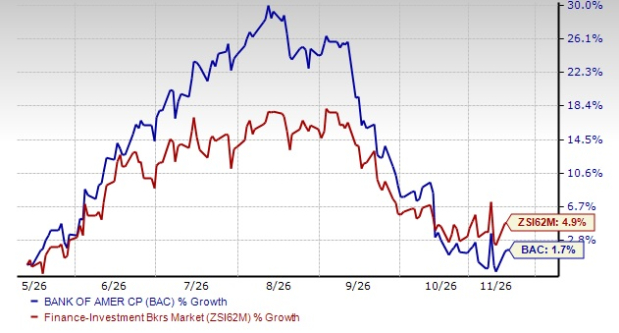
In the past six months, shares of Bank of America have gained 1.7% compared with the industry’s 4.9% growth.
Image Source: Zacks Investment Research
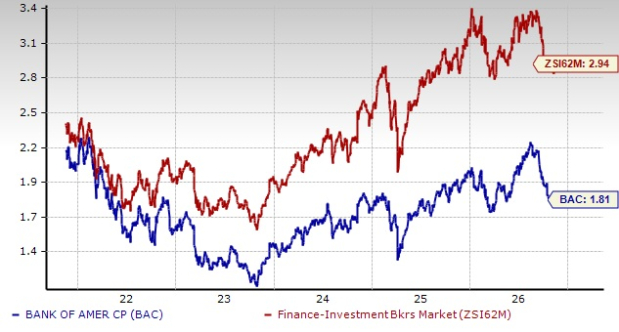
From a valuation standpoint, BAC trades at a trailing 12-month price-to-tangible book ratio of 1.81, below the industry average of 2.94.
Image Source: Zacks Investment Research
The Zacks Consensus Estimate for BAC’s 2026 and 2027 earnings indicates year-over-year growth rates of 18.4% and 14.9%, respectively. Earnings estimates for both years have been revised lower over the past 30 days.
Image Source: Zacks Investment Research

Currently, Bank of America carries a Zacks Rank #3 (Hold). You can see the complete list of today’s Zacks #1 Rank (Strong Buy) stocks here.
Zacks' Research Chief Names "Stock Most Likely to Double"
Our team of experts has just released the 5 stocks with the greatest probability of gaining +100% or more in the coming months. Of those 5, Director of Research Sheraz Mian highlights the one stock set to climb highest.
Of course, all our elite picks aren't winners, but this one could far surpass earlier Zacks' Stocks Set to Double like D-Wave Quantum, which shot up +680.1%.
Free: See Our Top Stock And 4 Runners UpWant the latest recommendations from Zacks Investment Research? Today, you can download 7 Best Stocks for the Next 30 Days. Click to get this free report
Bank of America Corporation (BAC): Free Stock Analysis Report
Wells Fargo & Company (WFC): Free Stock Analysis Report
JPMorgan Chase & Co. (JPM): Free Stock Analysis Report
This article originally published on Zacks Investment Research (zacks.com).