

Berkshire Hathaway has further reduced its stake in Bank of America BAC, raising questions about investor confidence in the banking giant. Per its November 16 Form 13F filing, Berkshire sold approximately 27.5 million BAC shares during the third quarter of 2026, reducing its holding by 5.7% to 455.9 million shares. Although the sale was smaller than the earlier speculation of 30-40 million shares, continued reductions could weigh on market sentiment.
The latest transaction marks another quarter of Berkshire trimming its BAC exposure. The conglomerate has reduced its position by approximately 57.8 million shares since March 2026. Such persistent selling by a prominent institutional shareholder could create a sentiment overhang, particularly if investors interpret the move as declining conviction in BAC’s near-term upside potential.
However, Berkshire’s portfolio adjustments do not necessarily indicate deteriorating fundamentals at Bank of America. The conglomerate continues to hold a substantial stake, valued at approximately $24.8 billion as of September-end. The reductions could reflect portfolio diversification or capital reallocation rather than concerns about the bank’s financial health.
Importantly, BAC’s underlying earnings prospects remain encouraging. Third-quarter 2026 net interest income increased year over year, supported by asset repricing and lending activity. Management expects approximately 8% net interest income growth in 2026 and at least 8% growth in 2027. Continued deposit stability, loan growth and improving interest income could support profitability despite uncertainty surrounding Berkshire’s investment strategy.
Yet, further institutional selling could limit BAC’s near-term valuation upside and heighten share-price volatility. Elevated operating expenses, potential credit deterioration and interest-rate uncertainty also warrant attention. While Berkshire’s continued stake reductions may unsettle investors, BAC’s earnings resilience and favorable net interest income outlook suggest that the selling alone does not undermine its longer-term investment prospects.
How Do BAC’s Peers Compare?
The implications of Berkshire’s continued stake reductions extend beyond Bank of America, as investors assess the broader outlook for large U.S. banks. JPMorgan Chase JPM, for instance, continues to benefit from its diversified business model, strong deposit franchise and multiple revenue streams. While BAC’s net interest income growth prospects remain favorable, JPMorgan’s diversified operations provide an additional cushion against interest-rate volatility and potential credit challenges.
Meanwhile, Capital One Financial COF has also witnessed a reduction in Berkshire’s ownership. During the third quarter, Berkshire trimmed its Capital One stake by approximately 61.7%, a much sharper percentage decline than the 5.7% reduction in BAC. This suggests that Berkshire’s selling activity is not limited to Bank of America and could reflect broader portfolio rebalancing rather than concerns specific to BAC.
Nevertheless, the investment outlook for BAC, JPMorgan and Capital One will largely depend on their respective earnings performance, loan demand, credit quality and interest income trends.
BAC’s Price Performance, Valuation & Estimates
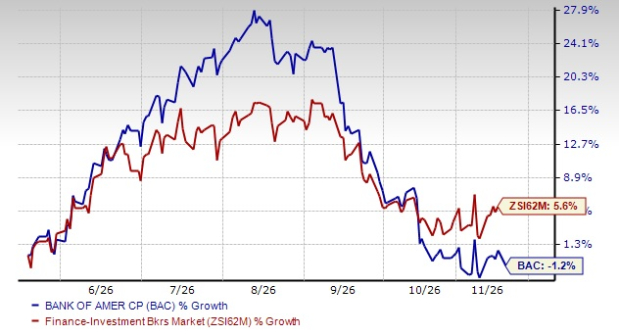
In the past six months, shares of Bank of America have lost 1.2% against the industry’s 5.6% growth.
Image Source: Zacks Investment Research
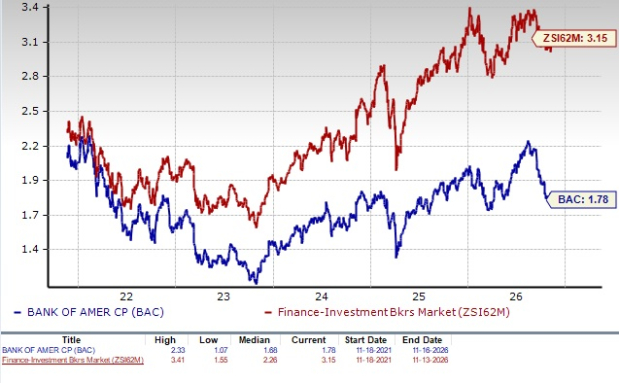
From a valuation standpoint, BAC trades at a trailing 12-month price-to-tangible book ratio of 1.78, below the industry average of 3.15.
Image Source: Zacks Investment Research
The Zacks Consensus Estimate for BAC’s 2026 and 2027 earnings indicates year-over-year growth rates of 18.4% and 14.9%, respectively. Earnings estimates for both years have been revised lower over the past 30 days.
Image Source: Zacks Investment Research

Currently, Bank of America carries a Zacks Rank #3 (Hold). You can see the complete list of today’s Zacks #1 Rank (Strong Buy) stocks here.
Beyond Nvidia: AI's Second Wave Is Here
The AI revolution has already minted millionaires. But the stocks everyone knows about aren't likely to keep delivering the biggest profits. AI’s second wave is moving from infrastructure to implementation and these companies are at the forefront of this transition, positioned to become what Amazon and Google were to the internet era.
See Stocks Now >>Want the latest recommendations from Zacks Investment Research? Today, you can download 7 Best Stocks for the Next 30 Days. Click to get this free report
Bank of America Corporation (BAC): Free Stock Analysis Report
JPMorgan Chase & Co. (JPM): Free Stock Analysis Report
Capital One Financial Corporation (COF): Free Stock Analysis Report
This article originally published on Zacks Investment Research (zacks.com).