RippleX Head of Research Aanchal Malhotra said the next phase of XRP Ledger development is focused on privacy, zero-knowledge proofs and post-quantum readiness, framing the work as an effort to future-proof the network without compromising its core settlement design.
Speaking on Episode 25 of Krippenreiter TV with XRP Ledger Foundation member Hussein “Vet” Zangana and Krippenreiter, Malhotra described RippleX’s research agenda as a balance between long-term cryptographic development and near-term product requirements. Her team, she said, works across privacy, consensus, protocol design, interoperability and DeFi, but the mandate is not to chase each new cycle.
“Lasting impact is not by chasing hype,” Malhotra said. “It’s actually building and focusing on security, the fundamentals, and that’s what we work on a lot.”
Ripple Focuses On Privacy, ZK Proofs And Post-Quantum Security
That work, according to Malhotra, is now centered on three areas: stronger cryptographic foundations, a rigorous path from research to production and demand from institutions asking for privacy and compliance features. She said RippleX is thinking about “ensuring that the right cryptographic primitives are in place,” including privacy foundations and preparations for the post-quantum era .
Malhotra repeatedly returned to the idea that research only matters if it can safely ship on a live network that moves value. She said proposed changes have to survive threat modeling, formalization where appropriate, internal review and adversarial testing before reaching production. That process, she argued, is what separates interesting academic work from infrastructure that can be used by institutions.
For XRPL, that means adding new capabilities without turning the base layer into a general-purpose execution environment. Malhotra defended the ledger’s original architectural choices, including its fixed-function design and limited native programmability, as still relevant more than a decade later.
“The architectural decisions, at the time, for the specific purpose that XRP Ledger was supposed to serve, that is fast, low-cost, transparent payments, were correct,” she said. “There are some things that still stand strong today.”
She pointed in particular to the absence of broad smart-contract functionality on layer one, arguing that clear boundaries have helped XRPL maintain performance and reduce the attack surface. The same reasoning applies to consensus, where Malhotra said XRPL’s design avoids the direct economic-incentive model seen in many other networks.
The next challenge is how to extend XRPL without undermining those trade-offs. That is where zero-knowledge proofs and layer-two-style architectures enter the roadmap.
Malhotra described ZK proofs as a way to prove that a statement is true without exposing unnecessary information. In one example, a user could prove they have enough funds to rent an apartment without showing bank statements, spending history or unrelated transactions. In another, a user could prove they are above a certain age without revealing full identity documents.
But she cautioned that zero-knowledge is not a single tool. It is a family of cryptographic constructions, each with different trade-offs. For scalability, she said, the more important property is often succinctness: the ability to generate a small proof for complex off-chain computation that can be verified efficiently on-chain.
That model could change the role of XRPL’s base layer. Instead of pushing complex computation onto the mainnet, developers could perform it elsewhere and settle proofs back to XRPL. Malhotra said that would allow the ledger to preserve its strengths while enabling new execution environments around it.
For privacy, RippleX appears to be taking a more targeted approach. Malhotra distinguished privacy from opacity , saying public financial systems need confidentiality for sensitive data while preserving market integrity and auditability.
“Privacy is not really the enemy, opacity is,” she said. “Financial systems require balances and transfer amounts to be protected in certain contexts. But the market should still be able to verify that the rules are being followed.”
That logic informed RippleX’s work on confidential transfers for multi-purpose tokens. Malhotra said the design aims to hide balances and transfer amounts, while keeping total supply public and allowing independent auditors to verify activity where appropriate. For that use case, RippleX chose Bulletproofs, a type of zero-knowledge proof suited to range proofs and mature enough for a narrower production setting.
Broader ZK functionality will require more foundational changes. Malhotra said XRPL’s existing cryptographic primitives were not designed with modern ZK systems in mind. Current signature schemes and hash functions are effective for fast payments, but not necessarily efficient inside ZK circuits. Retrofitting newer primitives, including pairing-friendly curves and ZK-friendly hashes, is therefore an engineering challenge.
Performance is another constraint. XRPL’s short ledger close times and low fees leave little room for expensive on-chain verification, which is why RippleX is exploring native support for lower-level cryptographic operations while keeping more complex logic outside the base layer.
Looking ahead, Malhotra said she wants XRPL to become a financial settlement layer that “just works,” with institutional payments, retail payments, tokenized assets and execution environments anchored to mainnet and settling in XRP. In that future, she said, cryptographic primitives such as zero-knowledge proofs and post-quantum security should become largely invisible to developers.
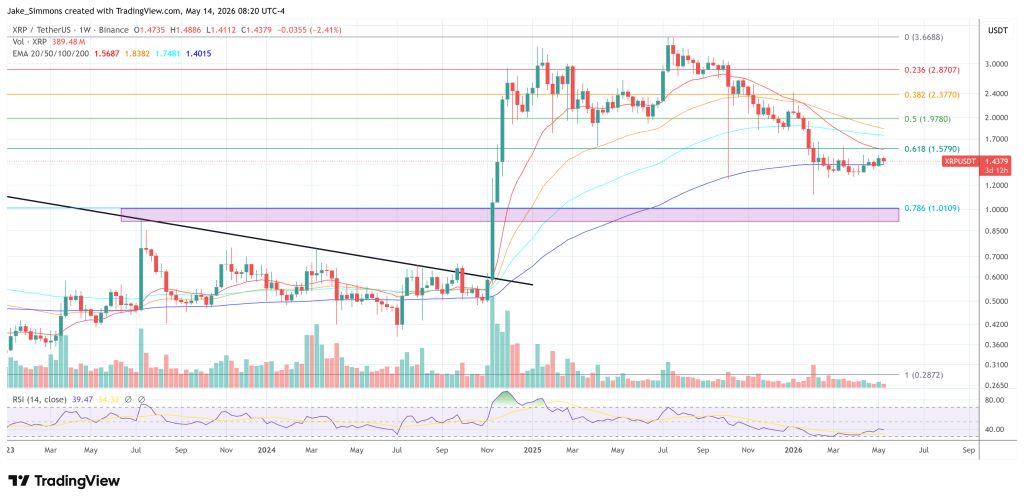
At press time, XRP traded at $1.43379.