
Verwandte Ticker
| # | Name | Preis | 24h % | 7d % | 1M % | 1J % | Letzte 7 Tage | |
|---|---|---|---|---|---|---|---|---|
| 1 | EURUSD Euro vs US Dollar | 1.09799 USD | +0.09% | -0.12% | -2.05% | -5.08% | ||
| 2 | GBPUSD Pound Sterling vs US Dollar | 1.31109 USD | 0.00% | -0.23% | -1.80% | -0.41% | ||
| 3 | AUDUSD Australian Dollar vs US Dollar | 0.66399 USD | +0.20% | -0.96% | -5.64% | +2.70% | ||
| 4 | USDCAD US Dollar vs Canadian Dollar | 1.42387 CAD | +0.16% | -0.45% | +1.55% | +1.02% |
Häufig gestellte Fragen zu US Dollar vs Yen
Wie hoch ist der heutige Wechselkurs des USDJPY-Tickers?
Der aktuelle Wechselkurs für USDJPY beträgt 159.206. In den letzten 24 Stunden hat sich das Paar um 0.00% verändert. Verfolgen Sie die neuesten Bewegungen auf dem Chart von USDJPY.
Wie wird der USDJPY-Wechselkurs berechnet?
Der USDJPY wird als Wert einer Währung im Verhältnis zu einer anderen angegeben. Der Kurs 159.206 zeigt an, wie viel von der Kurswährung benötigt wird, um eine Einheit der Basiswährung in US Dollar vs Yen zu kaufen.
Wie hat sich USDJPY in diesem Jahr entwickelt?
Seit Jahresbeginn hat sich der Kurs von USDJPY um +1.63% verändert. Vergleichen Sie die längerfristige Kursentwicklung auf dem USDJPY-Chart und verfolgen Sie die aktuellen Marktentwicklungen, bevor Sie handeln.
Wie hat sich USDJPY im Laufe der Zeit verändert?
USDJPY hat sich in der letzten Woche um -0.43%, im letzten Monat um +1.42% und im letzten Jahr um +2.09% verändert. Nutzen Sie den Echtzeit-Chart, um längerfristige Trends und die aktuelle Dynamik zu analysieren.
Um welche Art von Währungspaar handelt es sich bei USDJPY?
USDJPY ist US Dollar vs Yen. Währungspaare können je nach den beteiligten Währungen und ihrer Marktliquidität als Haupt-, Neben- oder exotische Währungspaare bezeichnet werden.
Wie kann ich mit USDJPY handeln?
Sie können USDJPY über Forex-Broker handeln, die Zugang zu diesem Währungspaar bieten. Bevor Sie eine Position eröffnen, sollten Sie die Spreads, die Ausführungsbedingungen, und die Margin-Anforderungen prüfen, einschließlich der Handelsideen, die auf metatrader.com verfügbar sind.
Soll ich USDJPY jetzt kaufen oder verkaufen?
Bei einer Kauf- oder Verkaufsentscheidung für USDJPY sollten folgende Aspekte berücksichtigt werden: technische Analyse, makroökonomische Daten, Zentralbankpolitik, Marktstimmung und Ihre eigenen Risikogrenzen. Sehen Sie sich vor dem Handel das Chart und die entsprechenden Nachrichten an.
Nachrichten
Japanischer Yen im Aufwind: Warum USD/JPY jetzt weiter fallen könnte
Japanischer Yen gibt Gewinne ab, da die Anleiherenditen trotz stärkerer Inflation fallen
USD/JPY Prognose: Erholung vom Ein-Monats-Tief; BoJ-Wetten dürften Gewinne begrenzen
Japanischer Yen zieht sich vom Ein-Monats-Hoch gegenüber dem sich erholenden USD zurück
Japanischer Yen gewinnt an Stärke, da die CPI-Inflation das Ziel übertrifft und Zinserhöhungen der BoJ unterstützt
Japanischer Yen steigt stark, da Risk-off-Stimmung die Nachfrage nach sicheren Häfen antreibt
Japanischer Yen zieht sich vom Monatshoch gegenüber dem schwachen USD zurück
USD/JPY fällt auf Wochentief - Unterstützung bei 157,50 rückt näher
Japanischer Yen hält sich in Handelsspanne gegenüber USD, da der Fokus auf Fed- und BoJ-Sitzungen bleibt
Der japanische Yen bewegt sich kaum, da ein stellvertretender Gouverneur der Bank of Japan die Inflationsrisiken hervorhebt
Japans Inflationszahlen stehen als Nächstes an, während der Yen nahe 158,00 feststeckt
Charts & Ideen
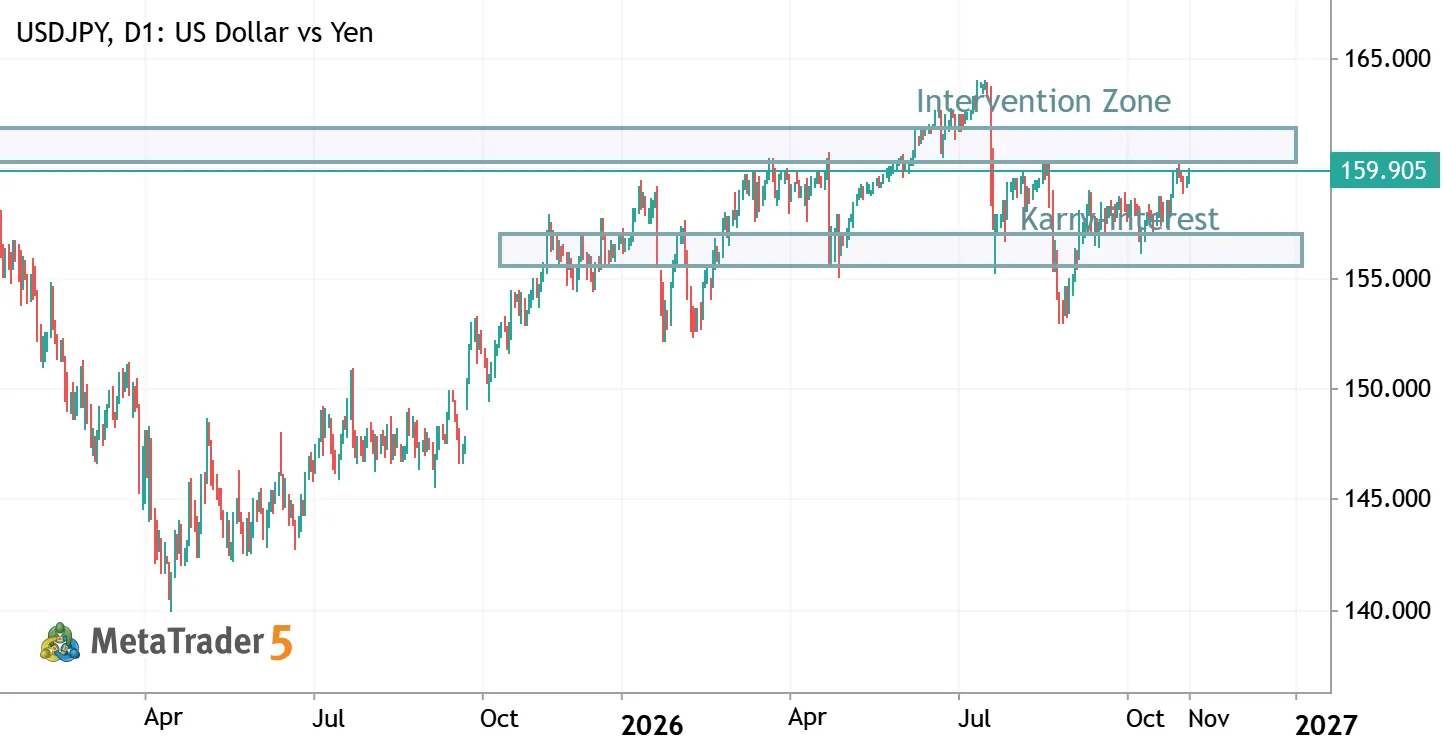
USDJPY: Impact of Inflation Data and Key Resistance Levels
In recent weeks, USDJPY has shown steady growth amid the release of strong US macroeconomic data. According to the economic calendar, the main driver has been inflation indicators: Core CPI m/m and CPI m/m both came in above market expectations (actual values of 0.3% and 0.4% versus forecasts of 0.2% and 0.3%, respectively). This has supported dollar demand and, combined with ongoing interest in carry trades, contributed to USDJPY strengthening. From a technical perspective, the 158 zone stands out on the chart as the area with the highest trading volume over the past year. This level serves as important support for major market participants. The 160 area remains a significant psychological resistance: previous Japanese currency interventions occurred in this zone, leading to sharp

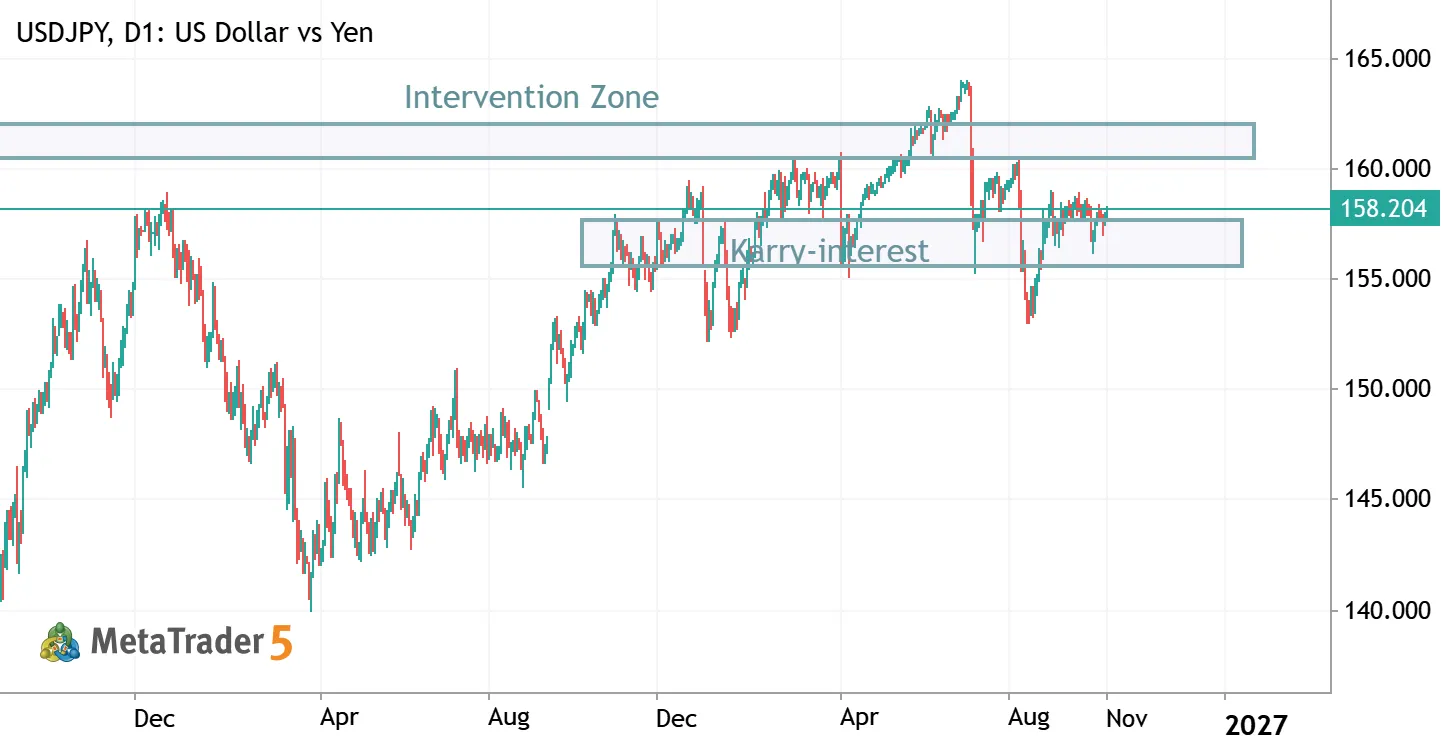
USDJPY Approaches 160: Carry Trade Strength vs Japan Intervention Risk
USDJPY is once again approaching the psychologically important 160 level , where market attention traditionally shifts toward possible action by Japanese financial authorities. However, reaching 160 does not automatically mean that a currency intervention will follow. For Japan’s Ministry of Finance and the Bank of Japan, other factors also matter, including the speed of yen depreciation, the nature of the USDJPY move, and the level of speculative activity . A gradual rise and a sharp speculative spike are very different situations from the perspective of potential policy action. Why Does USDJPY Remain Strong? The main fundamental driver remains the interest rate differential between the United States and Japan. After the latest Federal Reserve meeting, the U.S. policy rate remained in the

Für das USDJPY gibt es derzeit keine weiteren Handelsideen.
Durchsuchen Sie vorgefertigte Handelsideen oder wählen Sie ein Symbol aus und verwirklichen Sie Ihre eigenen.
Gehen Sie zu „Charts und Handelsideen“