


Ethereum has been relatively quiet as Bitcoin pushes above $80,000 and captures most of the market’s attention. ETH is holding its range, waiting for a catalyst that forces a directional decision. A few hours ago, data from Arkham Intelligence provided one piece of evidence that the structure beneath that quiet may be more significant than the price chart is currently showing.
Bitmine staked another 190,800 ETH — approximately $451 million — in a single transaction. That is the largest single stake this accumulation strategy has produced, and it arrived while Ethereum was barely moving and most participants were watching Bitcoin.
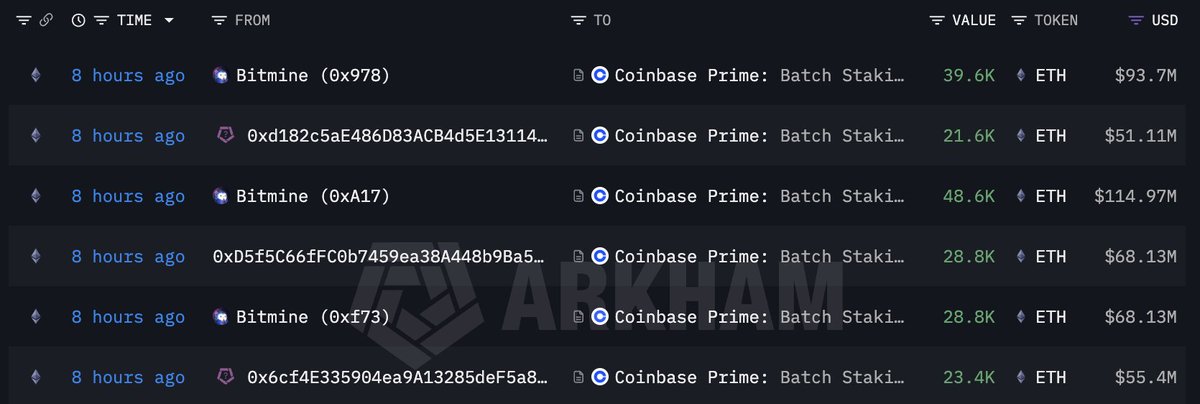
The timing is part of what makes it significant. Institutional commitments of this scale do not happen reactively — they are planned, executed deliberately, and reflect a conviction that was formed before the market confirmed it. A company choosing to lock $451 million into Ethereum’s validator infrastructure during a period when the asset is underperforming its primary competitor is not responding to price. It expresses a thesis about where value is being built regardless of where attention is currently directed.
Staked ETH is not liquid. It cannot be sold on short notice. Every transaction of this scale removes a meaningful amount of Ethereum from the immediately available sell side — quietly, without announcement, while Bitcoin gets the headlines.
$10.77 Billion Locked. 88% of Everything. The Strategy Has a Name Now.
The cumulative picture that the latest stake completes is the one that changes how Bitmine’s activity should be categorized. With 4,553,557 ETH now staked — $10.77 billion at current prices — and 87.9% of total holdings committed to validator infrastructure, this has moved beyond a treasury diversification strategy or a yield play. It is a structural claim on Ethereum’s network.
The 88% figure is the one that demands attention. A company that has locked nearly nine tenths of everything it owns into a single asset in an illiquid form has made a decision that has no meaningful parallel in institutional finance. This is not portfolio management. It is a thesis executed at scale — the belief that Ethereum’s value as infrastructure is more durable than any short-term price consideration.
The supply implications follow directly. At 4.55 million ETH, Bitmine controls approximately 3.7% of Ethereum’s entire circulating supply — locked in staking contracts that cannot be liquidated quickly. That is not a trading position. It is a structural removal of supply from the liquid market that compounds with every additional stake.
Ethereum trading quietly while Bitcoin takes the headlines is the current surface reality. Beneath it, one entity has been systematically removing nearly 4% of the asset’s available supply from the sell side — at an accelerating pace, with the largest single transaction arriving today. At some point, that supply math forces a conversation the price chart has not yet started.
Ethereum Reclaims $2,300 As Recovery Tests Overhead Resistance
Ethereum is trading near $2,370 after extending its recovery from the February capitulation low, but the structure remains a developing rebound rather than a confirmed uptrend. The chart shows a clear transition from a sharp downtrend into a sequence of higher lows, with price reclaiming the short-term moving average and stabilizing above the $2,250–$2,300 zone.
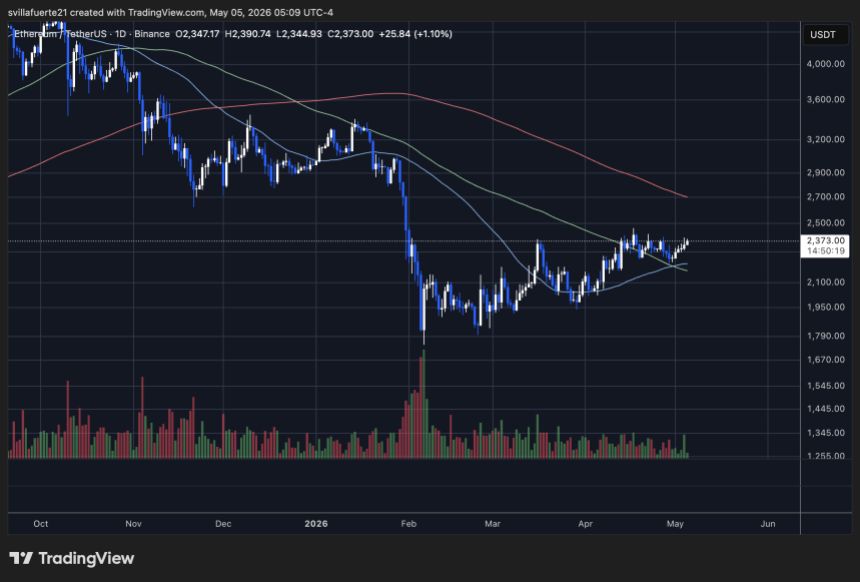
This area is now critical. It previously acted as resistance during March and early April and is now being tested as support. The fact that ETH is holding above it suggests buyers are defending the level, but the follow-through lacks strength.
Overhead, the $2,400–$2,500 region remains the immediate barrier. This zone aligns with the descending 100-day moving average, which continues to act as dynamic resistance. Until ETH can break and hold above that level, the broader trend remains structurally capped.
Volume trends add caution. Participation has declined compared to the selloff phase, suggesting reduced selling pressure is driving the move higher more than aggressive accumulation.
If ETH holds above $2,250, the recovery structure remains intact and opens the door for a test of $2,500. A failure to hold would likely rotate price back toward the $2,000–$2,100 demand zone.
Featured image from ChatGPT, chart from TradingView.com