

Cathie Wood has never been shy about backing Elon Musk’s boldest ideas. The ARK Invest founder has long viewed Tesla (TSLA) as one of the most important companies in the world, not simply because of its electric vehicles, but because of its broader exposure to autonomous driving, robotics, artificial intelligence (AI), and energy storage. Now, Wood is making an even bigger statement about Musk’s empire by loading up on SpaceX (SPCX) stock.
SpaceX has already become one of the most closely watched public companies in the market. Its shares surged following their debut, placing it among the world’s most valuable public companies. For Wood, the opportunity appears to go far beyond rockets and satellite launches. In ARK’s view, SpaceX is not just a space transportation company, but a vertically integrated platform spanning Starlink, defense, orbital infrastructure, and, increasingly, AI. And that AI angle is now central to the investment case.
More Top Stocks Daily: Go behind Wall Street’s hottest headlines with Barchart’s Active Investor newsletter.
So, does Cathie Wood’s aggressive buying signal that SpaceX is still in the early stages of a once-in-a-generation growth story, or has the stock already run too far on hype? Let’s take a closer look.
Read more from Barchart:
AI is “one of the largest industries ever” ...and it’s already disrupting this $1T market. The next AI wave won’t look like chatbots. It will look like this.About SpaceX Stock
SpaceX designs, manufactures, and launches advanced rockets and spacecraft while also operating Starlink, its global satellite-internet network. Following its acquisition of xAI, SpaceX has expanded beyond launch services and broadband connectivity into AI, combining space infrastructure, satellite communications, and AI development under one platform. The company’s core businesses include reusable Falcon rockets, Dragon spacecraft, the Starship program, Starlink, and xAI’s products, including Grok and “X,” formerly Twitter. This broader structure positions SpaceX as a vertically integrated technology company focused on space transportation, global connectivity, and AI-powered infrastructure. SPCX has a market cap of $2.53 trillion, making it the world’s sixth-most valuable public company.
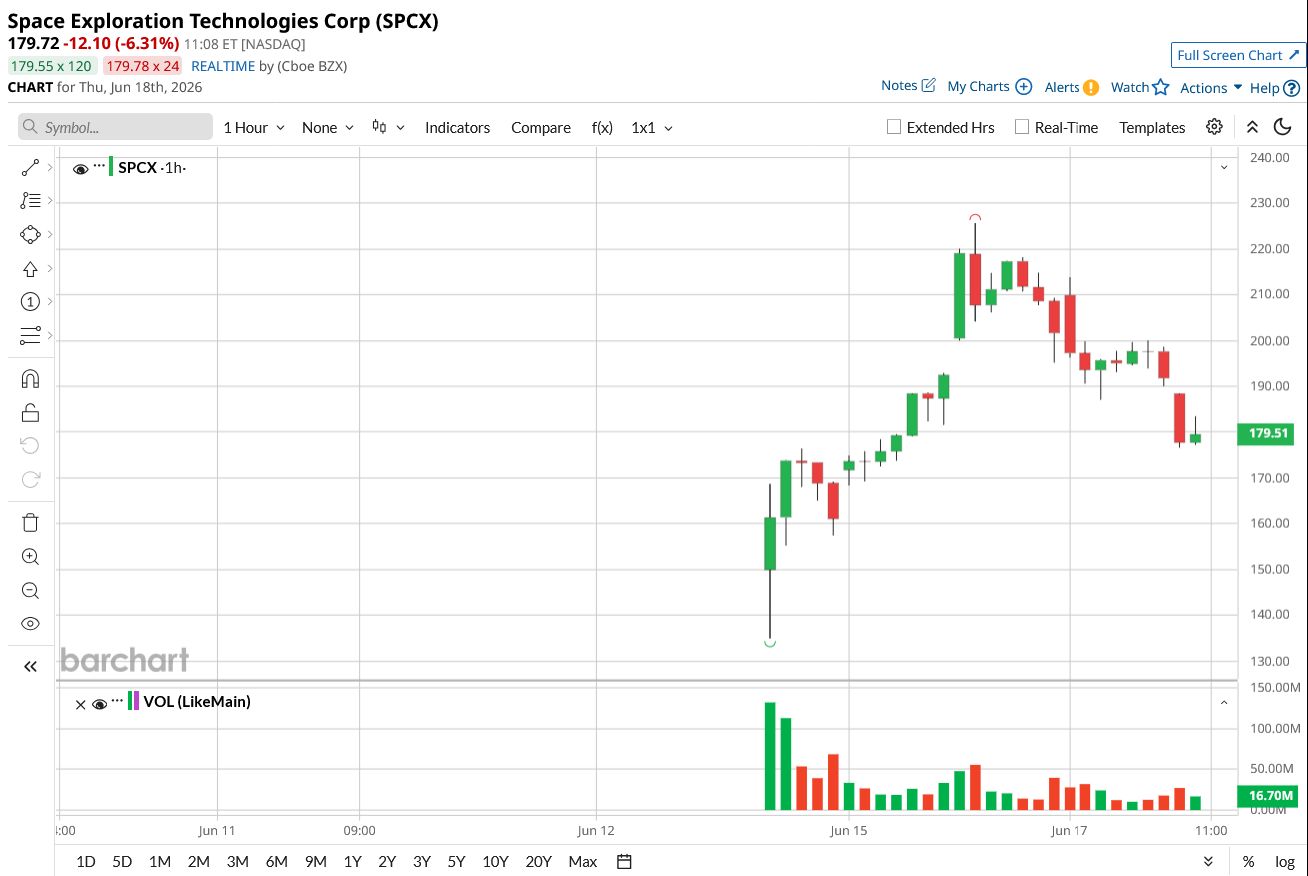
SPCX stock has been on a tear following its record-breaking IPO. Its shares surged 19% on their first day of trading, gained another 20% on Monday, and climbed more than 4% on Tuesday. However, the stunning rally showed signs of cooling on Wednesday and continued into Thursday, with the stock falling about 6%.
 www.barchart.com
 Cathie Wood Doubles Down on Elon Musk With SPCX Stock
Cathie Wood, founder of ARK Invest, is well known for backing Elon Musk’s vision. Tesla is Wood’s largest holding in the flagship Ark Innovation ETF (ARKK). Moreover, SpaceX is the top holding in the Ark Venture Fund, a position Wood acquired in the private market in late 2023. The fund also gained exposure to SpaceX through its investment in Musk’s social media platform X, which was acquired by AI lab xAI, with xAI later merging with SpaceX. However, the fact that Wood already owned a stake in SpaceX did not mean she stayed on the sidelines when the rocket-and-satellite company went public.
She added SPCX shares to four of her six actively managed ETFs last Friday. According to ARK’s daily trade notification, the firm’s ARK Innovation ETF made the biggest purchase, acquiring 1.69 million shares of SpaceX. The stock now accounts for 2.12% of the fund’s portfolio. Also, the ARK Autonomous Technology & Robotics ETF (ARKQ) purchased 736,442 shares, while the ARK Space Exploration & Innovation ETF (ARKX) acquired 537,341 shares. Finally, Wood’s ARK Next Generation Internet ETF (ARKW) scooped up 325,562 shares.
It remains unclear whether those shares were acquired through an IPO allocation before trading began or purchased in the open market after SpaceX started trading. And it remains unclear at what price ARK purchased those shares.
Interestingly, Wood sold $280 million worth of stocks in the week leading up to the SpaceX IPO to make room for the new holding. And on SpaceX’s IPO day, ARK Invest sold roughly 948,000 shares across 13 different companies, valued at at least $48 million, according to company records. ARK trimmed positions in Tesla, Advanced Micro Devices (AMD), and Teradyne (TER), among others.
All told, ARK Invest funds held approximately 3.29 million shares of SpaceX as of June 12. That marked one of Wood’s most aggressive public-market purchases in years. The position was valued at $534 million as of Friday’s close, and its value rose to $663.92 million as of Wednesday’s close. In ARK’s view, SpaceX is far more than a rocket company—it is also a satellite internet, defense, and orbital infrastructure business.
Why SpaceX’s Space-Based AI Data Centers Ambitions Matter for Investors
If you are neither Cathie Wood nor part of Musk’s devoted retail investor base, you may find it difficult—if not impossible—to justify SpaceX’s current valuation. Earlier this week, SpaceX briefly surpassed Amazon (AMZN) in market capitalization to become the world’s fifth-most valuable public company. This looks particularly striking when viewed against the company’s fundamentals. For example, Amazon, a highly diversified technology and retail conglomerate, generated $717 billion in revenue in 2025, compared with SpaceX’s $18.7 billion, while SpaceX was not even profitable.
Of course, you could point out that Musk posted on X over the weekend that SpaceX’s revenue could reach about $1 trillion in 2030, which would represent a roughly 66-fold increase from its 2025 revenue. While that growth would certainly be impressive, it is also worth noting that Wall Street’s base-case forecasts call for Amazon’s revenue to reach $1.15 trillion in 2030. But the key difference is that, for SpaceX to reach that figure, it must successfully turn Musk’s ambitious vision into reality.
And that brings us to the next logical question: What does SpaceX need to do to reach $1 trillion in revenue in 2030? I think the key to reaching that revenue target would be scaling up its Starlink and AI businesses. Let’s dive a bit deeper into this.
Starlink is SpaceX’s satellite-based broadband service, with more than 10 million subscribers and $11.4 billion in revenue generated in 2025. Goldman Sachs analysts project that Starlink’s revenue will reach $144 billion by 2030, making it the company’s second-largest business segment.
Next comes SpaceX’s AI business. The segment generated just $3.2 billion in revenue last year. However, momentum is beginning to build in this segment. SpaceX recently announced two new agreements to lease its data centers to Google (GOOG) (GOOGL) and Anthropic for about $26 billion annually. In addition, SpaceX said on Tuesday that it would acquire Cursor parent Anysphere for $60 billion, a move that could help the company narrow the gap with its AI rivals.
Still, there remains a gap of hundreds of billions of dollars between current projections and Musk’s revenue target. The only thing that could help close that gap is the deployment of low-cost AI data centers in space, which SpaceX believes could begin as early as 2028. So, this essentially tells us that SpaceX’s current valuation depends on its ability to build a multi-billion-dollar AI business in space. With that, it remains to be seen whether the company can build that business in a timely manner and ultimately justify its valuation.
On the date of publication, Oleksandr Pylypenko had a position in: AMZN . All information and data in this article is solely for informational purposes. For more information please view the Barchart Disclosure Policy here.
More news from Barchart
Why TSMC Doesn’t Even Need to Win the AI Race Cathie Wood Loads Up on SpaceX Stock. She Is Betting Big That Musk’s AI Vision Will Pay Off. Michael Burry Thinks the Market Has Adobe Stock Wrong. What Management Needs to Do to Prove Him Right. Nothing Seems to Be Going Right for Meta Platforms. How to Play META Stock Here.