


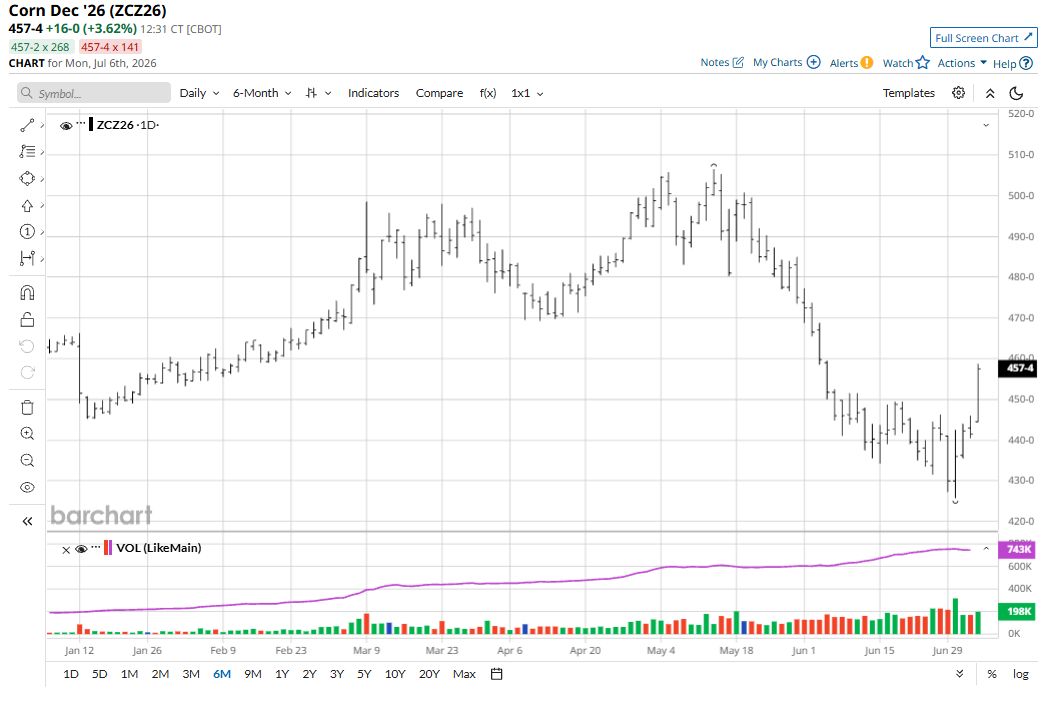
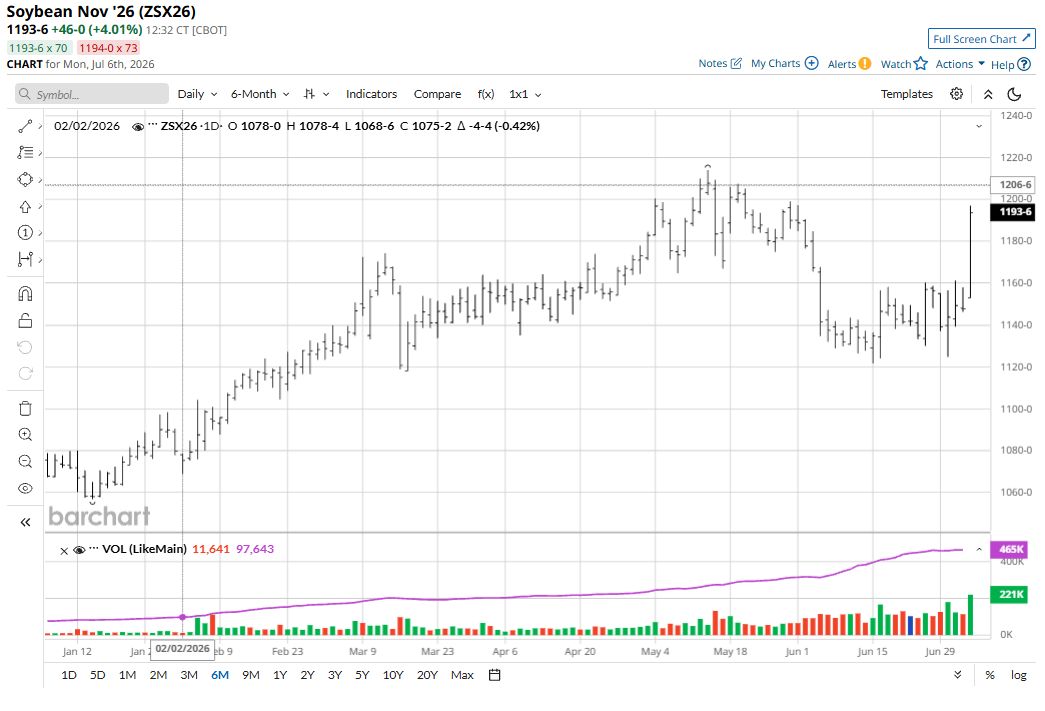
History shows the few trading days right after the Fourth of July holiday can be pivotal for the grain markets, especially corn (ZCZ26) and soybeans (ZSX26). And after the three-day holiday weekend, the bulls are out of the chute snorting.
An intense heat wave continues in France, one of the European Union’s largest corn producers. The FranceAgriMer agency reported deteriorating crop conditions after preliminary estimates indicated extreme heat may have damaged nearly one-third of the country’s corn crop.
Don’t Miss a Day: From crude oil to coffee, sign up free for Barchart’s best-in-class commodity analysis.
In the meantime, while U.S. rainfall during the holiday weekend was heavy to excessive in parts of the Corn Belt, a drier weather pattern in the region is forecast to develop over at least the next two weeks.
 www.barchart.com
 www.barchart.com
Still, good growing conditions presently over most of the Corn Belt may limit price gains in corn and soybean futures markets in the near term.
The first two weeks in July are generally the most important growing timeframe for most of the U.S. corn crop, as that’s when the key pollination phase of growth occurs.
Corn and soybean traders will keep watching the weekly USDA crop progress reports on Monday afternoons.
Despite last week’s USDA Quarterly Stocks data indicating record corn usage for the March-through-June period, the U.S. corn balance sheet remains relatively heavy on the supply side.
The closely followed annual Pro Farmer crop tour in late August will be a main late-growing-season market factor for corn and soybeans.
U.S. soybean export sales are still lagging, with the USDA last Thursday reporting weekly U.S. soybean export sales of 41,800 MT during the week ended June 25 for 2025/2026, a marketing-year low. Net sales were down 91% from the previous week and off 88% from the prior 4-week average. Soybean bulls keep hoping China will step up to the plate and buy more U.S. soybeans.
On the positive side for beans, the USDA last week reported the U.S. soybean crush in the month of May totaled 213.1 million bushels, once again setting a record for the month. Demand for soybean oil has not proven enough to slow the recent downdraft in prices, however.
August is arguably the most important growing month for most of the U.S. soybean crop. That means there is still time for a weather-market scare to pop up in soybeans. Focus will also be on the annual Pro Farmer crop tour that occurs in late August.
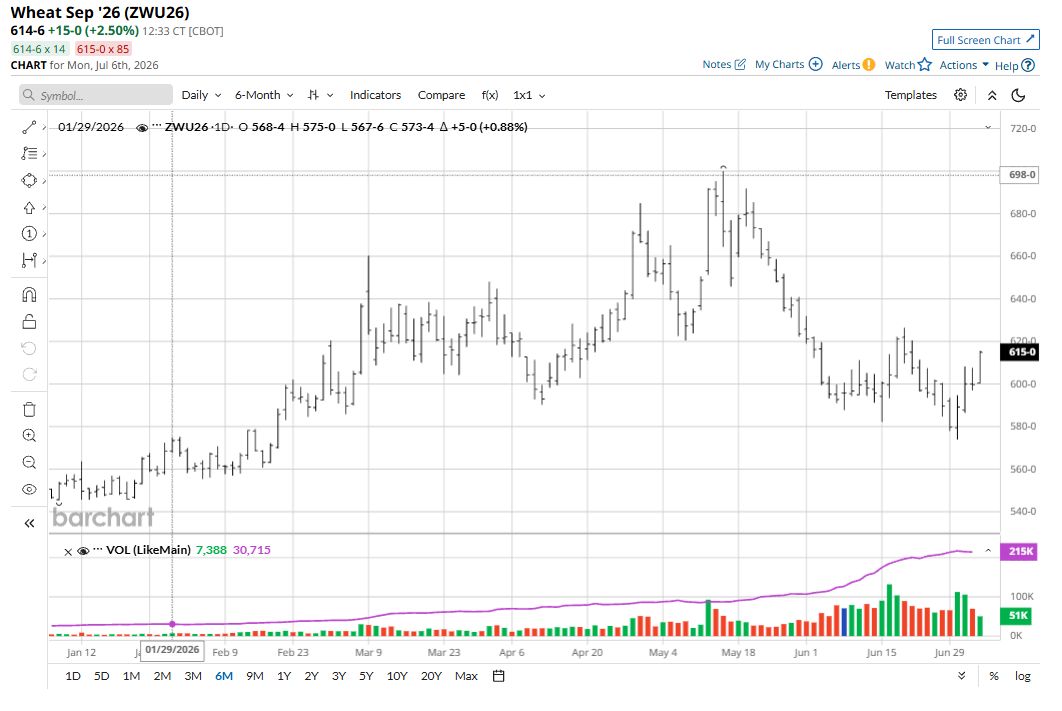
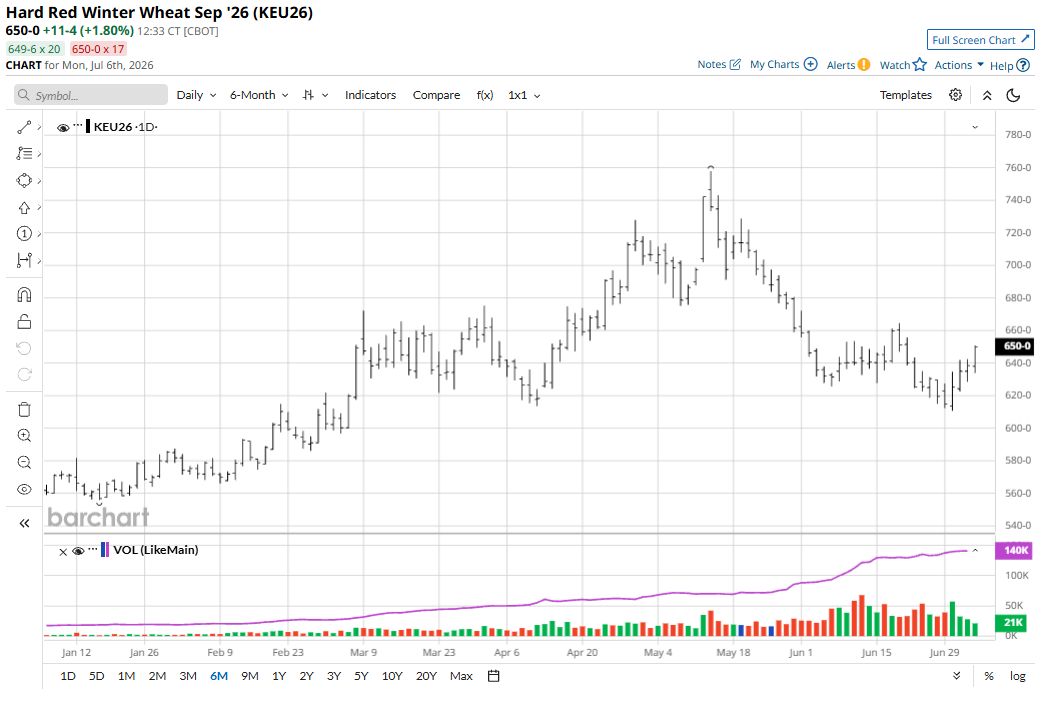
Wheat Futures See Some Harvest-Related Hedge Pressure
Weather forecasters say good harvest weather is expected across the central and southwestern U.S. Plains for the next 10 days. Temperatures will be warm to hot which should accelerate drying rates in between scattered showers and thunderstorms. The good harvesting pace and favorable weather in U.S. wheat regions will likely keep commercial hedge-related price pressure on the wheat futures markets, or at least limit the upside if corn and soybean futures can extend their rallies. For U.S. hard red winter wheat (KEU26), poor yields have been reported so far.
The USDA’s major reports last week reaffirmed the bullish supply picture for U.S. wheat. Soft red winter wheat (ZWU26) is also the class of wheat mostly produced in much of western Europe, which is currently experiencing a record-setting heatwave.
 www.barchart.com
 www.barchart.com
Cotton Sees Price Pressure from Wobbly U.S. Stock Market, Drop in Oil Prices
December cotton (CTZ26) futures last week were up 74 points from the week prior on some tepid short covering from recent selling pressure that still has the market in a price downtrend on the daily bar chart.
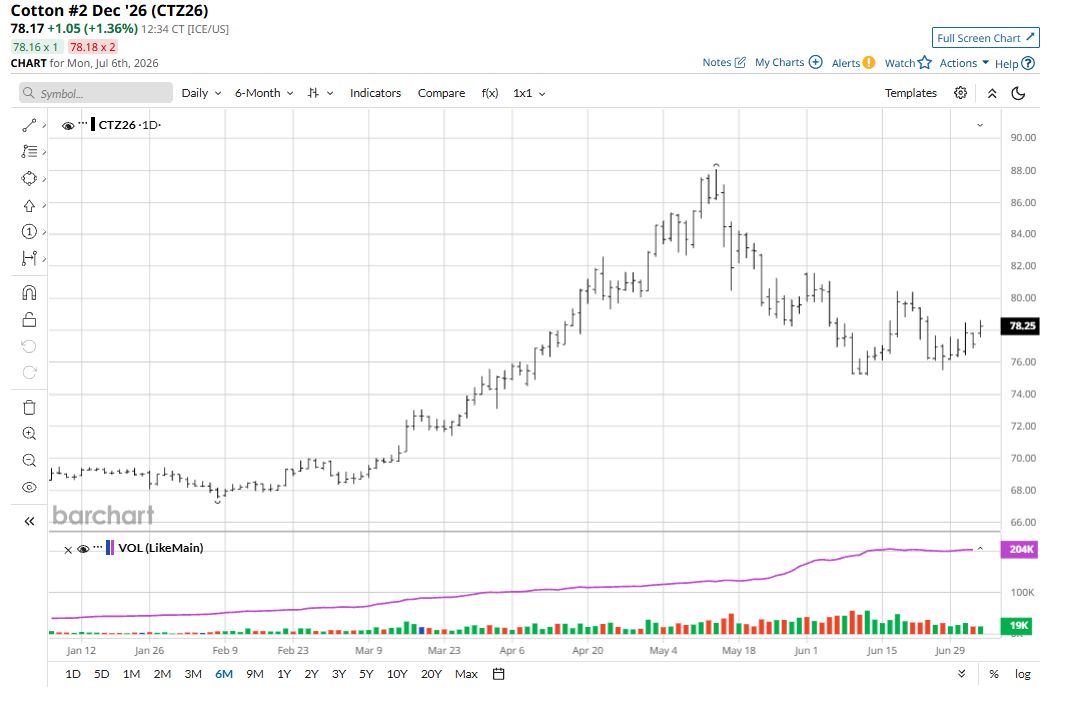 www.barchart.com
Wobbly U.S. stock index prices and lower crude oil (CLQ26) prices recently have also been weighing on cotton futures. Price action in the major U.S. stock indexes and retail gasoline prices at the pump will be major drivers for consumer confidence in the coming months, which in turn will influence consumer demand for apparel this fall. Gasoline prices at the pump have dropped below $4.00 a gallon, on average, which is positive for consumer confidence. However, gasoline prices are still elevated from levels seen at this time last year.
Weekly USDA cotton export sales have also been tepid. The agency last week reported U.S. cotton sales of 49,000 running bales (RB) for 2025/2026 were down 42% from the previous week and down 70% from the prior 4-week average. Shipments last week of 218,800 RB were down 27% from the previous week and down 22% from the prior 4-week average. For the cotton market to climb out of its price downtrend on the daily chart and to sustain a price uptrend over the coming months, U.S. cotton sales abroad will have to improve.
Tell me what you think. I read every one of your emails. My email address is jim@jimwyckoff.com. I enjoy getting feedback from all of you, my valued Barchart readers.
On the date of publication, Jim Wyckoff did not have (either directly or indirectly) positions in any of the securities mentioned in this article. All information and data in this article is solely for informational purposes. For more information please view the Barchart Disclosure Policy here.
More news from Barchart
Corn and Soybean Bulls Are Taking One Step Out of the Grave as a Critical Trading Period Kicks Off Another Record-High Crush for Soybeans Says Meal Prices Are a Value-Buy Here Soybean Oil Prices Fall as Crude Oil Slides Lower. 1 Trade to Make Here. Corn and Soybean Bulls Are Limping into the Critical Growing Month of July. Weather’s Not on Their Side.