


Space stocks have had a loud two weeks, and Rocket Lab (RKLB) has been at the center of most of the noise. Between a new, clean launch, a run of new government contracts, an $8 billion acquisition that reshapes the company's long-term business model, and a closely watched debut earnings report from a much larger industry peer, investors have collected more data points on the small-launch and space-systems market in the past 10 days than in most entire quarters.
Rocket Lab reports its own second-quarter results after today's close, and the setup looks better than it has in a while.
More Top Stocks Daily: Go behind Wall Street’s hottest headlines with Barchart’s Active Investor newsletter.
A Clean Launch, A Confident Stock
Rocket Lab notched its 13th Electron mission of the year last week, deploying a satellite for longtime customer iQPS as part of its QPS-SAR Earth-imaging constellation. The stock rose about 5% the same day. That's a small move in isolation, but it reflects something bigger: consistent execution. Thirteen successful missions through early August put Rocket Lab on pace for its busiest launch year yet, and each clean flight reinforces the operational reliability that government and commercial customers are paying for.
Year-to-date (YTD), RKLB shares are up 20%, though at around $83, they've pulled back 45% from the high of $151 hit in May.
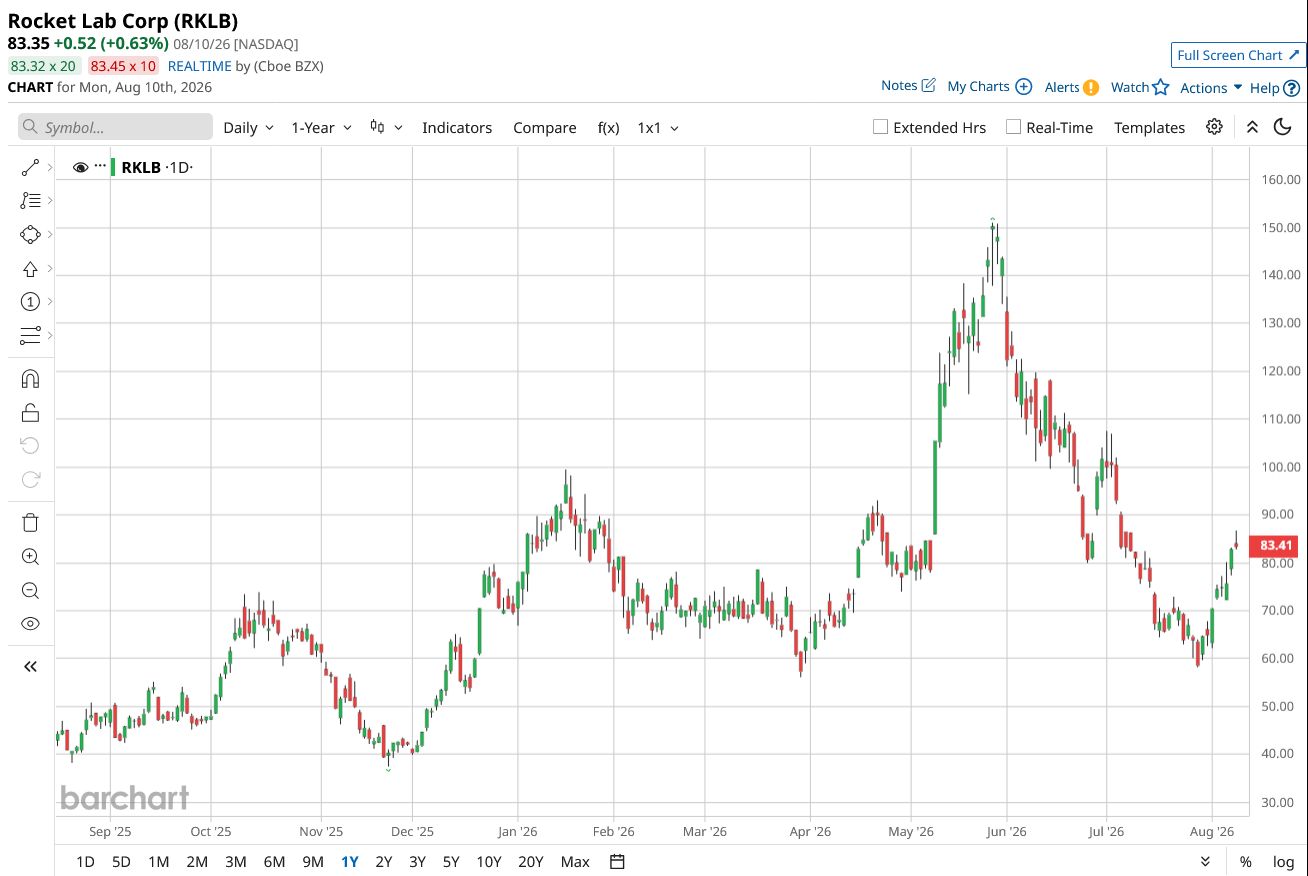 www.barchart.com
The Space Force Keeps Writing Checks
Government contracts have done even more heavy lifting. On Aug. 4, the U.S. Space Force awarded Rocket Lab a $397 million contract under the Space-Based Airborne Moving Target Indicator program to build, launch, and operate "Flatellite" satellites designed to track airborne threats as part of a broader $615 million package the Space Force split across three contractors. That award followed a separate $266 million contract for 12 guaranteed suborbital launches from Alaska.
Combined, Rocket Lab has picked up $663 million in Space Force commitments in a single week—a figure that dwarfs the $231.6 million in quarterly revenue Wall Street expects the company to report today.
One caveat worth noting: the larger of the two contracts depends on Neutron, Rocket Lab's next-generation rocket, which hasn't flown yet. The revenue is real. The launch vehicle it depends on is still unproven.
The Iridium Deal Changes the Long-Term Story
The biggest catalyst on the horizon isn't a contract at all—it's an acquisition. In June, Rocket Lab announced a definitive agreement to acquire Iridium Communications (IRDM) for approximately $8 billion in cash and stock, at $54 per Iridium share. The deal is expected to close in mid-2027, pending regulatory and shareholder approval.
Iridium operates a global satellite network serving more than 2.55 million subscribers across government, military, aviation, and maritime customers—a business built on predictable, subscription-based revenue rather than the lumpier, project-by-project revenue that defines launch and satellite manufacturing.
Pairing that with Rocket Lab's existing design, build, and launch capabilities creates a fully vertically integrated space company, one that owns the entire chain from satellite construction to the network those satellites run on. Rocket Lab also expects the deal to be accretive to cash flow and profitability—a meaningful claim for a company that has yet to turn a full-year profit.
What SpaceX's Earnings Debut Signals
Rocket Lab isn't the only space company that's been making headlines. SpaceX (SPCX) reported its first quarterly results as a public company on Aug. 4, and the numbers told a story worth watching. Revenue jumped 92% year-over-year (YoY) to $7.81 billion, beating the $6.93 billion analysts expected, while the per-share loss narrowed to $0.09 from an expected $0.26. Shares still fell roughly 8% to 13% afterward, as investors focused on a sixfold jump in capital expenditures to $18.4 billion for the quarter, driven largely by AI infrastructure spending.
The takeaway for Rocket Lab investors isn't "SpaceX's stock dropped, so worry." It's the opposite: even the market's most scrutinized space company generated demand that comfortably beat expectations. That's a useful demand signal for the broader sector Rocket Lab competes in and sells into—even if capital intensity remains the industry's shared challenge.
Key Takeaway on RKLB Stock
Rocket Lab heads into today's report with four tailwinds working in its favor: a 13-for-13 launch record this year, $663 million in fresh Space Force commitments, an $8 billion acquisition that could transform its revenue mix by 2027, and sector-wide evidence that demand for space infrastructure remains strong. None of that guarantees a beat when the numbers land after the bell. But it does mean today's report isn't happening in a vacuum—it's happening against a backdrop that's given shareholders more reasons for confidence than skepticism heading in.
On the date of publication, Rich Duprey did not have (either directly or indirectly) positions in any of the securities mentioned in this article. All information and data in this article is solely for informational purposes. For more information please view the Barchart Disclosure Policy here.
More news from Barchart
Rocket Lab Investors Have Plenty to Cheer Ahead of Q2 Earnings Today Cisco Systems Is In a Trading Range Ahead of Earnings - Shorting OTM Puts and Calls Works Why Didn't a $100 Billion Lockup Expiration Crash SpaceX Stock? 3 Numbers That Explain Its 10% Rally. Option Volatility And Earnings Report For Aug 10-14