

Nvidia (NVDA) has been one of Wall Street’s biggest winners over the years, and investors still can’t seem to look away. The chip giant sits at the heart of the artificial intelligence (AI) boom, with its powerful chips helping build and run some of the world’s most advanced AI models. At the same time, Nvidia is expanding its role beyond chips by providing financial support through backstops and other arrangements that help new AI data centers secure funding and get built.
Sure, the investor frenzy around Nvidia's stock has cooled somewhat this year after its incredible run. But the underlying Nvidia story hasn’t lost its spark. Its fundamentals remain strong, and now another potential catalyst is coming into view. Nvidia is set to take the stage at the Goldman Sachs Communacopia + Technology Conference on Thursday, Sept. 10. The company’s executive team might discuss its corporate strategy, market demand, and financial outlook during the conference, giving investors a fresh look at how Nvidia sees the next phase of the AI boom unfolding.
More Top Stocks Daily: Go behind Wall Street’s hottest headlines with Barchart’s Active Investor newsletter.
With the market listening closely, Sept. 10 could be an important date for Nvidia's investors. Thus, here’s a closer look at NVDA stock.
About Nvidia Stock
Over the past five years, few companies have become as closely tied to the AI boom as Nvidia. As artificial intelligence evolved from an emerging technology into one of the world’s biggest investment themes, demand for the computing power needed to train and run AI models exploded, and Nvidia was in the perfect position to ride that wave. Today, its GPUs power everything from ChatGPT and cloud-based AI platforms to autonomous vehicles, robotics, and advanced scientific research, placing the company at the center of the massive global spending spree on AI infrastructure.
It’s an extraordinary journey for a company that began in 1993, when Jensen Huang, Chris Malachowsky, and Curtis Priem founded Nvidia in a Denny’s diner. What started as a struggling gaming startup has since become the world’s most valuable publicly traded company. Nvidia’s transformation, however, was decades in the making. The company first built its reputation designing graphics processors for gaming before steadily expanding its GPUs into broader computing applications. That early bet on high-performance, parallel computing ultimately became a major competitive advantage when generative AI took off.
Training and running large language models (LLMs) requires enormous computing power, and Nvidia’s technology was already tailor-made for the task. Since then, the company has kept its foot firmly on the accelerator. Its Hopper-based H100 became the go-to AI accelerator during the early generative AI boom, while its newer Blackwell platform has pushed performance even further. Nvidia is now looking ahead to its upcoming Rubin architecture, which is expected to power the next generation of AI workloads. This rapid product cycle has helped Nvidia maintain a commanding position as businesses and cloud providers continue pouring billions of dollars into AI infrastructure.
And the numbers tell the story of just how successful that strategy has been. Nvidia is now valued at roughly $5.56 trillion, making it the world’s most valuable publicly traded company. Its stock has delivered an extraordinary 13,347.75% gain over the past decade, putting Nvidia among the greatest wealth creators in market history. That kind of performance naturally attracts plenty of competition for investor attention. Recently, several memory-chip companies and emerging AI-focused players have delivered even bigger gains, while profit-taking has also taken some steam out of Nvidia’s rally.
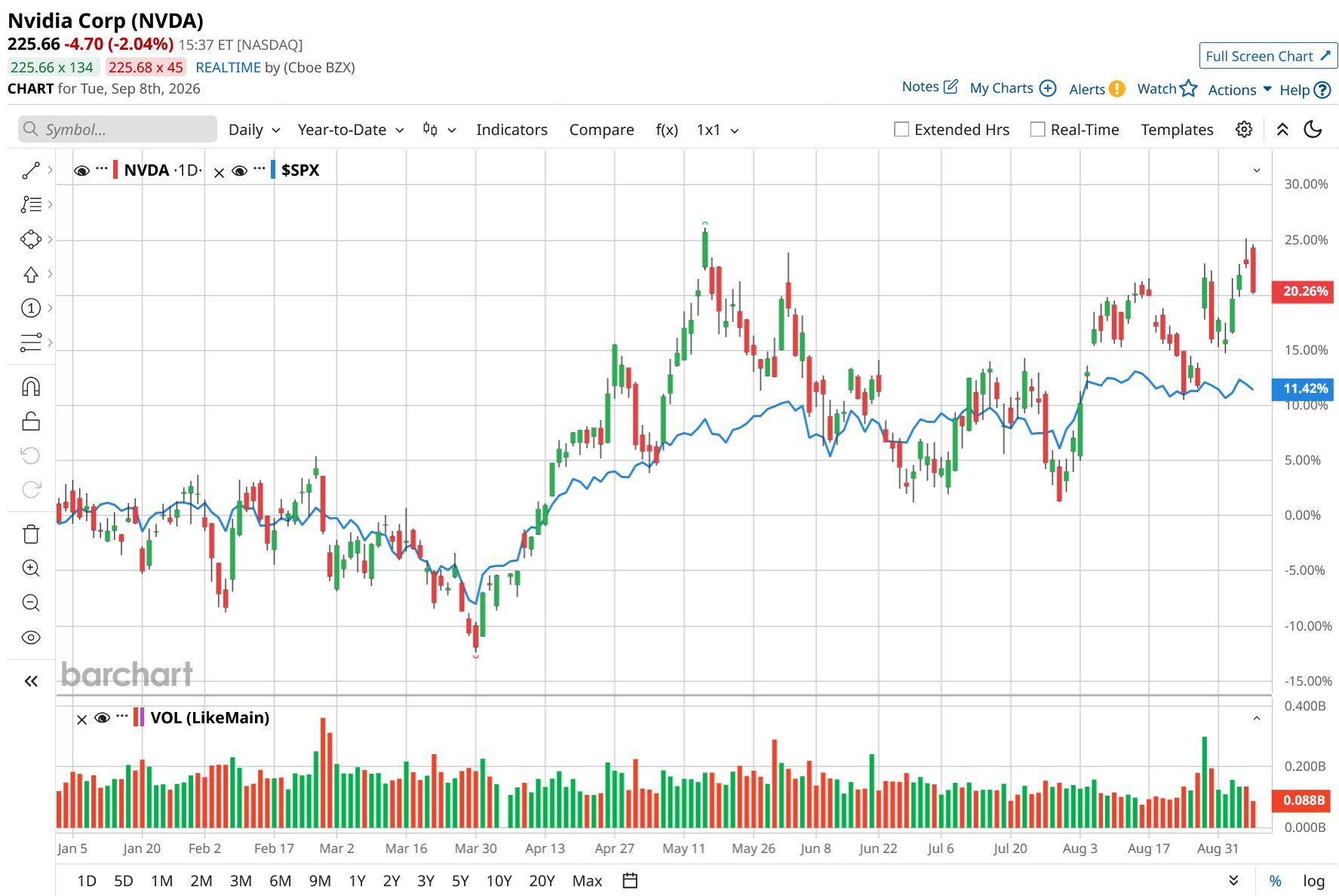
Still, Nvidia continues to leave the broader market in the dust. NVDA stock is up 34% over the past year and 21% so far in 2026, compared with gains of 18.3% over the past year and 12.3% in 2026 for the S&P 500 Index ($SPX). More recently, Nvidia shares have started picking up momentum again, helped by strong demand for AI infrastructure and easing concerns over how hyperscalers will finance their massive AI spending. The stock is now closing in on its all-time high of $236.54, reached on May 14, and is down just 3% from that peak.
 www.barchart.com
 A Closer Look Inside Nvidia’s Q2 Earnings Report
If Nvidia’s rise over the past few years has been impressive, its latest earnings report proves that the AI giant is still operating at full throttle. In its fiscal 2027 second-quarter results, published on Aug. 26, Nvidia once again delivered extraordinary growth, with revenue soaring 106% year-over-year (YoY) to $96.22 billion, compared with $46.74 billion a year earlier. The topline also comfortably topped Wall Street’s $92.17 billion forecast.
Profit growth was even more impressive. GAAP net income jumped 126% to $59.69 billion, while non-GAAP EPS came in at $2.22, beating analysts’ estimate of $2.10. Nvidia’s non-GAAP margin also expanded by 2.5 percentage points to 75%, highlighting just how powerful the company’s profitability engine remains. The star of the show was, unsurprisingly, Data Center.
The division generated a staggering $89 billion in revenue, accounting for more than 92% of Nvidia’s total revenue, while posting a 117% YoY increase. The surge was fueled by relentless hyperscaler capital spending and rapidly growing enterprise adoption of accelerated computing clusters. Sequential growth was further supported by the initial volume rollout of the next-generation Vera Rubin architecture, alongside continued full-scale production of Blackwell systems across major cloud partners, including Azure, Google Cloud, and OCI.
Nvidia’s growth story is also expanding beyond traditional hyperscale infrastructure. Its Edge Computing segment generated $7.2 billion in revenue, up 27% YoY, as on-device AI integration continued gaining commercial traction. Nvidia is also putting its enormous cash-generation power to work for shareholders. During fiscal 2027’s second quarter, the company returned approximately $26 billion to shareholders through share repurchases and cash dividends.
As of the end of the quarter, Nvidia still had approximately $99 billion remaining under its share repurchase authorization. Looking ahead, Nvidia expects the momentum to continue. For fiscal 2027’s third quarter, the company projects revenue of $108 billion, plus or minus 2%. Importantly, Nvidia is not assuming any Data Center compute revenue from China in this outlook. GAAP and non-GAAP gross margins are expected to come in at 74%, plus or minus 50 basis points.
How Do Analysts View NVDA Stock?
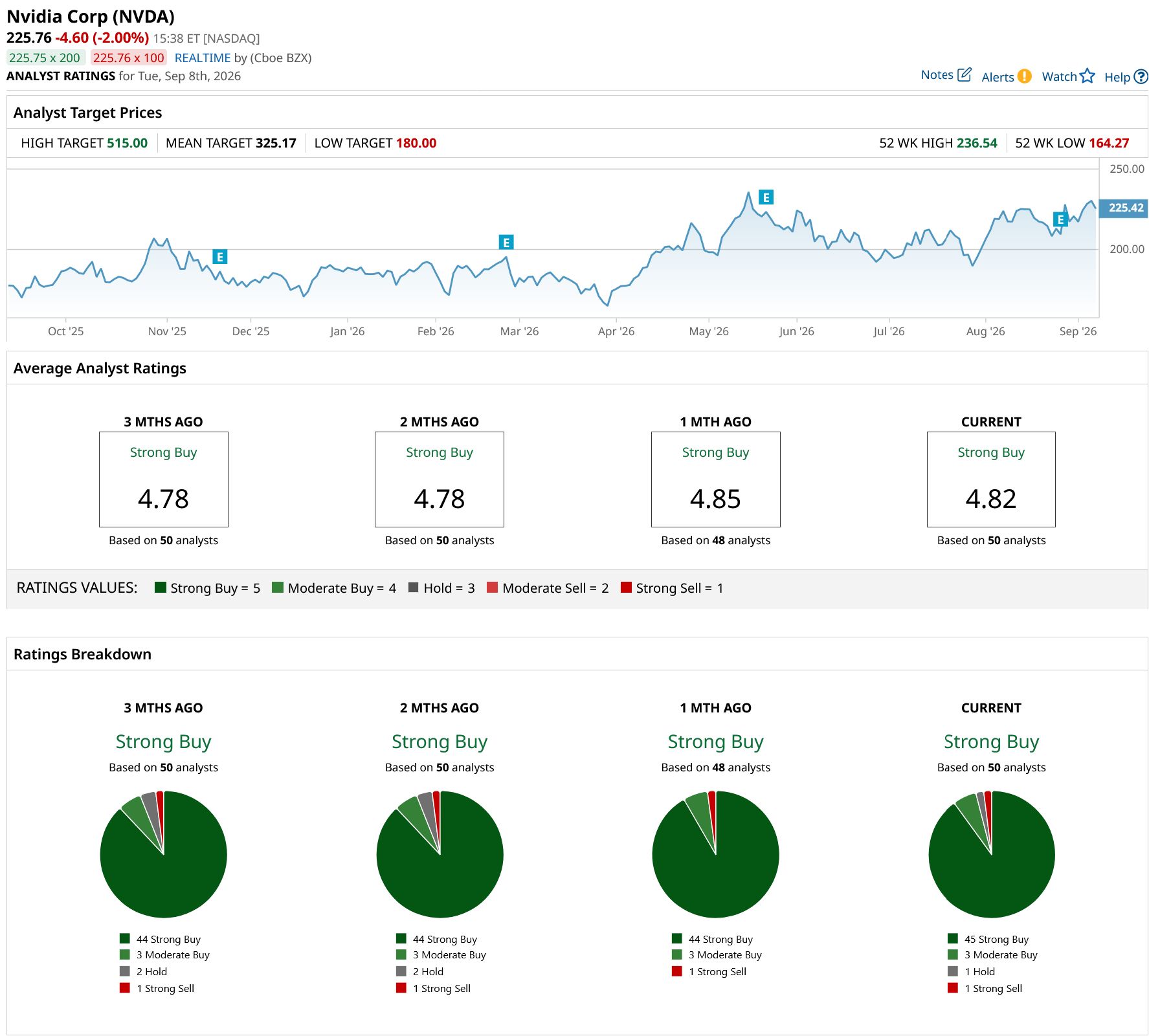
Wall Street’s confidence in Nvidia remains hard to miss. NVDA stock carries a consensus “Strong Buy” rating, with 45 of the 50 analysts covering the company recommending a “Strong Buy.” Three analysts see it as a “Moderate Buy,” while just one has a “Hold” rating and one calls for a “Strong Sell.” And the upside Wall Street sees is anything but modest.
The average price target of $325.17 points to about 44% potential upside, while the Street-high target of $515 suggests Nvidia could rally as much as 128% from current levels. Moreover, with the stock once again hovering near record territory, investors have plenty of reason to watch closely as the company heads into its next potential catalyst.
 www.barchart.com
 On the date of publication, Anushka Mukherji did not have (either directly or indirectly) positions in any of the securities mentioned in this article. All information and data in this article is solely for informational purposes. For more information please view the Barchart Disclosure Policy here.
More news from Barchart
SpaceX Stock Just Scored a New 'Buy' Rating. What to Know. Dear Nvidia Stock Fans, Mark Your Calendars for September 10 Quantum Stocks Are Climbing Today as CHIPS Act Cash Pours In. Here’s One Way to Invest. Morgan Stanley Just Downgraded Peloton Stock. Here's Why.