


On the evening of Friday, June 12, at 5:21pm Eastern, Anthropic received a letter. By the next morning, Claude Fable 5 and Claude Mythos 5, two of the most capable artificial intelligence models in existence, were dark for every user on Earth. Twelve hours after the news broke, a crypto token built on the premise that this exact scenario should never be possible had jumped about 30 percent.
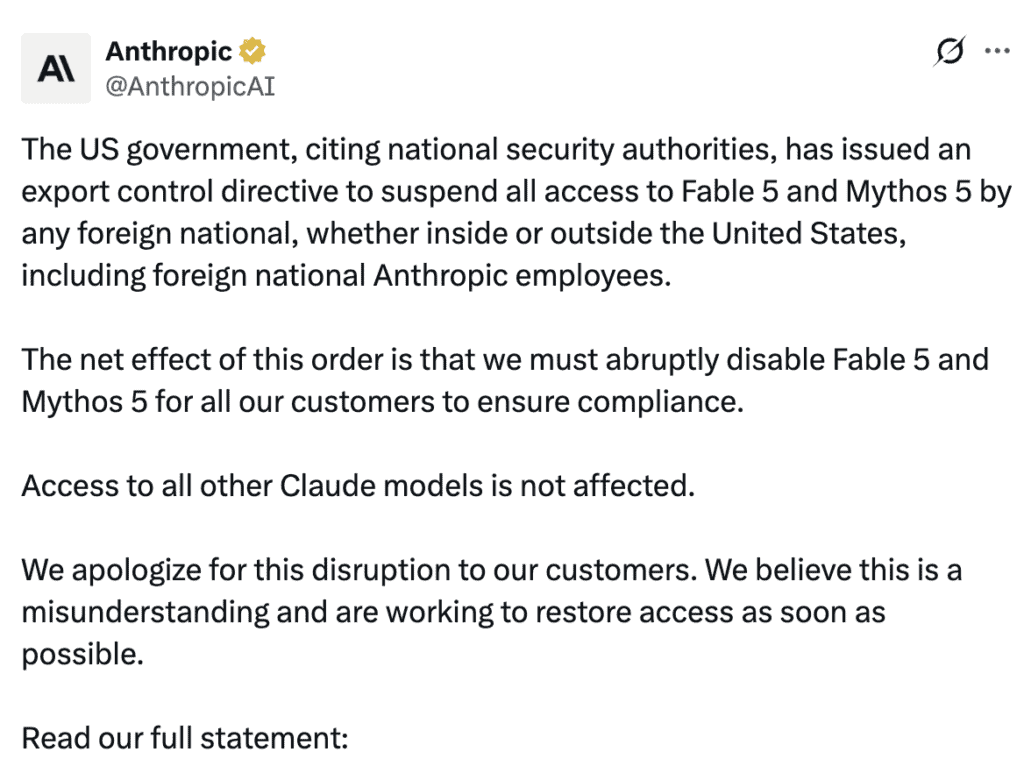
The Anthropic Tweet confirming that users cannot access Fable
That sequence, compressed into less than a day, is the entire argument for decentralized AI. You could write a hundred-page whitepaper making the case and not land it as cleanly.
What actually happened
The US government issued an export control directive ordering Anthropic to suspend access to Fable 5 and Mythos 5 for any foreign national, citing national security authorities. The scope was unusually broad. It covered not just users abroad but any foreign national inside the United States, including Anthropic's own non-citizen staff. Because the company cannot reliably tell in real time who is and is not a foreign national, it did the only thing that guaranteed compliance and switched the models off for everybody. Access to its other models, including the recently released Opus 4.8, was unaffected.
Reporting from Fortune traced the order to the Commerce Department, reportedly prompted after a third party claimed it had found a way to jailbreak Fable. Anthropic disputes the rationale. It says the technique surfaced only minor, already-known vulnerabilities, that other public models can find the same ones without help, and that it believes the whole episode is a misunderstanding. In its statement the company said it was "working to restore access as soon as possible." For now, the kill switch is on.
The market did what markets do
Bittensor's TAO token, the closest thing the sector has to a bellwether, rallied around 30 percent in twelve hours on the news. It has held most of that move. TAO is trading near $275 as I write, up roughly a third over the past week. The broader basket of decentralized-AI tokens added about 12 percent across the week to a combined value near $24 billion, with smaller compute and data projects such as io.net, Grass and ChainOpera AI leading the pop.
In the 12 hours after the shutdown, Bittensor's TAO token rallied about 30%, tagging a three-week high near $283 and easily outpacing the broader market before easing back toward $275. It was TAO's sharpest short-term move in months, with trading volume and social chatter spiking alongside it as traders rotated into the token.
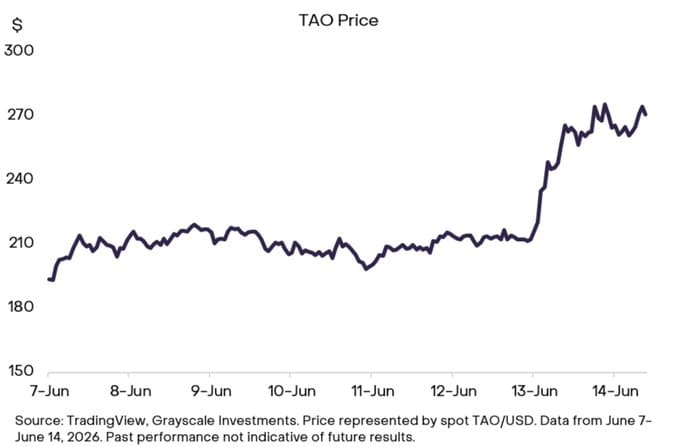
Bittensor's TAO token rallied about 30%, source: X
TAO has reclaimed the mid-200s and is now pressing on the $280 to $300 band that several analysts flag as the next real test. Hold the support shelf in the mid-240s to mid-250s and clear $300 on strong volume, and this starts to look like a trend rather than a one-off spike. Lose that support and the chart opens up a pullback toward $220.
The risks here are not subtle. A quick regulatory fix that puts Anthropic's models back online would remove the catalyst outright. Profit-taking after a run this steep is the base case for any token that just added a third of its value in a week. And anything specific to Bittensor's own network or governance could undercut the move regardless of the macro story. The June 19 Fed meeting is the next external swing factor worth watching.
Grayscale supplied the narrative. In a note published Monday, head of research Zach Pandl argued the episode was structural rather than incidental: when a handful of companies in the United States and China control the frontier, a single directive or lawsuit can yank access for the entire world at once. His prescription is the one his firm happens to be positioned for. Grayscale has filed to convert its Bittensor Trust into a spot ETF that would trade on NYSE Arca under the ticker GTAO, the first US fund offering direct TAO exposure, and it lifted Bittensor to roughly 43 percent of its AI-focused fund late last year. Pandl has taken to calling Bittensor "Bitcoin for AI," which is either a useful shorthand or a tell, depending on your priors.
The thesis underneath the trade
Strip away the token charts and there is a real argument here, and it predates this week.
Jake Brukhman, who founded the crypto investment firm CoinFund back in 2015, has spent the past year making that argument at conferences and in op-eds. His read on the Anthropic order is blunt: it confirmed that AI models are the single biggest target for government control, and on Friday that stopped being a thesis and became a market fact. The interesting part of his case is technical, not political. The world already has more than enough commodity GPU compute sitting idle to train frontier models, he argues. What was missing were the algorithms to coordinate that training across slow, scattered, untrusted hardware.
Those algorithms are arriving. Gensyn has demonstrated reinforcement learning that can be verified on-chain. Prime Intellect has aggregated surplus global compute into working training runs. Pluralis, which CoinFund backs, is chasing the hardest problem of all, training a single large model split across many machines, with a twist it calls Protocol Learning: the full set of model weights is never assembled in one place, so the network itself owns the model and value flows back to whoever contributed compute. Brukhman also pointed to Bagel, Nous Research, Macrocosmos and Covenant as teams pushing on distributed training that the field spent years insisting was flatly impossible.
That point about ownership matters more than the speed benchmarks. Open-source models have a chronic business-model problem: they are free, which is wonderful for users and ruinous for whoever pays the training bill. Pluralis's pitch is that tokenizing the weights finally gives decentralized AI something open source has never had, a way to pay for itself. If that holds up, it is a bigger story than any one token's weekly candle.
The part nobody is putting on a poster
Here is the wrinkle. Days before the government switched Mythos off, Mythos was quietly making crypto safer.
In late May, a researcher at Shielded Labs found a four-year-old soundness bug buried in Zcash's Orchard shielded pool, the kind of flaw that could in theory have let an attacker mint counterfeit ZEC without anyone noticing on-chain. After an emergency fix, Shielded Labs asked Anthropic to run a full audit of the protocol using Mythos. On June 12, Zcash co-creator Zooko Wilcox thanked Anthropic publicly and reported that the review turned up no further serious bugs. That was the same day the directive landed.
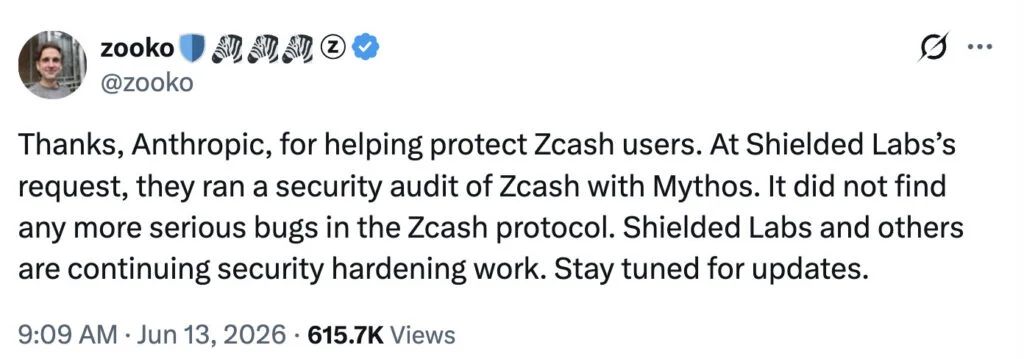
Zooko thanks Anthropic for using Mythos to bug check Zcash, source: X
So the most powerful model available for hardening an open, censorship-resistant cryptocurrency was itself sitting behind a switch the government could flip. Both things are true at the same time, and they are really one fact wearing two outfits. Concentrated capability and single point of failure are not opposites. They are the front and back of the same coin.
The cold shower
A 30 percent pop on a narrative is not a verdict on the technology, and these moves can fade about as reliably as they spike. The entire decentralized-AI sector is worth somewhere around $24 billion, a rounding error next to the centralized labs it claims to challenge, and a good deal of that value is reflexive, tracking sentiment far more than actual usage. Decentralized training has produced genuinely impressive proofs of concept, but it still trails the frontier on raw capability, and "can compete eventually" is doing a lot of work in most pitches. Anthropic, for its part, insists the ban is a misunderstanding it expects to reverse, in which case the catalyst simply evaporates. And decentralization is not a regulatory force field. Tokens, exchanges and the humans running validators all live somewhere with laws.
This week did not prove that decentralized AI works. It proved that centralized AI has an off switch, that the switch is wired to a government, and that it can be thrown on a Friday afternoon with three days' notice. The race to build unstoppable, uncensorable, global decentralized AI is on. Call it the “Bitcoin of AI”. Coming soon.