

Take a long look at this chart of the entire 21st century. I used the SPDR S&P 500 ETF (SPY) for stocks and a Vanguard Bond Index Fund (VBTIX) for bonds. These are five-year rolling returns since the year 2000.
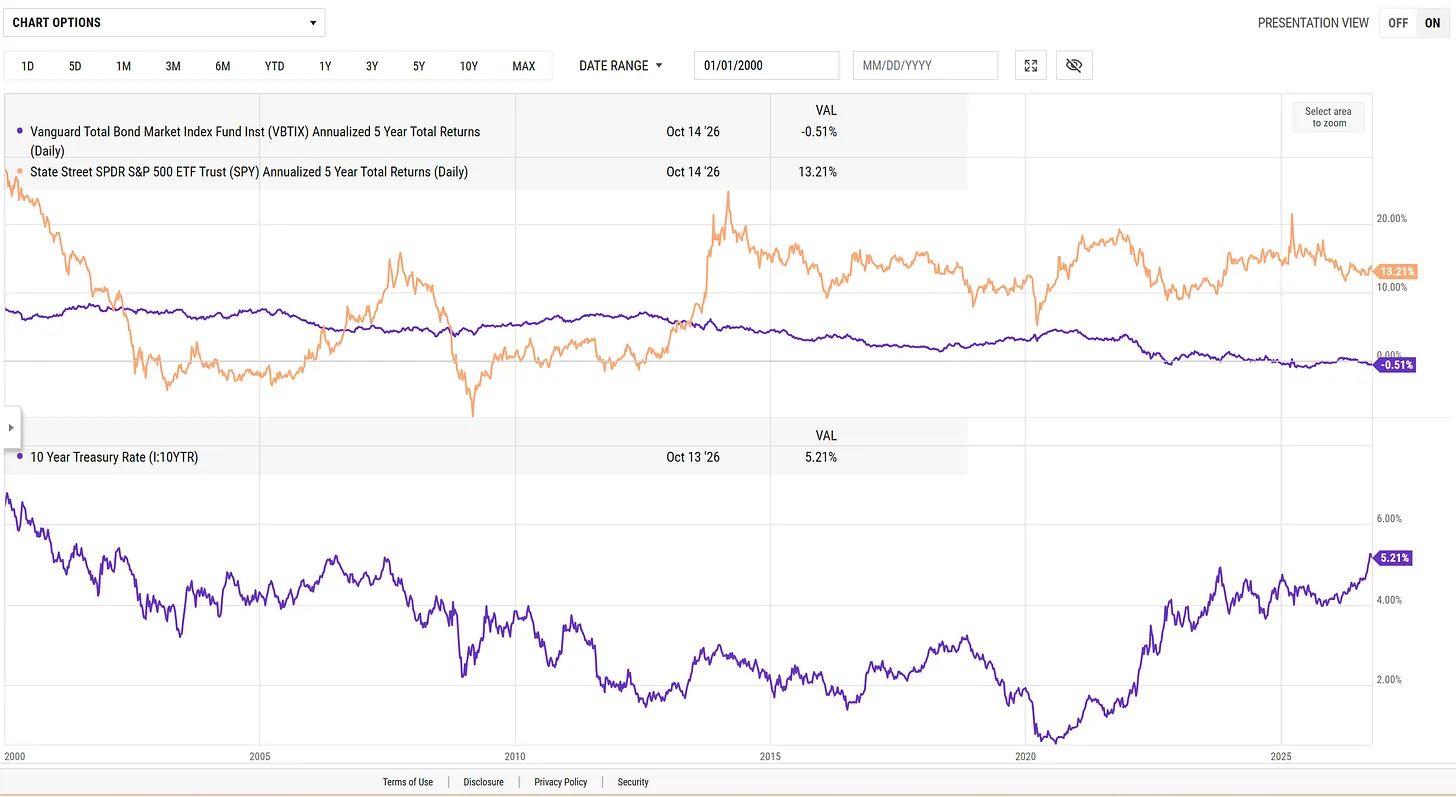 Chart screenshot courtesy of Rob Isbitts
If you glance at the top panel, you will see what looks like an open-and-shut case for passive equity investing. After all, over the past five years, the S&P 500 Index ($SPX) has compounded at an annualized rate of more than 13%, while the bond index has actually lost 0.5% a year.
Join 200K+ Subscribers: Find out why the midday Barchart Brief newsletter is a must-read for thousands daily.
To investors unfamiliar with bonds, that looks like total futility for fixed income. A five-year holding period that leaves you in negative territory while stocks march higher.
Now, look at the bottom panel.
The 10-Year U.S. Treasury yield sits at 5.2%. That is its highest sustained level since the very beginning of this century, right around the dot-com peak in 2000.
That single data point explains the entire story. It explains why bond fund returns were so muted since 2000. And more importantly, why bonds matter today in a way they haven’t for the past 26 years.
For a patient investor who evaluates their performance over half-decade time frames, the stock market carried them. It actually left them with no reason to even think about evaluating bonds.
Oh, has that ever changed!
To understand why bonds are suddenly relevant again, you have to look at what fixed income was doing for the first two decades of this century.
From the aftermath of the 2000 tech bust, through the 2008 Global Financial Crisis, and all the way to 2021, the bond market was living in an artificial world. Yields were driven down from 6% to near zero.
During the post-2008 Zero Interest Rate Policy (ZIRP) era, bonds stopped acting like an investment and started acting like a parking place. A zero return was better than a 50% drawdown in the S&P 500 Index. Which is what occurred twice during this century’s first decade. And not since 2009.
Investors accepted 1% to 2% yields on Treasuries because they were told bonds provided “safety” in a traditional 60/40 mix. But mathematically, they offered virtually no income while exposing investors to catastrophic price risk if interest rates ever normalized.
Then, the normalization finally arrived. When the 10-year Treasury rate surged from under 1% up past 5.2%, bond prices collapsed to adjust to the new reality. That rate shock is precisely why VBTIX shows a negative 5-year annualized return (-0.5%).
Investors who look at that paltry return and swear off fixed income are making a classic mistake. They are judging the future of an asset by the pain caused by the transition to today’s rates. That negative return is the rear-view mirror. The 5.2% yield on your screen is the windshield. I say, look through it, so you can see the darn road!
For the first time this century, the equity market faces genuine competition for capital. As someone who managed other people’s money throughout the ZIRP era, we saw Wall Street coin the phrase “TINA.” There Is No Alternative. You had to own equities, regardless of how stretched valuations were, because cash and bonds paid nothing.
Think about what the S&P 500 represents right now: an index trading at historically elevated multiples, heavily concentrated in a small handful of artificial intelligence and semiconductor heavyweights, with market breadth quietly deteriorating under the hood.
Why would an investor who has already built their wealth subject 100% of their net worth to a potential 30% to 50% equity drawdown just to chase an uncertain return, when high-quality fixed income is handing them 5.2% with zero credit risk? Or, as I said to a couple of my Barchart.com colleagues recently:
They are giving me 5% for 5-10 years. And I said to myself, take it!
Here is how active risk managers should approach this 5%+ environment:
Do not “buy and hold” broad-market bond index funds (like (AGG), (BND), or VBTIX). They never mature. They hold a rolling basket of bonds, which means their duration risk remains permanently locked in place. If long rates climb another 50 to 100 basis points, those funds will suffer price declines.
If you are OK with that, similar to how a dividend stock can pay you 5% yield but the stock price can keep falling in perpetuity, then OK. But I’m not in that camp. I will trade those but not own them long term.
If you want to capitalize on 5%+ yields, consider instruments with a guaranteed terminal value. Buy individual Treasury notes, zero-coupon Treasury STRIPs, or target-maturity bond ETFs (like iBonds or BondBuilder).
When you buy a defined-maturity instrument, your risk shrinks toward zero as maturity approaches. Bonds do that on their own. And defined-maturity ETFs maturing their portfolio’s underlying bonds, and ride out the last few months with cash-like investments.
My 1-2 punch is to use today's rates to my advantage. I anchor the majority of my portfolio in 5%+ fixed income, locking in an ironclad cash flow and total return floor. I then use the remaining capital to take small, tactical, defined-risk shots in equities, options, or volatile ETFs where upside is asymmetric.
That is, I will risk a little to try to make a lot. At some point, the stock market will be buyable again. Right now, it is purely a rental to me.
For 26 years, investors operated under the assumption that the stock market was the only place to build and protect wealth. The chart above proves that era is over.
Bonds were broken because rates were unnaturally suppressed by central bank policy. Now that the 10-year Treasury rate is back above 5%, even if it trades in a more normal 4%-7% range for the next several years, the natural order of capitalism has returned to a market near us.
Past performance for bonds is not likely any type of indication of future returns. Especially if you approach it with a risk-management mindset.
Rob Isbitts is a semi-retired CIO, former fiduciary investment advisor, Barchart columnist, and straight-talker. Download his new free e-book on hedged bond investing for retirement at ETFYourself.com. His research and model portfolios are at ROAR.PiTrade.com.
On the date of publication, Rob Isbitts did not have (either directly or indirectly) positions in any of the securities mentioned in this article. All information and data in this article is solely for informational purposes. For more information please view the Barchart Disclosure Policy here.
More news from Barchart
Why Bonds Matter for the First Time This Century (and How to Profit) U.S. Stock Futures Climb as Chipmakers Rebound; Corporate Earnings in Focus Where Is the Stock Market Heading in the Final Months of 2026? Your 60/40 Portfolio is Old Math in 2026. Steal These Strategies From Our Bond Market Pro Instead.