The article discusses the Extremal Optimization (EO) algorithm, an optimization method inspired by the Bak-Sneppen self-organized criticality model, where evolution occurs through the elimination of the worst-case components of the system. The modified population version of the algorithm demonstrates a shift away from theoretical principles in favor of practical efficiency, leading to the creation of powerful computational tools.
We invite you to explore the Actor-Director-Critic framework, which combines hierarchical learning and a multi-component architecture for creating adaptive trading strategies. In this article, we take a detailed look at how using the Director to classify the Actor's actions helps to effectively optimize trading decisions and improve the robustness of models in financial market conditions.
This article develops a class for managing partial position closing in MQL5 and then integrates it into an Order Blocks Expert Advisor. It also presents test results comparing the strategy with and without partial position closing, and analyzes the conditions under which this approach can help provide and maximize profit. In conclusion, partial position closing can be highly beneficial in trading strategies, especially those focused on wider price movements.
The article discusses the practical implementation of the HiSSD framework in algorithmic trading tasks. It explains how the skill hierarchy and adaptive architecture can be used to build sustainable trading strategies.
This article adds a regression gate to the MQL5 debugging and profiling workflow. It keeps the Part II profiler, TestLite runner, and trading math helper as contracts, then compares current profiler evidence with an accepted baseline. The workflow also adds symbol-aware assertions, compact status files, and report tables so performance drift, missing tests, and broker-assumption problems are visible before a build is accepted.
The article presents a new approach to creating trading systems based on quantum principles and artificial intelligence. The author describes the development of a unique neural network that goes beyond classical machine learning by combining quantum mechanics with modern AI architectures.
For this article we rotate to a custom MQL5 Wizard class implementation that explores Trailing Stops. Our custom class is ‘CTrailingReservoirLinReg’ that we derive by combining the Reservoir Sampling algorithm with a Linear Regression network. As has been the case throughout these series, this formulation is testable with MQL5 Wizard Assembled Expert Advisors that can be tuned with various entry signals and money management classes.
This article shows how to build a local stop-loss system in an MQL5 Expert Advisor that keeps stop levels on the terminal side. It walks through the execution logic, event handlers, inputs, and an OOP design using CTrade, CPositionInfo, CHashMap/CHashSet, and chart objects. You will implement multi-position tracking, draggable stops, visual spacers and labels, plus cleanup and disconnection behavior to create a practical risk-control utility.
MQL5's file system operates within a strict sandbox. Understanding its access flags and path resolution rules is the foundation of any reliable export pipeline. This article builds a CCSVExporter class that handles file creation, safe appending, and error recovery. It also covers CSV parsing, field tokenization, concurrent access conflicts, and write-buffering strategies for high-frequency optimization runs.
The article provides a detailed guide to creating the innovative 3DBarCustomSymbol.mq5 indicator, which generates custom symbols in MetaTrader 5 that combine price, time, volume, and volatility into a single three-dimensional representation. The mathematical foundations, system architecture, practical aspects of implementation and application in trading strategies are considered.
This article presents CTradeJournal, a self-contained MQL5 class for live tracking of open positions at tick frequency. It maintains MAE, MFE, and initial risk in money, calculates the R-multiple when a position closes, and writes a complete CSV record. The text explains the design choices, provides the implementation, and shows simple EA integration so you can analyze entries, stop placement, and outcome distribution.
Multi-core optimization in MetaTrader 5 can silently drop results when parallel agents contend for the same CSV file. A reusable MQL5 export engine applies an iteration-based spin-lock to acquire the file handle reliably and append rows without loss. It persists custom metrics such as the Sortino Ratio, average trade duration, and signal-quality measures (lag and whipsaws) into a consolidated CSV for downstream analysis.
The article explores the possibility of using regression models in algorithmic trading. Regression models, unlike binary classification, allow for the creation of more flexible trading strategies by quantifying predicted price changes.
The article extends the MQL5 recurrence library to Recurrence Network Analysis (RNA) by treating recurrence matrices as adjacency matrices of undirected graphs. It implements core network metrics—clustering, transitivity, average path length, betweenness, assortativity, and density—and applies them in rolling windows for single-series RNA and Joint RNA (JRNA). A modular metrics engine and two indicators visualize the evolving network structure on MetaTrader 5 charts for practical time-series analysis.
Manually drawn analytical object tools like Fibonacci tools, and Andrews Pitchforks are invisible to automated trading logic. This article extends a base detector to extract anchor points, level arrays, and geometric offsets from complex objects. You will implement a reusable collector that normalizes the raw chart data into structured memory arrays, ready for strategy decisions.
We extend the canvas drawing layer from the previous part with seven new categories of multi-anchor analytical drawing tools, covering three channel variants, three pitchfork variants, three Gann tools, and the six Fibonacci tools. We work through how each tool encodes its geometry on the canvas, how derived handles let users reshape compound shapes coherently, and how shared helpers handle ray clipping, scanline filling, and anti-aliased arc rendering. By the end, we will have a full set of analytical drawing tools that live on the same interactive canvas alongside the basic line tools from the previous part.
This article implements the Chapter 19 microstructure suite in afml.features.microstructure and explains a two-layer design for OHLCV-only and tick-augmented workflows. We cover Roll and Corwin–Schultz spread/volatility, Kyle's, Amihud's, and Hasbrouck's lambdas, VPIN, and bar‑level imbalance features, all in Numba‑accelerated kernels. A single np.searchsorted pass resolves bar boundaries, enabling prange parallelization and producing a bar‑indexed feature matrix ready for downstream ML models.
Automated trading systems often focus heavily on signal generation while neglecting the mechanisms required to protect capital during periods of stress. This article presents an Equity Governance Framework in MQL5 that monitors drawdown conditions, evaluates equity pressure, and dynamically controls trading activity through a state-driven risk management model. By combining drawdown analysis, cooldown logic, trade authorization, and execution restrictions, the framework demonstrates how trading discipline can be engineered directly into code using a modular and extensible architecture.
In this article, we explore the HiSSD framework, which combines hierarchical learning and multi-agent approaches to create adaptive systems. We examine in detail how this innovative methodology helps uncover hidden patterns in financial markets and optimize trading strategies in decentralized environments.
This article builds the Spectrum Fitter: from tau(q) we compute f(alpha) with a discrete Legendre transform, then fit Normal, Binomial, Poisson, and Gamma spectra under box constraints using BLEIC. The best model by SSE is selected, and its parameters (eg, alpha min, alpha max or alpha_0, gamma) become the cascade inputs for multifractal simulation.
Most retail traders ignore overnight swap rates, but for long-term positions, these interest payments can make or break your strategy. This article shows you how to build a dynamic MQL5 module that retrieves real-time swap data and converts it into actual profit or loss in your account currency. You will learn how to program an Expert Advisor that automatically calculates if a trade is worth holding based on carry income and adjusts your position size to account for expected interest. It is a practical guide to turning a hidden cost into a mathematical advantage for your trading systems.
The article presents a detailed analysis of the Exchange Market Algorithm (EMA) inspired by the behavior of stock market traders. The algorithm simulates stock trading, where market participants with varying levels of success employ different strategies to maximize profits.
When running multiple strategies in parallel, you may want to periodically close all open positions and start the strategies over again. The existing code only allows this behavior to be implemented through manual intervention. Let's try to automate this part.
For this article we switch to a custom MQL5 Wizard class implementation that explores Money Management. We are labelling our custom class ‘CMoneySuffixAE’ that we derive by combining the Suffix Automaton algorithm with an Autoencoder neural network. As always, this formulation is testable with MQL5 Wizard Assembled Expert Advisors that can be tuned with various entry signals and trailing stop approaches.
The article delivers an object-based MQL5 implementation that detects weekend gaps from time discontinuities and renders them directly on the chart. It manages graphical objects, tracks state transitions (fresh, partial, reaction, filled), and preserves completed gaps as historical zones. The result is a reproducible framework for monitoring how price revisits and fills weekend gap structures.
This article shows how to implement a production Z-Score engine in MQL5 using an object-oriented include file, the library computes a rolling mean and population standard deviation, exposes a shift parameter for historical queries, and avoids redundant tick work by running on bar close. An Expert Advisor executes rule-based entries at positive/negative sigma thresholds and closes on mean reversion; a custom indicator provides visual verification.
We continue to work on implementing the CATCH framework, which combines the Fourier transform and frequency patching mechanisms, ensuring accurate detection of market anomalies. In this article, we complete the implementation of our own vision of the proposed approaches and test the new models on real historical data.
In today's article we will begin studying the use of SQL in MQL5 code. We will also look at how to create a database. Or, more precisely, how to create a SQLite database file using the features built into MQL5. We will also see how to create a table, and then how to establish a relationship between tables by using primary and foreign keys. All of this, once again, will be done with MQL5. We will see how easy it is to create code that can later be migrated to other SQL implementations by using a class that helps hide the implementation being created. And, most importantly, we will see that at various points we may face the risk that something will go wrong when using SQL. This happens because, in MQL5 code, SQL code will always be placed inside a string.
This article completes the implementation of ATR- and RRRR-based breakeven mechanisms in MQL5 and develops, from scratch, a class that makes it easy to switch breakeven modes without having to enter the parameters again. To evaluate the effectiveness of each breakeven type, several backtests are run, analyzing their advantages and disadvantages in the context of algorithmic trading.
Replace static drawings with automated, stateful zones controlled by a CZone wrapper. The system synchronizes user rectangles, sizes zones by ATR, validates breakouts using consecutive closes, applies ghost/deactivation rules, merges nearby structures by a 1.5×ATR threshold, and projects edges forward. Traders gain durable levels that update themselves and reduce repetitive chart management.
This article adds eight volatility functions to MicroStructure_Foundation.mqh, including realized volatility, duration-adjusted volatility, fractional volatility, a FIGARCH-inspired proxy, a volatility clustering index, a GJR-GARCH asymmetry measure (using the Dube library), bipower-variation jump detection, and a wrapper function. The MFDFA implementation is revised to return the conventional Legendre-transform Δα with an R² confidence field, replacing the τ-spread proxy used in the original submission. Thresholds are derived from 514 NY sessions of NQ E-mini Nasdaq 100 futures (May 2024–May 2026); no new include file is created.
In today's article, we will look at how to control some object properties in a simple way using code. We will also see how a custom application can place more than one object on the same chart. In addition, we will begin to understand the importance of assigning a short name to any indicator we plan to implement.
In the previous article, we completed the necessary introduction to SQL. And, in my opinion, we properly clarified what we wanted to show and explain about SQL. This was done so that anyone who comes to look at the market replay/simulation system being built can at least get an idea of what may be happening there. The point is that there is no sense in programming things that SQL handles perfectly.
A detailed guide on how to create a heat map indicator for MetaTrader 5 that visualizes the price distribution over time. The article reveals the mathematical basis of time density analysis, where each price level is colored from red (minimum stay time) to blue (maximum stay time).
You have probably already heard about pointers when it comes to programming. But did you know that we can use this kind of data here in MQL5? Of course, this must be done in a way that keeps us in control and avoids strange program behavior during execution. Still, because this is a feature with a very specific purpose and aimed at particular kinds of tasks, it is rare to hear anyone discuss what a pointer is and how to use it in MQL5.
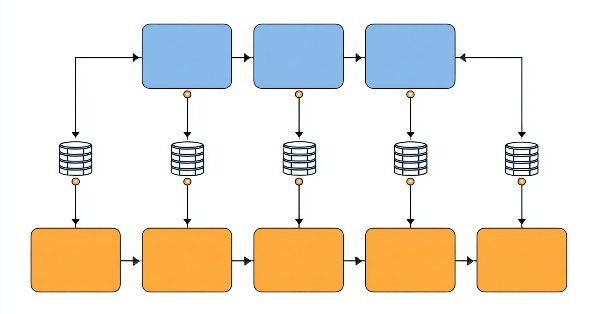
In this article, we will see how to visualize a database and, from that, understand how it is structured. This is done by analyzing the database’s internal structure. Although this may seem unnecessary at first, it is fully justified if we really want to become database administrators. After all, some people make a living maintaining and designing databases.
The article describes and codes MR Swing in MQL5, a mean‑reversion swing approach that combines a 200‑day hysteresis channel with Value Charts, DVO, and SVAPO. We document entry/exit rules for bull and bear regimes and show five‑year backtests on six high‑liquidity Nasdaq stocks. The complete EA code and backtest configurations are provided for reproducibility.
We replace native MetaTrader chart objects with a canvas-based drawing engine that renders tools pixel-by-pixel on a full-chart bitmap layer. The article implements persistent object storage with per-tool style memory, precise hit testing, selection, whole-object dragging, and handle manipulation. It also adds new line tools, a reorganized category system with a one-click delete action, and a rubber-band preview for multi-click placement.
We bridge Python-native artifacts to MQL5 for tick-accurate CPCV backtesting. The export script converts the ONNX model, calibrator, feature spec, and path masks to flat files, while the expert advisor rebuilds features, performs ONNX inference with calibration, and trades on real ticks. The Strategy Tester runs each combinatorial path, and Python aggregates per-path equities into a path Sharpe distribution to assess robustness after spread, slippage, and commission.
The article describes an MQL5 EA that automates Wyckoff accumulation and distribution via a finite state machine. It confirms spring to SOS and upthrust to SOW before placing LPS or LPSY entries, using relative tick volume as the confirmation metric. Readers get the state model, detection criteria, code organization, and MetaTrader 5 testing procedure.