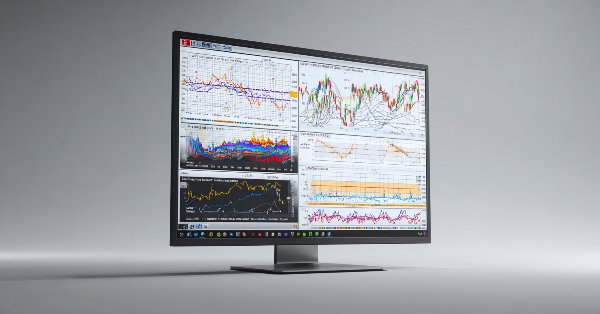
MetaTrader 5 provides no native tool for visualizing intraday return patterns across time dimensions simultaneously. This article implements a custom indicator that aggregates historical bar returns into a 5×24 matrix indexed by weekday and hour of day, then renders the result as a color-interpolated heatmap inside an indicator subwindow using CCanvas. Green cells represent positive average returns, red cells negative, with color intensity encoding return magnitude.
We integrate eleven one-minute microstructure measurements from Parts 2–6 into a composite regime label with confidence and direction. A rule-based RegimeClassifier() assigns one of six regimes—Normal, Stressed, Noisy, Informed, Trending, Mean-Reverting—using empirically derived thresholds from 514 NQ M1 sessions (May 2024–May 2026). The deliverable includes MARKET_REGIME, RegimeAnalysis, and PopulateRegimeAnalysis(), enabling position sizing, stop placement, and signal filtering from a single call.
In this article, we build an automated trading program in MQL5 that detects the Quasimodo reversal pattern from a zig-zag of confirmed swing pivots. We work through swing detection, pattern arming, retrace entries at the QM line, and structural stop placement with risk-based sizing. We also add trade management with breakeven, trailing, and partial closing to handle open positions.
The article explores the revolutionary Mamba/SSM neural network architecture for financial time series forecasting. We will consider a complete MQL5 implementation of a modern alternative to Transformer with linear complexity O(N) instead of quadratic O(N²). Selective State Space Models, hardware-aware optimizations, patching techniques, and advanced AdamW training methods are covered in detail. Practical test results showing an increase in accuracy from 62% to 71% while reducing training time from 45 to 8 minutes are included. A ready-made trading EA with auto learning and adaptive risk management for MetaTrader 5 is presented.
This article introduces an MQL5 trade authorization framework built around CDisciplineLayer, CDisciplineGuardian, and CDisciplinePanel. The framework manages setup lifecycles, signal freshness, session restrictions, setup expiry, and global trading locks through a centralized authorization layer. It also provides automated enforcement of violations and a real-time dashboard, enabling consistent trade validation and monitoring before and after execution.
The article establishes a reproducible method to measure portfolio risk for multiple symbols using MQL5 matrices and OpenBLAS. It covers computing log returns, building a covariance matrix, and evaluating wᵀΣw instead of summing individual variances. A complete script prints naive versus true volatility and the cross‑term contribution, enabling you to detect when correlated instruments inflate exposure beyond single‑asset estimates.
An MQL5 port of four entropy estimators — Shannon, Plug-In, Lempel-Ziv, and Kontoyiannis — operating on the intrabar tick-rule sequence. CopyTicksRange() limits data to the broker's cached tick window, so features apply to recent bars only. The implementation encodes bid-direction ticks from MqlTick, replaces NumPy-dependent steps with array-based methods, and ships CEntropyFeatures.mqh and EntropyViewer.mq5 for EA and indicator use.
This article adds trade-state reconciliation and Safe Mode recovery to a MetaTrader 5 Expert Advisor. The EA continuously validates recovery integrity by comparing the live broker position with the persisted SQLite state and the in-memory runtime state. Detected inconsistencies trigger an automatic transition to Safe Mode, suspending virtual protection, breakeven, and trailing management until the recovery state can be trusted again.
A lightweight persistence design lets EAs retain counters, flags, and timestamps between terminal restarts. Using only MQL5, CPersistentStore writes a human-readable key=value file in MQL5/Files and serves reads from a CHashMap write-through cache via a typed API. The article analyzes O(1)/O(n) operations, partial‑write risks, and lack of locking, compares with GlobalVariables/SQLite, and provides a demo that reloads state deterministically.
Trading is characterized by high demands on risk management discipline. The article presents an analysis of the main reasons for traders' failures and proposes a technical solution in the form of the CEnhancedRiskManager class for the MQL5 platform. It includes practical testing on an aggressive grid EA.
This article lays out 'CMoneyKDTreeESN' custom money management class usable with the MQL5 Wizard, that combines the KD-Tree algorithm and the Echo State Network. We use the KD-Tree on log returns and ATR to give us a risk score, while the ESN tracks recent flow to give us a bounded lot size multiplier. Our class is usable in a variety of Wizard assembled Expert Advisors as shown here with the Envelopes and RSI signals, with a broad objective of modulating exposure in high-volatility and tail-risk environments.
This article builds a self-contained MQL5 Expert Advisor that completes the Wyckoff cycle: it detects accumulation/distribution with a finite state machine, enters at the last point of support/supply, and calculates exit point-and-figure counts under Wyckoff's Cause and Effect. We detail the box size from range ATR, a 1-box reversal, target validation, and a 2R fallback. Readers get runnable code without external dependencies.
This article demonstrates how to build a reusable prop‑firm evaluation module for MQL5 Expert Advisors and export results to an HTML dashboard. The module monitors balance and equity during backtests, simulates single or rolling challenges, checks profit target, daily and overall drawdown, and minimum trading days, then outputs both a terminal summary and a browser‑readable report.
Multi‑timeframe EAs that initialize every indicator handle in OnInit() pay a fixed startup cost even when most handles are never used. CIndicatorCache applies lazy loading with composite‑key lookup, reference‑counted Acquire/Release, and a deterministic FlushAll() for cleanup. Handles are created on first request and reused across ticks, reducing startup latency, avoiding repeated heap allocation, and preventing terminal resource leaks through centralized ownership.
The article diagnoses two defects that neutralize sequential bootstrap during cross‑validation: type erasure of SequentiallyBootstrappedBaggingClassifier and a fold‑level shape mismatch from cloning full samples info sets. It retains the classifier's identity, adds find seq bagging to re‑inject fold‑sliced t1 in CalibratorCV.fit, and resets state per split. A new bootstrap_comparison module reports OOF and OOB metrics and memory, letting you verify that sequential sampling is applied correctly and quantify its impact.
Building on Part 2, the implementation introduces restart-aware breakeven and trailing-stop systems for MetaTrader 5. The EA persists the state, such as breakeven activation, last trailing price, and virtual SL in SQLite, then restores them on startup. This preserves dynamic protection flow and prevents lost progress after terminal interruptions.
This article shows how to implement a session vwap in MQL5 as a reusable include class with a strict daily reset at broker midnight. The engine computes VWAP and volume‑weighted deviation bands only on closed bars and anchors accumulation with MqlDateTime to avoid distortions from missing candles. A companion indicator plots the baseline and bands, while an Expert Advisor reads signals once per bar for consistent, CPU‑efficient execution and reliable testing.
The article provides production-ready entropy estimators (Shannon, plug-in, Lempel–Ziv, Kontoyiannis) operating on tick-rule–encoded sequences. It resolves three correctness and performance issues in the original code, verifies outputs against chapter references, and extends encoding with quantile and sigma options. Users gain reproducible results and markedly improved computation speed for large bar sets.
The article discusses the application of Grey models to forecasting financial time series. We will consider the operating principles of Grey models and the specifics of their application to financial series. We will also discuss the advantages and limitations of using these models in trading.
In this section, we will look at the implementation of the key interfaces of the library of Gaussian processes in MQL5: IKernel, ILikelihood, and IInference. We will also demonstrate its operation on synthetic data and implement indicators for classification and regression, demonstrating its operation in online mode - with retraining of the model on each new bar.
The article implements rolling OLS regression channels in MQL5 and computes confidence and prediction bands with Student's t critical values instead of a fixed standard-deviation multiplier. It explains the leverage-driven widening at window edges, contrasts the result with Bollinger and Donchian channels, and reviews OLS assumptions on price data. A five-line rendering is documented to ensure reliable display in MetaTrader 5.
We present a complete workflow for adaptive filtering in MQL5 using the CNlEq Levenberg–Marquardt–like solver. The EA fits a VAMAC model—two EWMAs with an ATR‑based scaling—by supplying residuals and a Jacobian through CNlEq's reverse‑communication loop, with optional numerical or analytical derivatives. Code, setup instructions, and GBPUSD H1 tests show how to replace static thresholds with on‑bar re‑estimation.
The DI crossover often triggers in ranges where +DI and -DI oscillate without persistence. We build a two-layer hybrid: Optuna's TPE optimizes a regime gate over ADXR threshold, DI lookback, and minimum DI separation to maximize signal precision on a held-out window, then a Random Forest uses eleven ADX-derived features to accept or scale entries via afml.bet_sizing. The result filters ranging-market bursts and calibrates position size on EURUSD H1.
Nested if-else logic inside OnTick() creates implicit states that are hard to isolate, debug, and extend without regressions. A formal finite state machine in MQL5 uses an IState interface, a CStrategyContext mediator, and four concrete states to separate detection from behavior. A three-file include structure resolves circular dependencies and keeps declarations, definitions, and instantiation clean, making changes safer and debugging faster.
We add a tabbed settings window opened from the ribbon and bound to the selected object. The tabs — Style, Text, Coordinates, and Visibility — are built from the same descriptor system, with scrolling, per-level rows, and shared color/width/style popovers. The article covers layout, rendering, interaction, and inline price/time and numeric editing. You get one place to edit every property with live preview and commit-or-discard on close.
We turn a price-embedded point cloud into a Vietoris–Rips filtration and its boundary matrix. The article enumerates vertices, edges, and triangles with filtration values, sorts them in entry order, and builds O(1) vertex/edge lookups. You get MQL5 classes CTDARips and CTDABoundary and a sparse Z/2 boundary suitable for the next-step persistence reduction.
This article advances the stateful supply and demand zone framework for MetaTrader 5 by replacing polling with an event-driven model based on OnChartEvent(). We split synchronization into dedicated handlers for creation, modification, and deletion, and separate market logic in OnTick() from user interactions in OnChartEvent(). A persistent, append-only CSV logger records all lifecycle events, improving responsiveness, state consistency, and recoverable history for downstream analysis.
The article describes implementation of the A3 algorithm - a metaheuristic optimization method inspired by chemical processes - in MQL5. Only two adjustable parameters, compactness and a small population, ensure high operating speed with sufficient quality of solutions.
The article focuses on creating a trading system with a real quantum simulator instead of mathematical analogies. The system uses 3 virtual qubits, quantum gates and superposition principles to analyze markets. It is implemented as a trading EA for MetaTrader 5 in MQL5. The main achievement is the transition from simulation to real quantum principles of financial information processing.
This article presents 'CSignalUKFCapsNet', as a custom class coded in MQL5. This class is meant to be used with the MQL5 Wizard when assembling an Expert Advisor and when selected in the Wizard it defines the Expert Advisor's entry signals. In building this custom class, we brought together the algorithm Unscented Kalman Filter and the Capsule Neural Network. Our algorithm is showcased with four operation modes, and the coding of this as a custom class for the MQL5 Wizard, allows testing with various Trailing Stop methods and Money Management systems.
This article introduces a frequency-analysis framework for encoded candlestick patterns in MQL5. By transforming candlesticks into alphabetic symbols, historical price action can be analyzed as a statistical sequence rather than a visual chart. Using GBPUSD and Gold across multiple timeframes, the study examines the occurrence frequency of individual candlestick types, identifies dominant market structures, and reveals the symmetry between bullish and bearish price movements. The results establish a quantitative foundation for pattern discovery and prepare the way for analyzing multi-candlestick sequences and their predictive potential in algorithmic trading systems.
This article describes a live data export framework for MetaTrader 5 built around a decoupled, three‑layer design. The MQL5 component batches bar and tick records via a write buffer and rotates CSV files daily; a Python daemon tails the stream, renders a live dashboard, and flags anomaly thresholds. The demo indicator illustrates integration points, enabling real‑time monitoring and auditability during trading sessions.
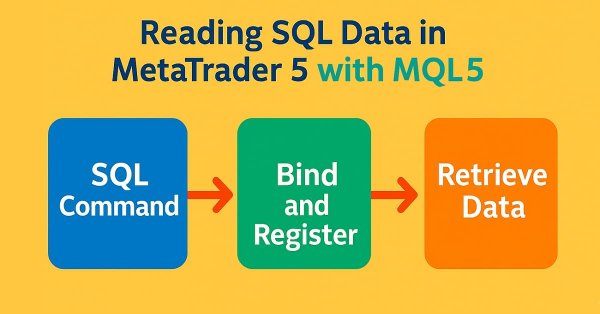
In the previous article, I showed how to proceed in order to add a query mechanism. This was needed so that, inside MQL5 code, you could fully use SQL and retrieve results using an SQL SELECT query. But there is still one last function we need to implement. This is the DatabaseReadBind function. Since understanding it properly requires a slightly more detailed explanation, it was decided to cover it not in the previous article, but in today's article. So, since the topic will be fairly extensive, let us proceed directly to the next section.
In this article, we will look at how the last three types of events generated by an object work. Understanding this will be very interesting, because in the end we will do something that may seem crazy to many people, but it is entirely possible and produces a very surprising result.
We resume the topic of optimization by the scientific community. CoSO should not be viewed as a ready-made solution, but as a promising research platform. With proper development, CoSO can find its niche in tasks where adaptability and resilience to change are important, and computation time is not critical.
This article adds six order-flow functions and a new OrderFlowAnalysis struct to MicroStructureFoundation.mqh: VPINOHLC, signed flow imbalance, trade intensity versus a 20-session baseline, a late-minus-early smart-money index, flow momentum, and a wrapper that outputs a confidence weight. Flow confidence is gated by noise and jump intensity from Parts 5 and 4. Calibrated on 602 NQ M1 NY sessions, it provides ready-to-use intraday flow signals with documented thresholds.
This article extends the chart‑object detector into a modular monitoring and execution layer. It defines objective interaction rules (touch, cross, breakout) for trendlines, Fibonacci levels, channels, rectangles, and pitchforks, then routes events through an interaction detector, alert manager, and optional trade executor. Orders use object geometry for stop‑loss and take‑profit. The result is a reproducible pipeline that converts static drawings into actionable alerts and, if enabled, trades.
This article implements the MMAR Simulation Engine that turns fitted parameters (H, distribution, coefficients, sample volatility) into synthetic price paths. It builds multifractal trading time via a multiplicative cascade, synthesizes fractional Brownian motion with Davies–Harte or Cholesky, scales it to target volatility, and composes the process by time deformation. Readers get a reusable MQL5 class, method choices by path length, and validation steps for scenario testing and Monte Carlo use in the next part.
This article implements an MQL5 Expert Advisor that connects to a weekend gap indicator via iCustom and CopyBuffer, reading six buffers for buy/sell signals and SL/TP. It validates broker stop-distance rules, handles closed-bar confirmation and duplicate-signal control, and executes orders with a configurable magic number. The EA also includes midpoint stop-loss management and a backtesting procedure so you can verify behavior and adapt parameters to your setup.
This article implements a custom Point and Figure indicator in MQL5 that maps price movement into X/O columns using a fixed box size and three-box reversal logic. We define the base price, convert prices into box intervals, manage trends and reversals, auto-scale the indicator window, and render symbols with objects, providing a clean, time-independent view of trends, breakouts, and support/resistance.