Implement the Malaysian Engulfing concept in MQL5 with two coordinated indicators. One applies strict, body‑based engulfing rules for precise pattern detection; the other uses a state-driven model to monitor what follows—pullbacks and timed retests—directly on the chart. The result is a repeatable, rule-based workflow that replaces visual guesswork with programmable logic.
Learn how to implement a tick-based chart in MQL5 where each bar is built from a fixed number of ticks instead of time. The article covers creating and configuring a custom symbol, capturing real-time ticks, forming OHLC values, and pushing data with CustomRatesUpdate. This approach produces activity-driven candles that better reflect market intensity and short-term momentum for precise intraday analysis.
Learn to engineer an MQL5 indicator that converts trend, momentum, and volatility into a single raw score using a matrix.mqh (ALGLIB). The article covers a separate‑window oscillator to validate the core mathematics, then a main‑chart indicator that plots non‑repainting buy/sell arrows when the score crosses user‑defined thresholds. An optional long‑term EMA filter, a minimum‑bar cooldown, and built‑in alerts make the tool practical for live trading.
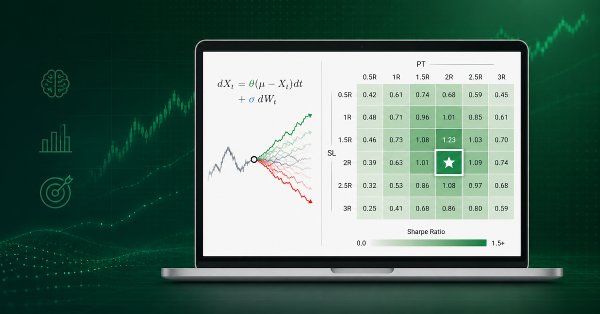
This article applies the Optimal Trading Rule from AFML Chapter 13 to set profit targets and stop-losses without in-sample calibration. We model post-entry P&L with a discrete Ornstein–Uhlenbeck process, run a 100,000-path search, and implement Python, multiprocessing, and a Numba @njit parallel kernel (242× faster). The result is an optimal (PT, SL) under three forecast specifications, constrained by the prop-firm daily loss limit.
The article is dedicated to the event-driven architecture in MQL5 and describes the transition from the monolithic OnTick model to distributed processing. We will consider predefined and custom events, services and messaging between programs, as well as common architectural errors. A practical example demonstrates how to organize interactions between indicators and an EA to reduce load, improve readability, and simplify maintenance.
The article presents a systematic approach to news trading in MetaTrader 5 using the built-in economic calendar: data structure, API functions, time synchronization rules, and event filtering. Methods of caching and incremental updating without overloading the server are described. The article also provides a working mechanism for exporting history to an .EX5 resource for deterministic testing using the same algorithm.
The article replaces hardcoded cost assumptions in triple-barrier labeling with measured inputs. An MQL5 script captures spread distribution, swap rates, and symbol metadata from your broker, and a Python model converts them into a broker-calibrated min ret you can pass to get events. Labels then reflect the actual round-trip friction for your instrument and holding period.
We refactor the Tools Palette from a flat, function-based panel into a modular, class-driven sidebar in MQL5. The design introduces supersampled canvas rendering for anti-aliased shapes, theme control, a category registry, snap alignment, and selective corner rounding. The result is a reusable, scalable sidebar foundation that you can extend with tool selection, dragging, and fly-out menus in future steps.
This article builds the foundation layer of a twelve-part MQL5 market microstructure toolkit. It implements guarded math helpers (SafeDivide, SafeLog, SafeSqrt, SafeExp, SafeTanh), robust data validation (ValidateSymbolV2, SafeCopyClose), trimmed statistical estimators (robust mean var), a linear regression slope, shared structs, and an FFT. You compile a single include file that hardens indicators and expert advisors against silent numerical failures and standardizes data flow for later parts.
This article tests three common filters on a standard MACD crossover for US_TECH100 H1 using five years of broker-native data. Filters are layered incrementally: regime, higher timeframe (HTF) alignment, and US session timing, to isolate each one's marginal impact. Results show session timing contributes far more than indicator refinements, while regime and HTF add little on their own. Includes a reproducible MQL5 regime classifier.
The article replaces clock-based sampling with López de Prado's alternative bar types and provides two aligned implementations: a unified Python module for batch tick histories and an object‑oriented MQL5 library for live EAs. It covers Parquet/Dask infrastructure, data cleaning, and a single API. Practical issues are solved explicitly: zero‑tick time‑bar filtering, imbalance threshold initialization, EWM state persistence, and parity between Python and MQL5 outputs.
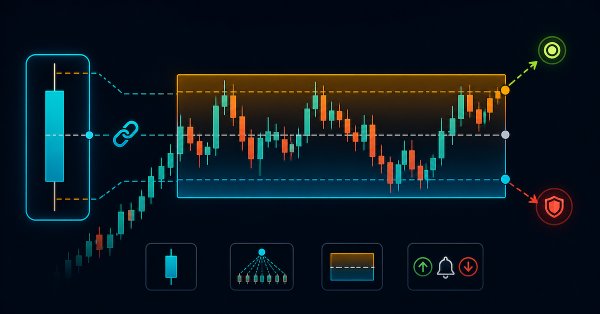
Higher-timeframe CRT ranges are informative, yet traders often execute on lower timeframes without that context. We implement an MQL5 indicator that reads higher-timeframe OHLC, projects the full candle range, body, and wicks onto the active lower-timeframe chart, and marks entries, stops, and targets. This improves situational awareness and removes the need to switch windows.
We introduce an MQL5 discipline engine that enforces risk consistently at the account level. It continuously scans positions from any source, validates SL/TP, equity-based exposure, and target R:R, and automatically corrects deviations by setting levels or adjusting volume. The result is uniform risk structure across manual and EA trades, supported by on-chart feedback and mode-based control.
Create an object-oriented fair value gap (FVG) scanner in MQL5 and display liquidity gaps directly on a MetaTrader 5 chart, this article formalizes the imbalance geometry based on three candlesticks, synchronizes OHLC arrays with CopyRates, manages rectangles without leaks, and monitors mitigation in real time. It also shows how to integrate this class into an Expert Advisor with a strict new bar filter for stable and efficient execution.
This article presents an MQL5 implementation of AutoARIMA that builds ARIMA models without manual tuning. It estimates d via a variance-based heuristic, fits ARMA(p,q) by gradient optimization with Adam, and selects p and q using AICc. The code returns a one-step-ahead price forecast by differencing, model estimation, and integration back to price level, ready to call on a Close series.
The article applies the A* heuristic to market structure by modeling validated swing highs and lows as graph nodes and weighting edges with ATR‑normalized distance, spread, and noise penalties. The engine searches the most efficient route to infer trade direction and targets, then filters signals by directional ratio, total path cost, and opposing swings. It anchors TP to the final node and SL to prior structure, with on‑chart visualization and configurable inputs.
Our next focus in these series on ideas that can be rapidly prototyped with the MQL5 Wizard, is a Custom Trailing class that uses the Blooming Filter. Trailing Stop systems are an optional but very resourceful part to any trading system that we want to explore more in these series besides the traditional Entry Signals.
We present a chart-embedded RSI panel that removes the need for a separate window by attaching momentum directly to live price. The article explains the design and MQL5 code: real-time RSI retrieval, slope-based signal classification, and adaptive positioning. Traders get RSI value, state, and signal strength where decisions are made, improving clarity across timeframes.
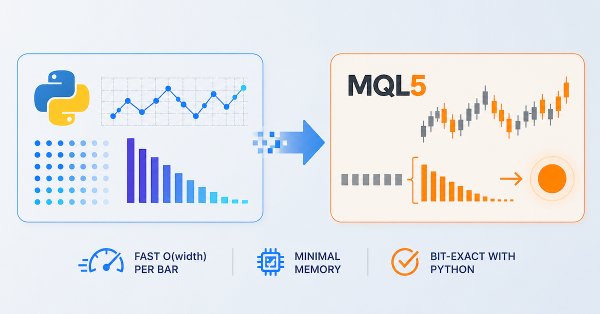
This article delivers a production-grade MQL5 implementation of fixed-width fractional differentiation for live MetaTrader 5 feeds. We introduce a header-only CFFDEngine that precomputes weights without a fixed cap, performs O(width) per-bar updates, and avoids per-tick allocations. The FFD.mq5 indicator supports all ENUM_APPLIED_PRICE types and prev_calculated optimization. Validation scripts confirm numerical equivalence with the standard Python frac diff_ffd pipeline.
Find out how to build a practical CPU-to-GPU migration path in MQL5 using OpenCL. We will focus on context initialization, buffer organization, large batches, kernel startup, and minimizing data exchanges. Typical errors and ways to eliminate them will be considered as well. An example with candlestick patterns illustrates the practical benefit of the approach.
The article presents a minimal working set for maintaining a trading journal in MQL5 using SQLite: a table structure for trades, signals, and events, indices, prepared statements and trades, as well as standard analytical SQL queries. Integration with the statistics dashboard in MetaTrader 5 and working with the database via MetaEditor are demonstrated. The approach allows automating the journal, accelerating calculations, and performing analysis without complicating the EA code.
The article demonstrates how Python and MetaTrader 5 integration combines research flexibility and trade execution into a single workflow. Python is used for data analysis, feature selection and model training, while MetaTrader 5 is used for testing and trading automation. This approach simplifies the transfer of solutions into practice, increases reproducibility, and makes the development of trading systems faster and more structured.
A backtest shows only one path among many possible outcomes. This MQL5 script performs 1000 bootstrap Monte Carlo resamples of a trade P&L series, draws a percentile fan chart on the chart via CCanvas, and reports probability of ruin, value at risk, and 95th‑percentile worst drawdown. The result is a practical view of path risk and drawdown exposure beyond a single equity curve.
Let's try mining CFTC data, downloading COT and TFF reports via Python, connecting all this with MetaTrader 5 quotes and an AI model, and get forecasts. What are COT reports in the Forex market? How to use COT and TFF reports for forecasting?
This article builds a complete Recurrence Quantification Analysis (RQA) toolkit for MetaTrader 5 in pure MQL5. We cover phase-space reconstruction, time-delay embedding, distance and recurrence matrix construction, RQA metric extraction, automatic epsilon selection, and rolling-window computation through a modular library design. The article concludes by applying the library in a practical indicator that plots RR, DET, LAM, ENTR, and TREND directly on the chart, providing a solid foundation for nonlinear time-series analysis in MQL5.
Build a Liquidity Spectrum Volume Profile in MQL5 that allocates volume to equal price bins over a chosen lookback using candle close prices. The guide covers data retrieval with copy functions, binning and normalization, and drawing rectangles and POC lines with chart objects and time offsets to reveal high-activity liquidity zones on the chart.
Mining central bank balance sheet data provides a picture of global liquidity in the Forex market and key currencies. We combine data from the Fed, ECB, BOJ and PBoC into a composite index and use machine learning to uncover hidden patterns. This approach turns raw data into real trading signals by combining fundamental and technical analysis.
This article presents a custom MQL5 money management class that adapts position sizing to real-time volatility using a monotonic queue for O(N) sliding-window extremes. The class applies inverse volatility scaling and optionally validates risk with an RBF network. We show implementation details in the Optimize method and compare results with the inbuilt Size-Optimized class to assess latency and risk control benefits.
If there is a need to display text on a chart, we can use the Comment() function. But its capabilities are quite limited. Therefore, in this article, we will create our own component - a full-screen dialog window capable of displaying multi-line text with flexible font settings and scrolling support.
This article implements a complete MQL5 Expert Advisor that monitors manually drawn support and resistance levels in real time. It synchronizes horizontal lines, detects approaches, touches, breakouts, reversals, and retests, and adds optional candlestick pattern checks. Alerts and on‑chart markers provide clear, repeatable feedback, allowing you to keep manual analysis while automating the surveillance of key price levels.
The article implements GJR-GARCH and TARCH in an MQL5 volatility library and explains why asymmetry improves on standard ARCH/GARCH. It covers model formulation, parameterization, and usage through derived classes and scripts. Readers get code examples for calibration and one-step-ahead forecasting on real data to support risk and diagnostics.
In this article, we expand our butterfly animation program with a four-stage animation pipeline: sequential curve drawing, smooth wing fill fading, detailed body rendering, and continuous flight. We implement a timer-driven state machine, four oscillators for wing flapping, vertical bobbing, horizontal sway, and tilt, as well as a neon glow around the wing outlines and a cyclical color change based on hue. You will learn how to structure these effects on the MetaTrader 5 canvas for clean and controlled playback.
This article shows how to connect AI agents directly to MetaTrader 5 by building a complete MCP (Model Context Protocol) server in Python. It details the architecture, MetaTrader 5 client wrapper, market data and order handlers, and tool registration over stdio, with testing via MCP Inspector and connections to clients like Claude Desktop or OpenClaw. The result is a standardized bridge for natural-language queries, live data retrieval, and safe order execution in MetaTrader 5.
Adaptation of the classical CAPM model for the Forex currency market in MQL5. The indicator calculates expected return and risk premium based on historical volatility. The indicators rise at peaks and bottoms, reflecting the fundamental principles of pricing. Practical application for counter-trend and trend-following strategies, taking into account the dynamics of the risk-reward ratio in real time. The article includes mathematical apparatus and technical implementation.
The article describes a variant of options emulation through an underlying asset implemented in the MQL5 programming language. The pros and cons of the chosen approach are compared with real exchange options using the example of the FORTS futures market of the MOEX Moscow exchange and the Bybit crypto exchange.
This article explains how to implement parameter versioning in MQL5 using binary files and packed structures. It shows how to write and read fixed-size records with FileWriteStruct and FileReadStruct in FILE_BIN mode, including version numbers, timestamps, and a checksum. You will also see how to detect changes via checksums, append records safely, and load the latest configuration without overwriting prior settings.
We build a lightweight bridge that captures closed trades in MetaTrader 5 and sends them to an external backend over HTTP as JSON. It uses OnTradeTransaction for event detection, reads details from deal history, assembles a JSON payload, and posts it via WebRequest. A local Flask API is used to test the flow, delivering a working path to move trade data outside the terminal.
We implement an MQL5 expert advisor that detects order blocks formed after consolidation breakouts and confirms them with fair value gaps. Each zone is validated by a break of structure and a preceding inducement, then filtered by the higher-timeframe trend. The program adds mitigation tracking, risk-based lot sizing, and two trailing stop modes, providing clear on-chart visuals and backtest-ready trade execution logic.
This article implements a static, CSV-based news source for the Strategy Tester, so historical economic news events can be preloaded and queried during backtesting. It replaces live calendar calls in tester mode with a fast in-memory search, preserves the live logic for trading, and delivers deterministic, repeatable results with explicit control over included events, enabling reliable validation of news-aware filters, stop suspension, and trade-blocking rules.
The CATCH framework combines Fourier transform and frequency patching to accurately identify market anomalies beyond the reach of traditional methods. Let us examine how this approach reveals hidden patterns in financial data.