We test AFML's claim that the sequential bootstrap decorrelates bagged trees on overlapping triple‑barrier labels by isolating two levers: draw count and draw rule. One decision identical tree is bagged under four row‑sampling regimes and evaluated on EURUSD 2022–2023 for draw uniqueness, between‑tree correlation, AUC, and calibration. Decorrelation comes almost entirely from throttling max_samples to average uniqueness; the sequential draw adds little. Out-of-bag inflation is largest under full-count sequential sampling.
In this article, triangular arbitrage is presented as a problem of finding cycles in a directed graph, where the vertices are currencies and the edges are currency pairs with weight rates. Profitable cycle: product of weights >1. Our Floyd-Warshall and DFS algorithms find optimal currency exchange paths that return to the starting point with a profit.
Kronos is a pretrained transformer that models OHLCV bars the way a language model predicts words. We reimplement its tokenizer/encoder and transformer block in native MQL5, export weights to flat .bin files, and remove Python from runtime entirely. Part 1 delivers preprocessing and BSQ tokenization plus a bit-for-bit verification harness against PyTorch, so you can run the encoder inside MetaTrader 5 with confidence.
Does better return conditioning buy strategy performance? We hold bar count fixed across time, tick, tick-imbalance, and tick-runs on 60.5 million EURUSD ticks, then meta-label RSI, Bollinger, and ADX/DI entries and score with purged cross-validation. No family delivers a consistent edge; efficacy varies narrowly and the best case fails a permutation test. Readers learn how to control overlap, leakage, and multiple testing in bar studies.
The article presents a complete implementation of TimeGPT, a specialized Transformer-based architecture for forecasting financial time series on the MetaTrader 5 platform. Adaptation of the attention mechanism to financial data, selective tokenization of price changes, hardware-aware optimizations, and advanced learning techniques are discussed. Included are practical testing results showing 87% forecast accuracy over a 24-bar horizon with a training time of 15 minutes on the CPU. We also present a ready-made trading EA with automatic retraining.
The article presents the revolutionary architecture of PatchTST, a tailored transformer for financial time series analysis that breaks market data into 16-bar patches for efficient processing. We will discuss the full implementation of a trading robot in MQL5 covering everything from mathematical fundamentals and data structures to a ready-made EA with risk management and continuous learning systems.
In Part 2, we introduce a reusable CCovarianceMatrix class that computes and stores a covariance matrix from raw return series using MQL5's native Cov() method. We verify symmetry, print a labeled matrix grid, and call Eig() to obtain eigenvalues and eigenvectors. Readers see how symbols co-move and which factors drive variance, enabling clearer portfolio diagnostics and reuse in scripts or EAs.
This article finalizes the MMAR project with a CMMAR facade class and a demo Expert Advisor for MetaTrader 5. The facade exposes a compact API—configure, Fit(), Forecast()—that wraps partition analysis, spectrum fitting and Monte Carlo simulation. You will learn how to load data, fit the model and obtain a volatility forecast, with diagnostics and status handling for robust use in EAs.
In this article, we introduce the Mamba4Cast framework and take a closer look at one of its key components: timestamp-based positional encoding. The article shows shows how time embedding is formed taking into account the calendar structure of the data.
The article discusses the adaptation and practical implementation of the ACEFormer framework using MQL5 in the context of algorithmic trading. It presents key architectural decisions, training features, and model testing results on real data.
In today's article, we will see how a simple code change that makes a neuron slightly more specialized can significantly speed up the training stage. After all, once a neuron or neural network, as we will see later, has been trained, the work it performs becomes much faster. We will also discuss a problem that exists but is rarely mentioned.
We port AFML Chapter 17 structural break tests to MQL5 as a single include, CStructuralBreaks, delivering six bar-indexed features for EAs: CSW statistic and critical value, Chow-Type DFC, SADF with a rolling lookback (default 252), SM-Exp, and SM-Power. SADF uses O(L²) rolling windows for real-time viability. A companion StructuralBreaksViewer indicator plots all series with per‑series visibility and optional z‑score normalization. SB_EMPTY marks invalid values for safe integration.
The article presents an innovative hybrid system for forecasting exchange rates that combines a linear autoregressive model with a U-Transformer architecture for residual analysis. The system automatically switches between signal sources depending on their quality and includes complete trading logic with averaging/pyramiding strategies. The key advantage of this approach is that the neural network is trained on the residuals of the linear model, which simplifies the task and reduces the risk of overfitting. The implementation is done entirely in MQL5 and is ready for use in real trading with automatic adaptation to changing market conditions.
We present a production‑ready implementation of AFML Chapter 17 structural break tests. The module includes Chu-Stinchcombe-White (one-/two-sided), Chow-type DFC, SADF across six models (linear, quadratic, sm poly 1, sm poly 2, sm exp, sm power), plus QADF (q, v) and CADF (q), returning bar-indexed scalar features. We address the book snippets' scaling issues and argument‑order pitfall, and show how a fixed lookback (L=504) bounds SADF cost to O(L²) per bar for regime detection.
We invite you to explore the ACEFormer architecture — a modern solution that combines the effectiveness of probabilistic attention with adaptive time series decomposition. This article will be useful for those seeking a balance between computational performance and forecast accuracy in financial markets.
A population-based optimization algorithm inspired by a controversial and little-studied phenomenon - the mechanism of human dreams. Agent groups with different "memory", cosine-wave modulation of motion, and an unusual 99/1 phase distribution — learn how these features affect the optimization efficiency of your trading strategies.
CTrailingSlidingMedianBiLSTM is a custom MQL5 Wizard trailing module that combines robust median/MAD outlier filtering with a BiLSTM context score in the range [-1, 1]. Four algorithm modes (standard, bands, RSI, adaptive) target noise, mean-reverting bursts and liquidity spikes, reducing premature stop adjustments. This module is intended for side-by-side evaluation with diverse entry signals and money management settings.
What if your trading strategies could learn from each other, like real fighters? Duelist Algorithm is a new optimization method where trading system parameters literally duel for the right to be called the best.
A revolutionary approach to machine learning in trading through quantum computing. The article demonstrates a practical implementation of an adaptive QRC system with continuous retraining for predicting market movements in real time.
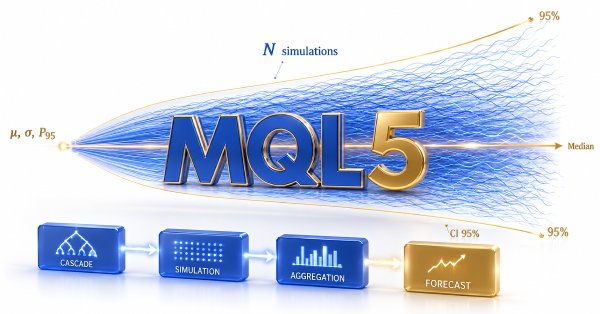
We implement the CMonteCarlo module that turns the fitted MMAR parameters into a volatility forecast via Monte Carlo. It runs N independent simulations over a chosen horizon and reports mean, median, standard deviation, and a percentile-based 95% confidence interval, with access to per-run values if needed. Adaptive cascade depth selects the minimal k such that b^k covers the horizon, keeping the run fast and consistent.
We implement Ehlers-style DSP filters in a single reusable MQL5 library and use it to build two indicators. The Roofing Filter applies a 2‑pole high‑pass followed by a Super Smoother to isolate the tradeable 10–48‑bar band. The Even Better Sinewave normalizes the wave to about ±1, oscillating in cycle regimes and railing in trends, so you can read cycles and detect regime shifts in charts and EAs.
The article explores the revolutionary Mamba/SSM neural network architecture for financial time series forecasting. We will consider a complete MQL5 implementation of a modern alternative to Transformer with linear complexity O(N) instead of quadratic O(N²). Selective State Space Models, hardware-aware optimizations, patching techniques, and advanced AdamW training methods are covered in detail. Practical test results showing an increase in accuracy from 62% to 71% while reducing training time from 45 to 8 minutes are included. A ready-made trading EA with auto learning and adaptive risk management for MetaTrader 5 is presented.
The article establishes a reproducible method to measure portfolio risk for multiple symbols using MQL5 matrices and OpenBLAS. It covers computing log returns, building a covariance matrix, and evaluating wᵀΣw instead of summing individual variances. A complete script prints naive versus true volatility and the cross‑term contribution, enabling you to detect when correlated instruments inflate exposure beyond single‑asset estimates.
An MQL5 port of four entropy estimators — Shannon, Plug-In, Lempel-Ziv, and Kontoyiannis — operating on the intrabar tick-rule sequence. CopyTicksRange() limits data to the broker's cached tick window, so features apply to recent bars only. The implementation encodes bid-direction ticks from MqlTick, replaces NumPy-dependent steps with array-based methods, and ships CEntropyFeatures.mqh and EntropyViewer.mq5 for EA and indicator use.
Trading is characterized by high demands on risk management discipline. The article presents an analysis of the main reasons for traders' failures and proposes a technical solution in the form of the CEnhancedRiskManager class for the MQL5 platform. It includes practical testing on an aggressive grid EA.
This article lays out 'CMoneyKDTreeESN' custom money management class usable with the MQL5 Wizard, that combines the KD-Tree algorithm and the Echo State Network. We use the KD-Tree on log returns and ATR to give us a risk score, while the ESN tracks recent flow to give us a bounded lot size multiplier. Our class is usable in a variety of Wizard assembled Expert Advisors as shown here with the Envelopes and RSI signals, with a broad objective of modulating exposure in high-volatility and tail-risk environments.
The article diagnoses two defects that neutralize sequential bootstrap during cross‑validation: type erasure of SequentiallyBootstrappedBaggingClassifier and a fold‑level shape mismatch from cloning full samples info sets. It retains the classifier's identity, adds find seq bagging to re‑inject fold‑sliced t1 in CalibratorCV.fit, and resets state per split. A new bootstrap_comparison module reports OOF and OOB metrics and memory, letting you verify that sequential sampling is applied correctly and quantify its impact.
The article provides production-ready entropy estimators (Shannon, plug-in, Lempel–Ziv, Kontoyiannis) operating on tick-rule–encoded sequences. It resolves three correctness and performance issues in the original code, verifies outputs against chapter references, and extends encoding with quantile and sigma options. Users gain reproducible results and markedly improved computation speed for large bar sets.
In this section, we will look at the implementation of the key interfaces of the library of Gaussian processes in MQL5: IKernel, ILikelihood, and IInference. We will also demonstrate its operation on synthetic data and implement indicators for classification and regression, demonstrating its operation in online mode - with retraining of the model on each new bar.
The DI crossover often triggers in ranges where +DI and -DI oscillate without persistence. We build a two-layer hybrid: Optuna's TPE optimizes a regime gate over ADXR threshold, DI lookback, and minimum DI separation to maximize signal precision on a held-out window, then a Random Forest uses eleven ADX-derived features to accept or scale entries via afml.bet_sizing. The result filters ranging-market bursts and calibrates position size on EURUSD H1.
The article describes implementation of the A3 algorithm - a metaheuristic optimization method inspired by chemical processes - in MQL5. Only two adjustable parameters, compactness and a small population, ensure high operating speed with sufficient quality of solutions.
The article focuses on creating a trading system with a real quantum simulator instead of mathematical analogies. The system uses 3 virtual qubits, quantum gates and superposition principles to analyze markets. It is implemented as a trading EA for MetaTrader 5 in MQL5. The main achievement is the transition from simulation to real quantum principles of financial information processing.
This article presents 'CSignalUKFCapsNet', as a custom class coded in MQL5. This class is meant to be used with the MQL5 Wizard when assembling an Expert Advisor and when selected in the Wizard it defines the Expert Advisor's entry signals. In building this custom class, we brought together the algorithm Unscented Kalman Filter and the Capsule Neural Network. Our algorithm is showcased with four operation modes, and the coding of this as a custom class for the MQL5 Wizard, allows testing with various Trailing Stop methods and Money Management systems.
We resume the topic of optimization by the scientific community. CoSO should not be viewed as a ready-made solution, but as a promising research platform. With proper development, CoSO can find its niche in tasks where adaptability and resilience to change are important, and computation time is not critical.
This article implements the MMAR Simulation Engine that turns fitted parameters (H, distribution, coefficients, sample volatility) into synthetic price paths. It builds multifractal trading time via a multiplicative cascade, synthesizes fractional Brownian motion with Davies–Harte or Cholesky, scales it to target volatility, and composes the process by time deformation. Readers get a reusable MQL5 class, method choices by path length, and validation steps for scenario testing and Monte Carlo use in the next part.
The article presents an innovative quantum neural network architecture for algorithmic trading that combines the principles of quantum mechanics with modern machine learning methods. The system includes quantum effects (resonance, interference, decoherence), multi-level memory of different time scales, Markov chains with the ALGLIB library, and adaptive parameter control. The full implementation is done in MQL5 using the built-in matrix/vector types, which removes implementation barriers in MetaTrader 5.
MetaTrader 5 is well suited for AI trading because it combines market data, MQL5 development, Python research, ONNX models, Strategy Tester, VPS, and the MQL5.community ecosystem into a single workflow. This article demonstrates a practical path from AI prompts to structured signals, working with code via the AI Assistant in MetaEditor, a quality model, a custom-created Expert Advisor, testing, and a controllable launch of a trading system.
For this article we look at a custom MQL5 Wizard class for Trailing Stops. Our implemented custom class ‘CTrailingConvexHullGRU’, is built from merging the Convex Hull algorithm with a GRU network. As always we seek to develop a model that is testable with MQL5 Wizard-Assembled Expert Advisors and can be tuned with various Money Management and entry Signals classes. Our testing is with the 'Envelopes' and the RSI classes for Signal.
We continue to implement the DA-CG-LSTM framework, which offers innovative methods for time series analysis and forecasting. The use of CG-LSTM and dual attention allows for more accurate detection of both long-term and short-term dependencies in data, which is particularly useful for working with financial markets.
Secrets of effective optimization of trading strategies in metaheuristic approaches. Community of Scientists Optimization is a new population-based algorithm inspired by the mechanisms of the scientific community. Unlike traditional nature-inspired metaphors, CoSO models unique aspects of human scientific activity: publishing results in journals, competing for grants, and forming research teams.