We build an automated MQL5 program that trades Turtle Soup by fading false breakouts of the N-bar high and low. The article implements liquidity-sweep detection, confirmation closes back inside the level, sweep-depth and extreme-age filters, and an optional reversal-candle body check. It adds configurable dynamic or static stops, two take-profit modes, points-based trailing, and clear chart visuals, providing a ready baseline for backtesting and further customization.
This article will illustrate to the reader how to implement a mean-reverting strategy for the EURUSD pair. The strategy follows contrarian trading rules. Our strategy implements a weekly moving average channel, with one moving average on the high-price feed and the latter on the low-price feed. We enter short positions when the price falls beneath the low moving average and long positions when the price rises above the high moving average. Additionally, we will export daily market data to build a simple ONNX model of the market to provide an additional filter for our entries. This provides the reader with a reproducible template for strategy development and backtesting.
Standard MQL5 risk tools read risk from recent history and miss how heavy the downside tail can be. We implement Extreme Value Theory in MetaTrader 5: a Peaks‑Over‑Threshold fit of the Generalized Pareto Distribution via ALGLIB, a live indicator that reports EVT VaR/ES and tail shape, and an EA that sizes positions from the tail estimate. A controlled backtest illustrates reduced drawdown for unchanged entries.
This article demonstrates how to build the UT Bot Alerts indicator in MQL5 using a clear, step-by-step approach. The tutorial explains how to implement an ATR-based trailing stop system, compute a custom EMA for signal detection, and generate buy and sell signals without repainting. The final indicator provides well-structured buffers that enable easy integration with Expert Advisors, automated trading systems, and other algorithmic tools within the MetaTrader 5 platform.
The content we will cover from this point on is much more complex in terms of theory and concepts. I will try to make the material as simple as possible. The programming part itself is quite simple and straightforward. But if you do not understand the theory behind it, you will be left with no practical basis at all for refining or adapting the replay/simulation system to tasks different from the ones I am going to show. I do not want you merely to compile and use the code I present. I want you to learn, understand and, if possible, be able to create something even better.
This is perhaps the most entertaining article so far. The reason is that here we will modify an object already available in MetaTrader 5 in order to create another one that is not originally present on the platform. Of course, what we are going to look at here may seem a little crazy, but it works and serves a very interesting purpose.
This article extends Part 1 by giving an AI access to the development lifecycle on MQL5 Algo Forge. We implement an MCP server over the Forgejo REST API so an agent can create repositories, commit Expert Advisors, branch from main, open pull requests, file issues, and tag releases. You will get a ready-to-run Python server, clear tools, and a safer, reversible workflow.
The article builds a reusable validation layer for Expert Advisors in MQL5. It implements lot-size rules and normalization, SL/TP and freeze-level guards, price digit normalization, margin sufficiency checks, unchanged-level filtering on modifications, account order-limit control, new-bar detection, symbol tradability checks, economic-calendar news windows, and session detectors. The result is cleaner code and fewer terminal errors in live trading.
We add a pinned-tools ribbon: a floating bar that exposes frequently used tools for one-click access without reopening the sidebar. The article implements the ordered pin set and its API, an anti-aliased pushpin control in the flyout, and the ribbon with offscreen clipping, user-resizable width, and horizontal scrolling. The result is faster activation of favorite tools from a draggable, resizable ribbon on the chart.
Parameter optimization inside MetaTrader 5's Strategy Tester routinely produces strategies that perform well in-sample and collapse on forward data. This article builds a native MQL5 Walk-Forward Efficiency scoring engine that quantifies how much of a strategy's in-sample Sharpe ratio transfers to each out-of-sample window. The distribution is rendered as a CCanvas histogram and validated against real EURUSD Daily backtest data.
We implement a symbol resolution framework that abstracts broker naming differences in MetaTrader 5. Using a persistent mapping store, layered resolution with validation, a hash-indexed registry, and a cache, it returns selectable symbols with live market data and logs unresolved cases. Practically, you can deploy the same EA across brokers and keep symbol access consistent at low runtime cost.
We complete persistent homology for MQL5 by reducing the Vietoris–Rips boundary matrix to a persistence diagram. The article implements Z/2 column reduction (CTDAReduction), a diagram container with analytics (CTDADiagram), and a facade that runs the six-stage pipeline in one call (CTDA). Outputs are cross-checked against Ripser to numerical agreement, enabling reliable diagram-based metrics.
This article demonstrates a working prototype integrating Brain-Computer Interface technology with MetaTrader 5, proving thought-based trading is feasible at the software level. A Python Flask server simulates neural command generation, communicating with an MQL5 Expert Advisor via JSON-over-HTTP. The complete pipeline—from signal generation to trade execution—is validated through WebRequest and CTrade. While BCI hardware remains clinically restricted, this simulation establishes a reference architecture for future accessibility options, enabling direct intention-based trading that expands how traders can interact with financial markets.
In this article, we introduce the Mamba4Cast framework and take a closer look at one of its key components: timestamp-based positional encoding. The article shows shows how time embedding is formed taking into account the calendar structure of the data.
The article discusses the adaptation and practical implementation of the ACEFormer framework using MQL5 in the context of algorithmic trading. It presents key architectural decisions, training features, and model testing results on real data.
In today's article, we will see how a simple code change that makes a neuron slightly more specialized can significantly speed up the training stage. After all, once a neuron or neural network, as we will see later, has been trained, the work it performs becomes much faster. We will also discuss a problem that exists but is rarely mentioned.
In this article, we will prepare the foundation for what will be covered in the next publication. We will also look at how to make an OBJ_LABEL object fully interactive for editing and moving. In other words, we can change both the text and the position of the OBJ_LABEL object without opening the Object Properties dialog.
Abnormal bars inflate mean and standard deviation estimates, distorting ATR, Bollinger Bands, and moving averages. We implement a native MQL5 indicator that detects such bars with the Modified Z-Score applied to four features: body, upper wick, lower wick, and tick volume. The indicator marks flagged bars on the chart and plots a composite score in a separate subwindow, helping you diagnose contamination in rolling-window indicators.
This article implements a real-time monitoring dashboard for a self-healing MetaTrader 5 Expert Advisor. The dashboard displays the current EA state, virtual stop-loss and take-profit levels, breakeven and trailing status, recovery state, synchronization status, and heartbeat information directly on the chart. By exposing the internal recovery state visually, the Expert Advisor becomes easier to monitor, verify, and troubleshoot while managing active trades.
We build an MQL5 Expert Advisor that emails a structured daily trading report. The article shows how to configure SMTP in MetaTrader 5, collect and filter closed trades for the previous day, compute totals for profit, wins, losses, and trade count, and assemble account details into the subject and body. You also schedule one send per day and prevent duplicates using daily candle detection.
This article presents a multi‑broker CSV normalization framework. An MQL5 include file enriches exports with broker metadata. A Python module resolves schema divergences — pip conventions, symbol aliases, time offsets, commission models, and currency denomination — producing a unified canonical dataset. Comparative visualizations of slippage distributions and net‑of‑cost performance enable reliable cross‑platform strategy analysis without silent data corruption.
We present a timer-based MQL5 EA for Opening Range Breakout aligned to NYSE hours. It screens “Stocks in Play” via opening-range relative volume, enforces price/volume/ATR minimums, sizes positions by risk, and exits at 16:00 ET. A Sharpe-ranked optimization across 30 liquid Nasdaq stocks and a single-symbol test are provided, together with backtest settings and an Excel report for verification.
This article presents a complete Expert Advisor built around Stan Weinstein's Stage Analysis method. The EA classifies the market into one of four stages using the 30-week moving average slope and position and volume behavior, then trades only Stage 2 breakouts long and Stage 4 breakdowns short. It explains each stage, how to detect it programmatically, and why the method's discipline—trading only in the correct stage—is what produces the edge.
We port AFML Chapter 17 structural break tests to MQL5 as a single include, CStructuralBreaks, delivering six bar-indexed features for EAs: CSW statistic and critical value, Chow-Type DFC, SADF with a rolling lookback (default 252), SM-Exp, and SM-Power. SADF uses O(L²) rolling windows for real-time viability. A companion StructuralBreaksViewer indicator plots all series with per‑series visibility and optional z‑score normalization. SB_EMPTY marks invalid values for safe integration.
The article presents an innovative hybrid system for forecasting exchange rates that combines a linear autoregressive model with a U-Transformer architecture for residual analysis. The system automatically switches between signal sources depending on their quality and includes complete trading logic with averaging/pyramiding strategies. The key advantage of this approach is that the neural network is trained on the residuals of the linear model, which simplifies the task and reduces the risk of overfitting. The implementation is done entirely in MQL5 and is ready for use in real trading with automatic adaptation to changing market conditions.
We build a Support and Resistance Volume Profile indicator that adapts to the current viewport in MetaTrader 5. You will learn viewport detection, dynamic SnR identification, zoom‑driven bin sizing, min‑max volume scaling, and fast on‑chart rendering controlled by OnChartEvent. This approach expresses the relative strength of SnR levels with volume, keeping the chart focused on actionable reaction zones.
We present a production‑ready implementation of AFML Chapter 17 structural break tests. The module includes Chu-Stinchcombe-White (one-/two-sided), Chow-type DFC, SADF across six models (linear, quadratic, sm poly 1, sm poly 2, sm exp, sm power), plus QADF (q, v) and CADF (q), returning bar-indexed scalar features. We address the book snippets' scaling issues and argument‑order pitfall, and show how a fixed lookback (L=504) bounds SADF cost to O(L²) per bar for regime detection.
We invite you to explore the ACEFormer architecture — a modern solution that combines the effectiveness of probabilistic attention with adaptive time series decomposition. This article will be useful for those seeking a balance between computational performance and forecast accuracy in financial markets.
Maximum drawdown is one number that hides what really matters: how often an equity curve declines, how long it stays below a previous peak, and how quickly it recovers. This article builds a native MQL5 tool that reconstructs the underwater curve, breaks it into individual drawdown episodes (depth, duration, recovery time), computes the Ulcer Index, Pain Index, and Recovery Factor, and combines them into a single resilience grade with practical recommendations. No external libraries, no Python, no AI.
The article delivers MQL5 implementations of FIGARCH and HARCH and updates the volatility library for long‑memory processes. It provides code for Hurst and GPH testing, parameter setup (truncation and horizons), and scripts for fitting, forecasting, and simulations. Readers learn how to apply and compare the models on market data to select an appropriate specification.
The article presents a structured approach to external and internal market structure in MQL5, from swing identification to CHoCH/BoS validation within an established trend. It explains refining true highs/lows, enforcing “first internal signal” logic, and rendering lines, labels, and markers on the chart. The outcome is a consistent indicator that converts price structure into defined entries, stop losses, and 1.5R targets.
A population-based optimization algorithm inspired by a controversial and little-studied phenomenon - the mechanism of human dreams. Agent groups with different "memory", cosine-wave modulation of motion, and an unusual 99/1 phase distribution — learn how these features affect the optimization efficiency of your trading strategies.
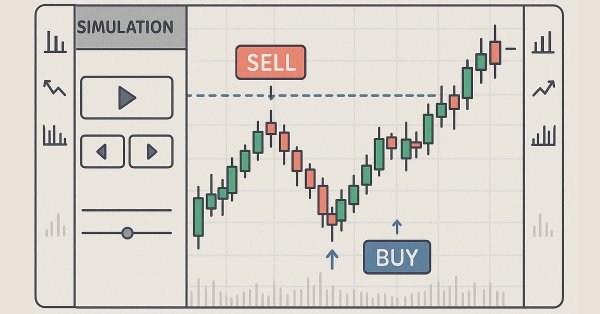
This article finalizes the Forward Simulation Engine for MetaTrader 5 by calibrating synthetic candles to recent market volatility instead of using slope-only sizing. It samples average body, upper wick, and lower wick from closed bars, applies a sine-envelope with decay, proportional wicks, gaps between candles, and periodic counter-trend injections. The result is a live projection that advances one bar ahead, with code you can reuse for calibrated, anchor-based forward rendering and automatic cleanup.
CTrailingSlidingMedianBiLSTM is a custom MQL5 Wizard trailing module that combines robust median/MAD outlier filtering with a BiLSTM context score in the range [-1, 1]. Four algorithm modes (standard, bands, RSI, adaptive) target noise, mean-reverting bursts and liquidity spikes, reducing premature stop adjustments. This module is intended for side-by-side evaluation with diverse entry signals and money management settings.
Implement a session-focused volume profile in MQL5: acquire ticks with CopyTicksRange(), bin prices, and compute POC, VAH, and VAL by the 70% approach. The indicator renders directly on the chart as native objects, supports fixed-width scaling for consistent geometry across timeframes, and refreshes on each new session. This provides objective reference levels without external dependencies.
What if your trading strategies could learn from each other, like real fighters? Duelist Algorithm is a new optimization method where trading system parameters literally duel for the right to be called the best.
This article discusses the transition to MQL5 Algo Forge as a modern and convenient format for publishing program code and article attachments. Using repositories instead of traditional ZIP archives and source code allows you to keep projects up-to-date, make edits quickly, and professionally interact with your readers. Recommendations are provided for quickly migrating developments to the cloud environment via the MetaEditor interface.
A revolutionary approach to machine learning in trading through quantum computing. The article demonstrates a practical implementation of an adaptive QRC system with continuous retraining for predicting market movements in real time.
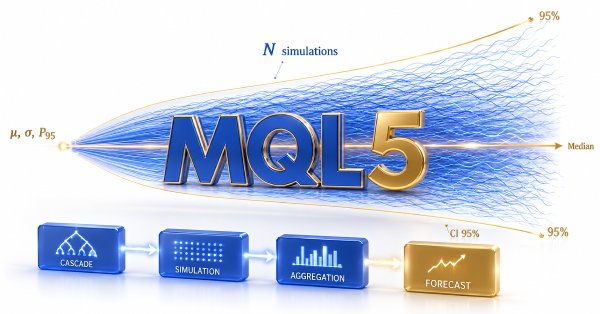
We implement the CMonteCarlo module that turns the fitted MMAR parameters into a volatility forecast via Monte Carlo. It runs N independent simulations over a chosen horizon and reports mean, median, standard deviation, and a percentile-based 95% confidence interval, with access to per-run values if needed. Adaptive cascade depth selects the minimal k such that b^k covers the horizon, keeping the run fast and consistent.
We implement Ehlers-style DSP filters in a single reusable MQL5 library and use it to build two indicators. The Roofing Filter applies a 2‑pole high‑pass followed by a Super Smoother to isolate the tradeable 10–48‑bar band. The Even Better Sinewave normalizes the wave to about ±1, oscillating in cycle regimes and railing in trends, so you can read cycles and detect regime shifts in charts and EAs.