In this article, we will look at how to handle user requests to change the chart plotting mode. This is necessary so that an indicator designed for the current chart plotting mode does not look strange or differ from what a MetaTrader 5 user expects.
This article presents a multi-symbol execution filter that scores real-time market quality before any trade is allowed. It measures spread behavior, tick velocity, quote gaps, micro-volatility, and a slippage estimate, then classifies the state to block degraded conditions. Once noise settles, a liquidity sweep continuation model evaluates structure shifts so entries occur only when execution is mechanically stable.
This article develops an object-oriented framework for MQL5 indicators by evolving a primitive example into reusable modules. It formalizes partial buffer recalculation in OnCalculate, moves logic into header-based classes (CAppliedPrice, CSma), and introduces CSubIndiBase, CIndicatorBase, and a registry to centralize requirements. You get portable components, isolated inputs, and clean buffers with minimal boilerplate, making new indicators faster to assemble and easier to maintain.
RSI accumulates losses in trending conditions by firing at every threshold crossing regardless of market regime. A Random Forest secondary classifier trained on 12 contextual features — RSI momentum slope, EMA50 trend velocity, ATR-normalised trend stretch, and nine others — filters raw signals and scales position size by classifier confidence on EURUSD H1. Results compare plain RSI, meta-filtered RSI, and bet-sized RSI across a 16-month out-of-sample period with per-trade metrics and drawdown diagnostics.
The article delivers a dynamic MetaTrader 5 indicator that detects liquidity sweeps via swing‑point logic, wick‑ratio thresholds, and engulfing confirmation. It recognizes single‑wick and dual‑candle patterns without a fixed window, updates buy‑/sell‑side targets as price evolves, and invalidates broken levels to maintain a reliable liquidity map.
This guide integrates a trained XGBoost model (ONNX) into an SMC EA to evaluate trade setups before execution. The Python pipeline labels historical XAUUSD events and produces a 12-feature representation aligned with the EA. The result is a reproducible method to train, export, and embed the model so the EA can filter OB, FVG, and BOS signals programmatically.
This article builds a Market Structure Sentinel indicator in MQL5 that detects and visualizes Smart Money Concepts (SMC) events, including Break of Structure (BOS) and Change of Character (CHOCH), in real time. It explains swing detection, structural validation, and trend classification, and adds a compact dashboard to track bullish, bearish, or ranging states for faster on‑chart interpretation.
This article addresses the interpretative gap between visual chart objects and algorithmic execution. You will build a systematic detector that iterates over all chart objects, identifies analytical types, and normalises their geometric data (time and price coordinates) into a structured SChartObjectInfo array. The implementation uses raw MQL5 functions, a filter‑extract‑store pipeline, and a timer‑driven test EA, resulting in a reusable framework for rule‑based trading inputs.
The article provides a step-by-step guide on how to migrate code from a published project into a fully-fledged MQL5 Algo Forge project. You will set up the environment and authentication in MetaEditor, create a project in Shared Projects, select the type, arrange the files, add README.md, check the encoding and build, commit the changes to Git, and open the repository publicly. The article helps to build a working structure and preserve version history for the convenience of readers.
Learn a practical way to execute MetaTrader 5 trades from Telegram voice notes using a Python middleware and an MQL5 EA acting as an HTTP client. The article covers architecture, WebRequest polling, in-memory queuing, JSON parsing with null-terminator stripping, and a constrained command grammar with a 0.001-lot default. You will configure the environment and validate round‑trip latency suitable for mobile data connections.
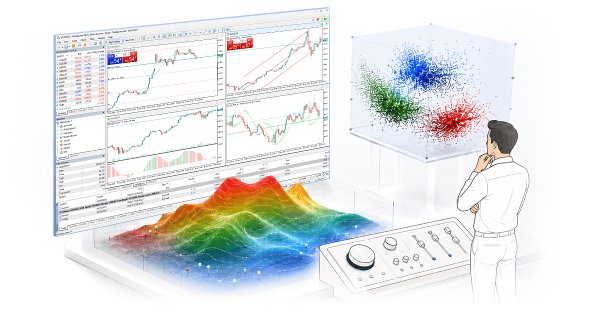
The article describes the practical application of DirectX 11 and built-in MQL5 tools for creating 3D visualizations and interactive interfaces in MetaTrader 5. The focus is on cognitive efficiency - the ability of 3D charts and guided scenes to help in understanding optimization data, liquidity clusters, and multi-dimensional trading scenarios. The basics of the DX pipeline, working with shaders, binding mouse and keyboard events, and objective technological limitations are discussed in detail. The article is intended for MQL5 developers and algorithmic traders who are ready to transform strategy metrics into understandable 3D analytical landscapes, where the visual layer accelerates decision-making.
The article introduces a unified MQL5 discipline framework that consolidates the symbol whitelist, trading‑hours and news filters, and daily trade‑limit modules under CDisciplineEngine.mqh. It explains centralized trade validation and state synchronization shared by a chart dashboard and an enforcement Expert Advisor. Readers learn how to authorize orders through a single gate, monitor permissions in real time, and automatically enforce rules across the terminal.
In this article, we demonstrate how to use API of the MetaTrader 5 custom symbols to transform your terminal into a data constructor for generating timeless Renko, Range, and Equal-Volume charts and assembling synthetic instruments. We will analyze tick aggregation and history modification for stress tests (spread widening, stop level changes) taking into account platform limitations. Besides, you will get some practice of handling CiCustomSymbol and routing orders to a real symbol through the CustomOrder wrapper with ready-made code fragments.
The article implements CMultiTimeframeMatrix, a reusable dashboard that maps symbols vs. timeframes and displays a numeric, colour‑coded score. The score combines trend, momentum, and volatility, updates by timer, and respects performance constraints. You will learn how to build the UI with CAppDialog/CLabel, compute metrics via CMatrixDouble, and embed the component into a thin EA for a consistent, real-time overview.
This article shows how to convert subjective flag recognition into reproducible MQL5 logic for live charts. It combines ATR-normalized pole strength, retracement limits, consolidation structure checks, breakout confirmation, and overlap control. Readers gain a workable approach that renders adaptive channels and zones, updates active setups efficiently, and provides optional alerts for newly confirmed patterns.
This article examines a comprehensive approach to developing trading algorithms: from project setup and logic debugging to protecting the finished product. We will explore MetaEditor's built-in tools, including step-by-step debugging using real ticks, performance profiling, and direct integration with C++ DLLs to speed up calculations. The article also explains how to protect intellectual property using MQL5 Cloud Protector. The application of the described techniques will transform Expert Advisor development from a chaotic search for solutions into a systematic process, significantly reducing the time required to develop a strategy.
Many MetaTrader 5 setups run several EAs on one account, so risk gets fragmented and correlated exposure slips through. The article introduces RiskGate, a centralized Service that evaluates EA intents account‑wide: EAs send a JSON signal, the Service returns approved, lot and reason. You will see the client/server wiring, example rules (daily loss, exposure and correlation caps), unit‑tested handler design, and an EA example. The result is consistent portfolio‑level risk with simpler EAs.
This work presents an end-to-end pipeline: collect MetaTrader 5 data, engineer entropy/volatility/trend features, train a PyTorch classifier, and expose predictions through a Flask API. An MQL5 EA posts rolling prices each tick, receives probability and regime, and applies adaptive position sizing and stop distances. The result is a clear recipe for integrating ML inference with MetaTrader 5.
The article adds a self-adaptive layer to the Malaysian Engulfing indicator by optimizing the retest bar range with a constrained brute-force search scored by MFE and MAE. It details the data model, helper routines, and an MQL5 implementation that gathers historical setups, computes excursions, and selects the best parameter. Readers learn how to remove manual tuning and run the indicator with context-appropriate settings across symbols and timeframes.
A custom forward simulation engine detects fast/slow EMA crossovers and immediately projects synthetic candles ahead of the signal bar. It generates bodies and wicks using controlled logic, draws them with chart objects, and refreshes on every new signal or anchor change. You get a clear forward-looking view to test timing, visualize scenarios, and manage invalidation on the chart.
Implement the Malaysian Engulfing concept in MQL5 with two coordinated indicators. One applies strict, body‑based engulfing rules for precise pattern detection; the other uses a state-driven model to monitor what follows—pullbacks and timed retests—directly on the chart. The result is a repeatable, rule-based workflow that replaces visual guesswork with programmable logic.
The article is dedicated to the event-driven architecture in MQL5 and describes the transition from the monolithic OnTick model to distributed processing. We will consider predefined and custom events, services and messaging between programs, as well as common architectural errors. A practical example demonstrates how to organize interactions between indicators and an EA to reduce load, improve readability, and simplify maintenance.
The article presents a systematic approach to news trading in MetaTrader 5 using the built-in economic calendar: data structure, API functions, time synchronization rules, and event filtering. Methods of caching and incremental updating without overloading the server are described. The article also provides a working mechanism for exporting history to an .EX5 resource for deterministic testing using the same algorithm.
We introduce an MQL5 discipline engine that enforces risk consistently at the account level. It continuously scans positions from any source, validates SL/TP, equity-based exposure, and target R:R, and automatically corrects deviations by setting levels or adjusting volume. The result is uniform risk structure across manual and EA trades, supported by on-chart feedback and mode-based control.
This article presents an MQL5 implementation of AutoARIMA that builds ARIMA models without manual tuning. It estimates d via a variance-based heuristic, fits ARMA(p,q) by gradient optimization with Adam, and selects p and q using AICc. The code returns a one-step-ahead price forecast by differencing, model estimation, and integration back to price level, ready to call on a Close series.
The article applies the A* heuristic to market structure by modeling validated swing highs and lows as graph nodes and weighting edges with ATR‑normalized distance, spread, and noise penalties. The engine searches the most efficient route to infer trade direction and targets, then filters signals by directional ratio, total path cost, and opposing swings. It anchors TP to the final node and SL to prior structure, with on‑chart visualization and configurable inputs.
We present a chart-embedded RSI panel that removes the need for a separate window by attaching momentum directly to live price. The article explains the design and MQL5 code: real-time RSI retrieval, slope-based signal classification, and adaptive positioning. Traders get RSI value, state, and signal strength where decisions are made, improving clarity across timeframes.
The article presents a minimal working set for maintaining a trading journal in MQL5 using SQLite: a table structure for trades, signals, and events, indices, prepared statements and trades, as well as standard analytical SQL queries. Integration with the statistics dashboard in MetaTrader 5 and working with the database via MetaEditor are demonstrated. The approach allows automating the journal, accelerating calculations, and performing analysis without complicating the EA code.
If there is a need to display text on a chart, we can use the Comment() function. But its capabilities are quite limited. Therefore, in this article, we will create our own component - a full-screen dialog window capable of displaying multi-line text with flexible font settings and scrolling support.
This article implements a complete MQL5 Expert Advisor that monitors manually drawn support and resistance levels in real time. It synchronizes horizontal lines, detects approaches, touches, breakouts, reversals, and retests, and adds optional candlestick pattern checks. Alerts and on‑chart markers provide clear, repeatable feedback, allowing you to keep manual analysis while automating the surveillance of key price levels.
The article implements GJR-GARCH and TARCH in an MQL5 volatility library and explains why asymmetry improves on standard ARCH/GARCH. It covers model formulation, parameterization, and usage through derived classes and scripts. Readers get code examples for calibration and one-step-ahead forecasting on real data to support risk and diagnostics.
This article implements an MQL5 module that analyzes the lower‑timeframe bars inside each liquidity‑zone base candle. It detects swing points and applies objective rules to classify the internal structure as an ascending, descending, or symmetrical triangle; a rectangle; M; W; or undefined. The indicator displays geometry labels on the chart and adds the pattern to alerts, reducing manual lower‑timeframe inspection.
This article presents an EA that automates the previously introduced Market Entropy methodology. It computes fast and slow entropy, momentum, and compression states, validates signals, and executes orders with SL/TP and optional position reversal. The result is a practical, configurable tool that applies information-theoretic signals without manual interpretation.
This article builds the user interface layer of an Account Audit System in MQL5 using CChartObject classes. We construct an on-chart dashboard that displays key metrics such as start/end balance, net profit, total trades, wins/losses, win rate, withdrawals, and a star-based performance rating. A menu button lets you show or hide the panel and restores one-click trading, delivering a clean, usable foundation for the broader audit pipeline.
Build a local, bidirectional voice interface for MetaTrader 5 using MQL5 WebRequest and two Python services. The article implements offline speech recognition with Vosk, wake‑word detection, an HTTP command endpoint, and a text‑to‑speech server on localhost. You will wire an Expert Advisor that fetches commands, executes trades, and returns spoken confirmations for hands‑free operation.
This article explores the practical application of L1 trend filtering in MetaTrader 5, covering both its mathematical foundations and usage in MQL5 programs. The L1 filter enables extraction of piecewise-linear trends that preserve essential market structure while reducing price noise. The study analyzes parameter scaling, trend estimation behavior, and integration of the method into algorithmic trading strategies. Experimental results demonstrate how L1 trend filtering can enhance signal stability, trade timing, and overall robustness of trading systems.
GoertzelBrain combines Goertzel spectral analysis with an online‑trained neural network ensemble to convert cycle features into a directional confirmation signal. The indicator builds a compact feature vector from the dominant period, amplitude, confidence and their dynamics, plus local volatility, and outputs +1, −1 or 0. The article provides the full MQL5 implementation, explains the architecture and feature engineering, and shows how to use it as a directional filter.
This article presents a Time-of-Day capital rotation engine for MQL5 that allocates risk by trading session instead of using uniform exposure. We detail session budgets within a daily risk cap, dynamic lot sizing from remaining session risk, and automatic daily resets. Execution uses session-specific breakout and fade logic with ATR-based volatility confirmation. Readers gain a practical template to deploy capital where session conditions are statistically strongest while keeping exposure controlled throughout the day.
This is an improved chaotic optimization algorithm (COA) that combines the effects of chaos with adaptive search mechanisms. The algorithm uses a set of chaotic maps and inertial components to explore the search space. The article reveals the theoretical foundations of chaotic methods of financial optimization.
This article presents an MQL5 Expert Advisor that upgrades raw swing detection to a rule-based Structural Validation Engine. Swings are confirmed by a break of structure, displacement, liquidity sweeps, or time-based respect, then linked to a liquidity map and a structural state machine. The result is context-aware entries and stops anchored to validated levels, helping filter noise and systematize execution.