The article discusses the Extremal Optimization (EO) algorithm, an optimization method inspired by the Bak-Sneppen self-organized criticality model, where evolution occurs through the elimination of the worst-case components of the system. The modified population version of the algorithm demonstrates a shift away from theoretical principles in favor of practical efficiency, leading to the creation of powerful computational tools.
The article presents a new approach to creating trading systems based on quantum principles and artificial intelligence. The author describes the development of a unique neural network that goes beyond classical machine learning by combining quantum mechanics with modern AI architectures.
For this article we rotate to a custom MQL5 Wizard class implementation that explores Trailing Stops. Our custom class is ‘CTrailingReservoirLinReg’ that we derive by combining the Reservoir Sampling algorithm with a Linear Regression network. As has been the case throughout these series, this formulation is testable with MQL5 Wizard Assembled Expert Advisors that can be tuned with various entry signals and money management classes.
MQL5's file system operates within a strict sandbox. Understanding its access flags and path resolution rules is the foundation of any reliable export pipeline. This article builds a CCSVExporter class that handles file creation, safe appending, and error recovery. It also covers CSV parsing, field tokenization, concurrent access conflicts, and write-buffering strategies for high-frequency optimization runs.
The article provides a detailed guide to creating the innovative 3DBarCustomSymbol.mq5 indicator, which generates custom symbols in MetaTrader 5 that combine price, time, volume, and volatility into a single three-dimensional representation. The mathematical foundations, system architecture, practical aspects of implementation and application in trading strategies are considered.
This article presents CTradeJournal, a self-contained MQL5 class for live tracking of open positions at tick frequency. It maintains MAE, MFE, and initial risk in money, calculates the R-multiple when a position closes, and writes a complete CSV record. The text explains the design choices, provides the implementation, and shows simple EA integration so you can analyze entries, stop placement, and outcome distribution.
Multi-core optimization in MetaTrader 5 can silently drop results when parallel agents contend for the same CSV file. A reusable MQL5 export engine applies an iteration-based spin-lock to acquire the file handle reliably and append rows without loss. It persists custom metrics such as the Sortino Ratio, average trade duration, and signal-quality measures (lag and whipsaws) into a consolidated CSV for downstream analysis.
The article explores the possibility of using regression models in algorithmic trading. Regression models, unlike binary classification, allow for the creation of more flexible trading strategies by quantifying predicted price changes.
The article extends the MQL5 recurrence library to Recurrence Network Analysis (RNA) by treating recurrence matrices as adjacency matrices of undirected graphs. It implements core network metrics—clustering, transitivity, average path length, betweenness, assortativity, and density—and applies them in rolling windows for single-series RNA and Joint RNA (JRNA). A modular metrics engine and two indicators visualize the evolving network structure on MetaTrader 5 charts for practical time-series analysis.
Manually drawn analytical object tools like Fibonacci tools, and Andrews Pitchforks are invisible to automated trading logic. This article extends a base detector to extract anchor points, level arrays, and geometric offsets from complex objects. You will implement a reusable collector that normalizes the raw chart data into structured memory arrays, ready for strategy decisions.
We extend the canvas drawing layer from the previous part with seven new categories of multi-anchor analytical drawing tools, covering three channel variants, three pitchfork variants, three Gann tools, and the six Fibonacci tools. We work through how each tool encodes its geometry on the canvas, how derived handles let users reshape compound shapes coherently, and how shared helpers handle ray clipping, scanline filling, and anti-aliased arc rendering. By the end, we will have a full set of analytical drawing tools that live on the same interactive canvas alongside the basic line tools from the previous part.
This article builds the Spectrum Fitter: from tau(q) we compute f(alpha) with a discrete Legendre transform, then fit Normal, Binomial, Poisson, and Gamma spectra under box constraints using BLEIC. The best model by SSE is selected, and its parameters (eg, alpha min, alpha max or alpha_0, gamma) become the cascade inputs for multifractal simulation.
The article presents a detailed analysis of the Exchange Market Algorithm (EMA) inspired by the behavior of stock market traders. The algorithm simulates stock trading, where market participants with varying levels of success employ different strategies to maximize profits.
When running multiple strategies in parallel, you may want to periodically close all open positions and start the strategies over again. The existing code only allows this behavior to be implemented through manual intervention. Let's try to automate this part.
For this article we switch to a custom MQL5 Wizard class implementation that explores Money Management. We are labelling our custom class ‘CMoneySuffixAE’ that we derive by combining the Suffix Automaton algorithm with an Autoencoder neural network. As always, this formulation is testable with MQL5 Wizard Assembled Expert Advisors that can be tuned with various entry signals and trailing stop approaches.
This article shows how to implement a production Z-Score engine in MQL5 using an object-oriented include file, the library computes a rolling mean and population standard deviation, exposes a shift parameter for historical queries, and avoids redundant tick work by running on bar close. An Expert Advisor executes rule-based entries at positive/negative sigma thresholds and closes on mean reversion; a custom indicator provides visual verification.
In today's article we will begin studying the use of SQL in MQL5 code. We will also look at how to create a database. Or, more precisely, how to create a SQLite database file using the features built into MQL5. We will also see how to create a table, and then how to establish a relationship between tables by using primary and foreign keys. All of this, once again, will be done with MQL5. We will see how easy it is to create code that can later be migrated to other SQL implementations by using a class that helps hide the implementation being created. And, most importantly, we will see that at various points we may face the risk that something will go wrong when using SQL. This happens because, in MQL5 code, SQL code will always be placed inside a string.
This article adds eight volatility functions to MicroStructure_Foundation.mqh, including realized volatility, duration-adjusted volatility, fractional volatility, a FIGARCH-inspired proxy, a volatility clustering index, a GJR-GARCH asymmetry measure (using the Dube library), bipower-variation jump detection, and a wrapper function. The MFDFA implementation is revised to return the conventional Legendre-transform Δα with an R² confidence field, replacing the τ-spread proxy used in the original submission. Thresholds are derived from 514 NY sessions of NQ E-mini Nasdaq 100 futures (May 2024–May 2026); no new include file is created.
In the previous article, we completed the necessary introduction to SQL. And, in my opinion, we properly clarified what we wanted to show and explain about SQL. This was done so that anyone who comes to look at the market replay/simulation system being built can at least get an idea of what may be happening there. The point is that there is no sense in programming things that SQL handles perfectly.
A detailed guide on how to create a heat map indicator for MetaTrader 5 that visualizes the price distribution over time. The article reveals the mathematical basis of time density analysis, where each price level is colored from red (minimum stay time) to blue (maximum stay time).
In this article, we will see how to visualize a database and, from that, understand how it is structured. This is done by analyzing the database’s internal structure. Although this may seem unnecessary at first, it is fully justified if we really want to become database administrators. After all, some people make a living maintaining and designing databases.
The article describes and codes MR Swing in MQL5, a mean‑reversion swing approach that combines a 200‑day hysteresis channel with Value Charts, DVO, and SVAPO. We document entry/exit rules for bull and bear regimes and show five‑year backtests on six high‑liquidity Nasdaq stocks. The complete EA code and backtest configurations are provided for reproducibility.
We replace native MetaTrader chart objects with a canvas-based drawing engine that renders tools pixel-by-pixel on a full-chart bitmap layer. The article implements persistent object storage with per-tool style memory, precise hit testing, selection, whole-object dragging, and handle manipulation. It also adds new line tools, a reorganized category system with a one-click delete action, and a rubber-band preview for multi-click placement.
The article explains how to develop a tool for analyzing recurring price patterns in financial markets — by day of the month (1-31), day of the week (Monday-Sunday), or hour of the day (0-23). The indicator analyzes historical data, calculates the average return for each period, and displays the results as a histogram with a forecast. It includes customizable parameters: seasonality type, number of bars analyzed, display as percentages or absolute values, chart colors.
What if an optimization algorithm could remember its past journeys and use that memory to find better solutions? BSA does just that – balancing exploration with revisiting the tried and true. In this article, we reveal the secrets of the algorithm. A simple idea, minimum parameters and a stable result.
Before you give up and decide to abandon learning SQL, allow me to remind you, dear readers, that here we are still using only the most basic elements. We have not yet looked at some of SQL's capabilities. Once you understand them, you will see that SQL is far more practical than it seems. Although, most likely, we will eventually change the direction of what we are building, because the creation process is dynamic. We will show a little more about creating different things in SQL, because this is truly important and useful for you. Simply thinking that you are more capable than an entire community of programmers and developers will only lead to wasted time and opportunities. Do not worry, because what comes next will be even more interesting.
Time gap analysis helps traders identify potential market reversal points. The article discusses what a time gap is, how to interpret it, and how it can be used to detect large volume influxes into the market.
In this article, we take a closer look at the DEA algorithm, a metaheuristic optimization method inspired by dolphins' unique ability to find prey using echolocation. From mathematical foundations to practical implementation in MQL5, from analysis to comparison with classical algorithms, we will examine in detail why this relatively new method deserves a place in the arsenal of researchers facing optimization problems.
Many of you may have far more experience working with databases than I do, and therefore may have a different opinion. Since it was necessary to explain why databases are designed the way they are, and why SQL has the form it does—especially why primary and foreign keys emerged—some things had to remain somewhat abstract.
In this article we present yet another custom MQL5 Signal Class that we are labelling ‘CSignalBTreeBayesian’. We are marrying the algorithm of a balanced tree with a neural network that is built on Bayesian principles to formulate yet another custom signal testable independently or with other signals thanks to the MQL5 Wizard.
In this article, we shift from Python research to native MQL5 engineering. We build the first module of the MMAR library: a shared constants header, an SVD-based OLS regression class, a Generalized Hurst Exponent estimator, and the partition analysis engine that computes the partition function, extracts tau(q), estimates H via zero-crossing interpolation, and scores multifractality through three diagnostic tests. Tested on 500,000 bars of EURUSD M10, the engine correctly classifies the data as multifractal in under four seconds. Part 4 of an eight-part series. Part 5 fits the tau(q) curve to four candidate distributions via the Legendre transform.
An SLSQP optimizer is implemented in MQL5 to resolve parameter discrepancies between a volatility library and Python's ARCH module. The article details constraint handling, gradient options, configuration, and convergence controls and shows how to integrate the solver into existing code. Practical examples and comparisons demonstrate matched log‑likelihoods and parameters on shared datasets.
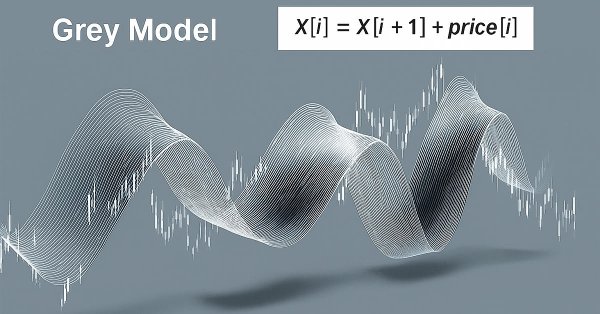
This article explores the grey model, a promising tool that can expand trader's capabilities. We will look at some options for applying this model to technical analysis and building trading strategies.
We extend the RQA library for MetaTrader 5 with JRQA, which detects when two series simultaneously revisit their own past states. The article covers the joint recurrence matrix, twelve JRQA metrics (including TREND and COMPLEXITY), dual-epsilon configuration, and a rolling-window engine with OpenCL acceleration and automatic CPU fallback. A practical indicator plots JRR, JDET, JLAM, JENTR, and JTREND for any symbol pair with timestamp alignment and normalization.
The article explores one of the most interesting non-gradient optimization algorithms, which learns to understand the geometry of the objective function. We will focus on the classical implementation of CMA-ES with a slight modification - replacing the normal distribution with the power one. We will thoroughly examine the math behind the algorithm, as well as practical implementation, and check where CMA-ES is unbeatable and where it should be avoided.
This article addresses the interpretative gap between visual chart objects and algorithmic execution. You will build a systematic detector that iterates over all chart objects, identifies analytical types, and normalises their geometric data (time and price coordinates) into a structured SChartObjectInfo array. The implementation uses raw MQL5 functions, a filter‑extract‑store pipeline, and a timer‑driven test EA, resulting in a reusable framework for rule‑based trading inputs.
A GPH‑based estimator for d, the key ARFIMA parameter, is added to MicroStructure_Foundation.mqh. GPHEstimator() computes d via log‑periodogram regression, while PopulateARFIMAAnalysis() stores d with an R² confidence score and validates the theoretical relationship H = d + 0.5. An empirical study on 72 US100 M1 sessions confirms pooled d = −0.006, consistent with the random walk boundary established in Part 2.
The article attempts to examine financial time series from the perspective of self-similar fractal structures. Since we have too many analogies that confirm the possibility of considering market quotes as self-similar fractals, this allows us to think about the forecasting horizons of such structures.
For our next Exploration on notions that are testable with the MQL5 Wizard we examine if Skip Lists and the Hopfield Network can give us a profit-guarding trailing strategy. Trailing Stop Management, as already argued, can be overlooked in most trading systems at the expense of Entry Signals or even Money Management. Trailing stops can make all the difference in certain situations such as trending markets, and thus we test this out with GBP USD.
Learn a practical way to execute MetaTrader 5 trades from Telegram voice notes using a Python middleware and an MQL5 EA acting as an HTTP client. The article covers architecture, WebRequest polling, in-memory queuing, JSON parsing with null-terminator stripping, and a constrained command grammar with a 0.001-lot default. You will configure the environment and validate round‑trip latency suitable for mobile data connections.